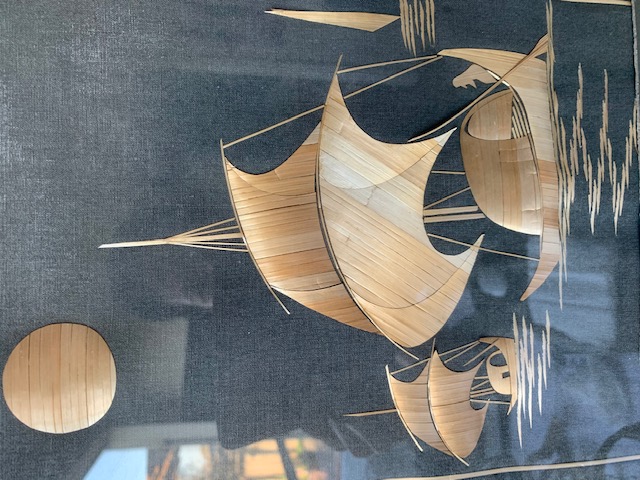
One of the pastoral scenes by a famous artist that I acquired in Bangladesh. A straw collage on black cloth.
Chapter 29
Dacca, Bangladesh
I had bought a round trip ticket to Dacca for a four-day excursion and got back to Vitoon's house just in time to pack my suitcases to go to the airport. Thai Airway's "Royal Orchid Service" began before departure with lavish food and drink from a traffic jam of stewards/stewardesses.
After we took off, I began talking to the Japanese businessman seated next to me at the window. He asked me if I'd seen the crash, and then went on to tell me that he'd seen a military plane crash at the airport as we left. I didn't see it, so it didn't bother me as I concentrated on what I'd find in one of the poorest countries in the world. He traveled the route often, and explained why the Hindus and Moslems took advantage of the lavish food and drink while they could before arriving at destinations where these luxuries are either illegal or unavailable. When the flight left Delhi on the return trip late in the day, supplies would be depleted.
When I arrived at Dacca on January 11, I sat down on a chair in a large room with many others to complete some form I was given. When I looked up, the contents of my case that I was using to write on were strewn all over the floor in front of me. I nearly panicked, but no one in the room filling out their forms even seemed to look up.
As I started to pick up all the brochures, receipts, and other papers from my journey, a man in an official-looking uniform appeared and kindly helped me pick things up. He then whisked me to the head of lines through customs and immigration. My red white and blue Bicentennial passport was apparently powerful.
That finished, he started to carry my bags out of the airport. I passed through a waiting throng, asking every man if he was Mr. Chowdhury. Finally, a man and woman stepped out of the crowd, greeted me, and we all headed for a waiting car. The smile on the face of the man who had helped me disappeared as he grimly followed us to the car. Rahman Chowdhury waived off my offer and tipped the man, hence the source of his disappointment.
Dacca was a small place compared to Bangkok. Life was slow and orderly and Rahman Chowdhury commanded much respect. He left his village in the North as a young man in disagreement with his father, the chief. He went to Calcutta and made his way on the streets. He joined the Royal Air Force during World War II. After twenty years, he retired and set up three auto repair shops in Dacca. He brought his four younger brothers through college and into the business. After a brief retirement in the United States, he had returned to help the business rebuild because it had declined in his absence. He didn't say it was mismanagement by his brothers, but I suspected.
Our car was a Hillman Minx, a British car that briefly got to the United States in the 1950s. It was a bit cramped and one day, we picked up a tire and drove it around town to be delivered to one of the shops. All of Chowdhury's customers were wealthy, trying to keep their aging European cars running in a country with few resources.
Dacca had few cars and broad streets. Cycle rickshaw taxis were the primary transportation. They crowded the right side of streets as we passed. We stopped at a small shopping center and Rahman got me a Coke, thinking that, as an American, I'd need a soda in my hand as we traveled through the city. I didn't, but obliged him anyway. Remembering Vitoon’s anger over water.
The Chowdhury home was located in a compound behind a bazaar. As we wound our way through the narrow passage of the bazaar lined with small shops and stalls, I was amazed at the paucity of goods for sale. For example, there would be two pair of well used shoes in a wooden box. While most people were barefoot. In the back, laundered clothes were stretched out flat on the ground to dry. Food was not in evidence and I think the Chowdhurys killed several of their chickens for my visit. Rahman complained of a cat that had frightened his pigeons—another source of food.
The Chowdhury compound was rather large and secured against thieves and occasional floods by a high wall that completely surrounded its two or three acres. When we arrived at the gate, it was automatically opened by an old man that Rahman employed living in a little gatehouse where the pigeon quarters were, above. He told me that he also employed a young woman who had been lured away from her village by a rickshaw driver who came there and told her father that he was rich. When they arrived in Dacca and she became pregnant, he tossed her away. Servants were easy to employ in a city with so many in need.
Lillie was clearly the head of the household. The large sprawling and very comfortable, California style, home had been designed by her. Filled with souvenirs from their time in retirement in Houston. She was very beautiful and quite young. It was hard to believe that she had a son beginning his doctorate studies in the United States. I was escorted to a very large guest bedroom with its own shower with in-line heat like the one in Karachi, an energy efficient way to heat water, a German technology not available in the United States at that time.
Three nights I was served a curried chicken on rice with peas. It was toned down for my American taste and was quite good. On the second night, we drove to the downtown area to another compound with an open gate and a lobster sign over the arch in the gate. It was a Victorian mansion converted to a restaurant for the wealthy. Austere by American standards, I don't recall what I ate there, but I doubt if they had any lobster.
I didn't see any starvation except for the slow pace of life, and the general thinness of the people. What I remember was the peace of the streets, with thousands going about their business without the roar of motors and diesel fumes. At night, each cycle rickshaw carried a single kerosene lantern, hanging from the back to ward off collisions with cars. Passing hundreds of these taxis at night with their lanterns swaying with each rotation of the driver's feet, was a silent sight to behold, almost romantic, a sea of lights in perpetual motion, flowing along the thoroughfares and around the many squares and traffic circles.
Chowdhury was not impressed, either with the condition of the laboratories in the national university he took me to, to show off, or with the deteriorating condition of the old city, the lost legacy of British grand colonialism. While there were beggars, young and old in every city I'd visited, here, young emaciated women would approach cars with young babies, holding them out in the hope of a handout for food. Most men were so poor, barely able to feed themselves, that when they got a young girl pregnant, would reject her and the burden a baby would bring. Similarly, her family would throw her out because she got pregnant and threatened the existence of the family. Most women were held in such low esteem that they and their babies were outcasts, beggars in the streets.
The headlines of the daily papers included how many wood cutters had been killed by tigers since the first of the year in the Sundarbans, the mangroves of the delta of the Ganges and other rivers flowing into the Gulf of Bengal, and how much foreign aid the country had received, its primary economy. That kind of money was building a brand-new Intercontinental Airport. For the foreign money to come to the country more quickly.
For the rich like the Chowdhurys, it was a different story. Elaborate searches and lengthy and costly ceremonies insured that the marriage of young men and suitable wealthy young women would be successful. In fact will, these arranged marriages seem to endure when the open, love driven marriages we Americans favor, so often fail. Raj was in America, where the temptation to marry the American way was great. So there was urgency in Rahman's purpose for taking me around Dacca.
First, I had to check in with Immigration within two days. It was only a formality, but perhaps to insure that my purpose was only to tour. The rooms in the building were large with little furniture. The one I needed to go into had several men in it and a few tables. When I approached the table with the official I was to see sitting behind it, a uniformed man who was sitting on the only chair there got up and offered it to me. As I nodded in appreciation for his generous gesture, I could see that his face and uniform insignia showed that he was a Chinese officer. Chowdhury explained later that the Chinese were building a road from China to Bangladesh through Tibet.
We went to visit the head of the country's power company. The office of the company was more like a very large home. As we climbed the stairs to the upstairs floor where the office was, Rahman suddenly was out of breath and coughing. Made me regret giving him a carton of duty-free cigarettes I bought on the plane flight there. I sat in the back of the huge office while Chowdhury conferred with the rich CEO father of a potential bride. "She's ancient!" He muttered as we left.
That evening, we went to a new part of town to the home of a movie producer. The home was large, beautiful and appeared to be brand-new. Inside there was a crowd of people, perhaps a party going on. Movies are very popular with the people of the Subcontinent. And very lucrative from the Hollywood style of this home. While Lillie and the women conferred in back, we sat with the producer and his two college-student sons in the front room. The meeting was cordial, but when we left, Chowdhury was upset that the girl had hid herself away and he hadn't seen her.
The next day, we left the city for a tour. Our car was changed for a better one to make the trip but I don't remember what kind it was. We stopped for a picnic at the National War Memorial, recently finished to commemorate all the people who had lost their lives in the war with Pakistan in 1971. Raj told me that his father had him leave the city. Up ahead on the road he and others met the Pakistani Army coming their way. They hid in the ditches by the road, breathing through straws, until the Army passed.
There were very few cars on the road. We saw one only every half hour or so. When we passed a bus stop, there appeared to be about three hundred people waiting. Buses were stuffed to the ceiling and young men would ride on the roof, fenders, and hood. Travel was torturous for the poor. I wondered how long that crowd would have to wait for a ride.
Everywhere, men were hand watering small crops of rice by receding water holes. They would do this by two men swinging a sling into the water and then back out in a continual fluid motion that required very little energy and probably, food. Perhaps a glassful of water each swing. We passed the entrance to a jute factory where I was told about 50,000 people worked. Jute was the ubiquitous grass that grew everywhere during the rainy season, and then, dried out.
The landscape was picked clean during this winter dry season, and everything was barren except for the many islands of woven jute houses, little villages that dotted the landscape on higher ground. When the monsoons come later in the spring, everything would flood except the islands. When cyclones roar up the shallow Bay of Bengal, these fragile houses wash away, only to be picked up and reconstructed again.
We drove to the edge of the "jungle," where tigers were reputed to roam, but here, too, woodcutters and the dryness of winter had decimated the vegetation. We returned to Dacca to one of the several rivers that run through the city. Everywhere on the channel there were numerous boats in full, white sail. There were pull paths on both banks, but the wind enabled all traffic to sail on this day. Even with all this traffic, no motors were heard. It was an eerie and incredible sight rivaling the rickshaws at night.
Chowdhury stopped at a warehouse by the river where he often bought fish, but was disappointed because it was closed. We drove home without fish. I continued to eat chicken but the experience had improved my stomach from Thailand. There was no catching any Maharaja's revenge on that trip. Thank goodness.
Too soon, my four days were up. Chowdhury complained. "Why don't you stay two more weeks? We will take you down to Chittagong to the Red Beach." Apparently this was a pristine area where the wealthy could go and spend time like the beach resorts in Thailand but much more primitive and enjoyable. Recently, the beaches been used as a place to salvage ships from all over the world for the Bangladesh steel industry. The pristine beach it is now sullied by oil and chemicals from the ships as well as their hulks rusting in the sun.
Instead, Rahman took me to the Intercontinental Hotel at the airport before I flew out. It was the only suitable hotel for foreigners at that time. While there, I bought two beautiful straw images on black cloth by a famous Bangladesh artist. I still have them hanging in my office bedroom.
The rest of the story…
After I returned to work at West Virginia University, the search continued for a suitable bride for Raj Chowdhury. One day in March, he came up to me excitedly and showed me a picture of a 14-year-old girl. "I saw her once before I came here in London, but I don't remember. But she's the girl I'm going to marry." He smiled broadly at the prospect.
True to his word, in August he invited us over, faculty and graduate students, to the old brick house he occupied with other students on a hillside to the 4 pm wedding by telephone with London. When we arrived, he embarrassingly apologized, saying that he had to quickly call Mahfooz over so they could complete the ceremony that was being held at 4 pm in London but 12 noon in Morgantown, West Virginia.
We partied anyway. Most of us out on the second floor deck of the old brick building. Not only were we on the second floor, but the area below the deck, like so many buildings in that hilly town of Morgantown, dropped off steeply into a deep ravine. Later, upon hearing of other decks like that collapsing, we were fortunate there weren't more of us.
It was some time before his bride, Shammi, now 18, could come. I believe it was in November when she was scheduled to arrive and I offered to take Raj on the ten-hour drive to Kennedy Airport to pick her up.
The drive was not without incident because I was pulled over on the New Jersey Turnpike for having someone of brown complexion riding in my car with me. The state trooper made a point of going to the passenger side after we pulled over to question Raj. It wasn't long before he found that we weren't involved in crime and let me drive off, with an impression of how police felt about different races in the same car.
At the airport, waiting after the airplane arrived, Raj was a nervous wreck. I hadn't seen him smoking before. The jumbo jet from London emptied out and there was no Shammi in sight. He grew increasingly worried and questioned an Indian woman in a sari if she had seen a girl on board crying. Finally, in a blue green pantsuit, with a scarlet blouse matching her lipstick, the bride came off the plane and shocked Raj by her beauty.
Hardly a word was said as Shammi rode between us on the way back home. While Raj was normally quite talkative, he could only occasionally glance at her, now his bride. She spoke in a beautiful clipped British accent. We stopped at my twin brother's house with his family of two girls and rested a bit before driving the long way in the mountains to get back home. By that time, Raj had acquired an efficiency apartment in the medical center apartments for them to live in.
A short while later, Raj told me that he wanted an American wedding, too. I agreed to have it at my cottage. There was also a master's degree student who was a Presbyterian minister who agreed to conduct the ceremony. They got an American marriage license and took their tests. We had a wonderful celebration with me as a witness at my cottage with all the students and faculty from the department present. I believe it was in December, because it snowed quite a bit.
Like the rest of us, Raj got his doctorate and got into academia teaching in colleges. He moved up quickly in the ranks while having two children with Shammi, and her going to school for her degree. He eventually became dean at three schools and is now Dean and Professor, emeritus, at Kent State University in Ohio. Both of his children are college graduates on their own.
Copyright 2020 © Ronald W. Hull
2/2/21