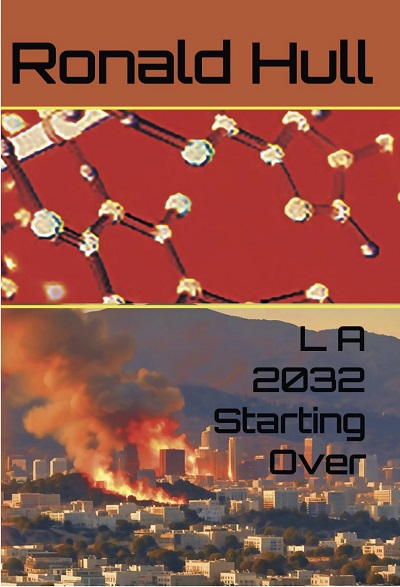
Rain like this was to be expected. The United States Congress finally got its act together in 2025 and passed the historic War on Climate Change bill. The law changed everything as far as the direction the government was taking towards eliminating fossil fuels altogether with a combination of incentives and rebates. Also, allowing business and individual taxpayers to finally be able to literally get off the grid.
Most didn't and retained their grid connection to the various electric providers and producers, who had to all be 100% carbon free except for their equipment manufacture requiring some fossil fuels to be processed and made for the effort.
As a result, by the New Year 2033, about 80% of the homes and businesses in the greater Los Angeles area had solar power equivalent to daily usage. With about 60% having battery storage of one kind or another for up to three days without the sun. Making our job easier when renovating property for the village to grow.
Only about 40% of the homes and businesses had wind power, largely because of the danger involved even though the installations were usually on rooftops away from all but occasional workmen. Both solar arrays and windmills were subject to damage from ice and snow and the occasional windstorm that had become much more severe, like the hurricane of midsummer 2032.
When United States finally followed the rest of the world in 2025, it was already too late to stop global warming and the consequences to the climate. Megatons of methane had been released from the melting permafrost, warming oceans of the polar regions. A condition that only a drastic reduction in the using population, like the pandemic of 2032, created any hope that humankind and all life on the planet would make it to the year 2100.
Our fathers and the Hutchins and Jones Construction Company had shifted gears from making earthquake tolerant high-rise energy consuming buildings to massive solar, wind and water retention projects all over the LA area since even before 2025. Derek and I were masters at this kind of construction and recycling demolished construction materials; we had made our compound and the port nearly completely off the grid after the pandemic and never stopped.
So, drought like we had the summer before stretching well the beyond normal November rains had become the new normal during the latter 20th and the earlier 21st century. Like the hurricane and the flood aftermath, as well as, the January flooding now. We had to be prepared for all kinds of weather never experienced before. And come up with ways to stop erosion and landslides.
The urgent need was for roads to be maintained while flooding continually eroded them. But all we could do during this rainy weather was haul gravel to fill the collapsed areas of the streets and clean debris out of storm inlets that were dammed by it. Under the current conditions, pouring of concrete and proper repair would have to wait for warmer, sunny days to come.
But the shortest way between the compound and the port had to be kept open because our babies and their mothers needed access to the medical center and our daily work required a lot of commuting back-and-forth. Especially for town meetings every Friday night.
It took us two weeks to get the roads open to the port with a combination of detours and with makeshift repairs. But those repairs had to be constantly maintained while it continued to rain.
The good news was that all of our catchment systems had full cisterns by January 10. But we were beginning to think that we needed to more than double that capacity if we were going to make it through the droughts to come. More and more I thought about bringing water from the Los Angeles River, but those thoughts had to be postponed to meet what was currently demanded.
Derek and I had a hard time setting schedules with so much to be done. Fortunately, we gained volunteers to do the work almost every day requiring them to be taught how to do things they did not have experienced skills in.
More good news was how well the space-based, solar powered, and AI-run satellite Internet grid worked and continued to provide G6 connectivity to everywhere in the world. While many business websites disappeared, many stayed open, run by AI for the foreseeable future, allowing searches for almost anything to continue. Even defunct local businesses that could be scavenged or renovated.
Email spam and scams nearly disappeared and there were no more irritating software updates or requests for monthly payments for services no longer rendered. Without updates, software and hardware lasted much longer for users. Wondah estimated that there was enough in stores that weren't looted, homes with no occupants but the dead, and warehouses to last the village until the end of the century.
The same was true of most consumer items. We formed a recycling committee to determine what to do and how to keep recycled demolition materials and even consumer items that wore out or were broken. Regulations prevented putting anything in the sewers except biodegradable materials like sewage.
Plastics and electronics were warehoused for the possibility of future recycling. Animal dung was gathered and used for fertilizer along with bones and unused parts from both animal and fish processing. Plant and vegetable waste for cooking processing was routed to compost bins that we constructed for every garden in the entire compound and the village. A natural way to make fertilizer and maintain garden soil health.
Similarly, everywhere we processed meat, like the Santa Monica pier in the fish market, we built smoking sheds from salvaged lumber and created smoke with salvaged wood that littered the beaches. We scavenged drying appliances, radiating appliances and ways of canning fruit for storing harvested garden seasonal abundance.
Throughout the village, individuals took upon themselves to create small businesses and even commandeer some of the nearby shopping centers to set up those businesses like hair salons, taverns, restaurants, martial arts studios, and the like. Restoring the monetary system for these businesses seemed paramount.
When the community met the first Friday in January Mayor Roberts had on the agenda the establishment of a fire department at the defunct port fire department where much of the equipment had been vandalized. Some former volunteer firefighters and former Fire Chief, Eric LaRosa, 33, of the Torrance, Los Angeles Fire Department #1 volunteered to start up his department again and get the Harbor Department #40 working on the water right at the port.
Also on the agenda was the establishment of a money system. Everyone agreed to sticking to the United States way of doing things, financially. Locally, there was a credit union and branch bank.
Fortunately, in the village was one bank vice president of the Golden State Bank & Trust, Dorothy Chung, 47, and two employees of a credit union, one manager, Elsie Cook, and a cashier Henry Hines. They were already part of the financial committee. They were charged with reopening the Seafarers Federal Credit Union to serve the financial needs of the community. It was agreed to continue bartering, but also to allow the use of cash and checks, for now, to do financial dealings.
The financial committee decided they would oversee the operation and make corrections in the rules as things progressed. It was not known if major national banks or even brokerages, were still in business. Some of their websites still operated. Wondah was charged with finding out if any of them were still doing business. I doubted it.
It was agreed that any wealth that the community gathered as a whole, either by salvaging, scavenging or by earning, would be shared equally among the citizens of the village. That included treasure that could be located, but not hoarded, by individuals.
It was a difficult task to oversee, but necessary if the village was to grow economically and to join the rest of the United States in commerce again. More connections would be made with other parts of the United States and the world that was, hopefully, recovering. Some would be useful for us.
Meanwhile, all of our water catchment systems were overflowing and there was much need for more wind turbines because the dark skies made power production with solar panels sketchy.
Still, the thought of a safe and stable water and sewer system stayed on my mind. How would I accomplish it along with all the other renovation and restoration projects that our firm would have to take on in the coming months, rain or shine, I didn't know?
Copyright 2023 © Ronald W. Hull
12/16/23