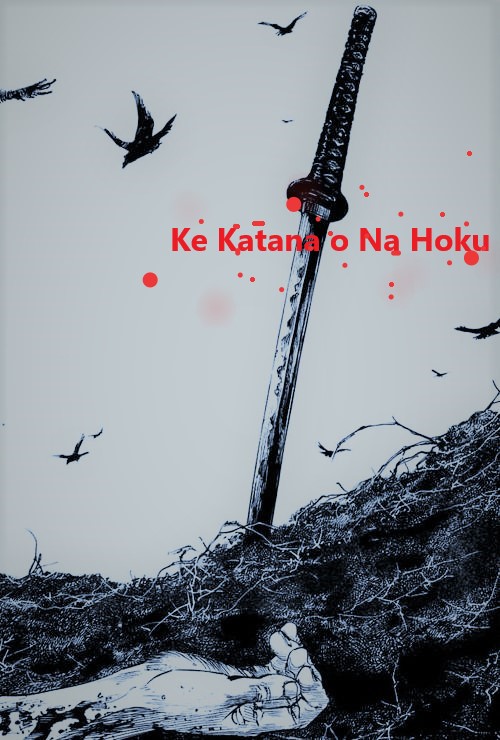
Ke Katana o Na Hoku
Umi‘maka
Captain Cook is often credited with the discovery of the Hawaiian Islands, but Hawaiians would scoff at that idea and might add that the first foreigner to visit the islands came centuries before him. This was a visitor from the Far East. Genealogies speak of an earlier shipwreck. Centuries later, diaries left behind by Captain Cook himself verify the legend of a magical staff that was unlike anything Hawaiians had seen. It had the properties of mana from heaven and shone in the light as if it were supernatural. It was sharper than a shark’s tooth and was believed to be magic. There are those who whispered of a Japanese shipwreck in the 1500’s. Most of the men perished. What was left behind was thought of as having magical properties to the native people, the Kanaka Maoli, who had never seen metal, much less a samurai sword. The year is unknown, but the Hawaiian Islands had been involved in centuries of inter-island wars pitting chief against chief. Clan against clan. Hand to hand combat was common, and the fighting was that much fiercer because of the blunt weapons used. Tiger shark teeth and wooden spears. Marlin bills and large stones. Fish used not as swords, but daggers. If stabbed by one of these daggers, the bacteria would cause the cut to fester, eventually resulting in an infection which would kill even the largest warrior.
The air had just a touch of trepidation hanging in it, or was that death? How many would bleed out before the day was done? There were apparitions on the horizon, fierce mirages, and it seemed as if the underworld might merge with the living. Umi‘maka couldn’t tell as he peered over the rock wall. Although the day had not yet begun to get hot, Umi‘maka had cold feet. The invading Hawaiian army members were merely the size of rodents, but they had already tripled in size. They had gone from ants to beetles to small palm rats. He could hear in the distance the beat of the pahu drum. They were coming like an advancing storm.
Most of the morning, the army had been advancing the pali, a steep hill-like cliff with only one way up and down. Kalaunuiohua’s men were coming, and a savage battle would most certainly ensue. Umi‘maka was only a boy, not even thirteen. He looked down at the opposing army of men. He could feel the hair stand up on the back of his neck. The army was small, there were certainly fewer of them, but they had Kalaunuiohua and his magic ko‘o stick. In truth, he had never seen the magic ko‘o but had heard stories of how it could slice through flesh like a shark. The staff was said to glisten and shine like the stars in the sky. Akoni had told him the ko‘o stick was made from something not from this Earth, or at least not from these Polynesian islands. It was said the stick was unbreakable and could give a man advantage over ten.
For over a century, the kahuna had prophesied of a warrior king who would move the islands themselves. Some had interpreted this as unifying the Hawaiian Islands. Of course, this was hundreds of years before the Lonely One, Kamehameha. In the 1500’s each island was an independent kingdom. It sounds funny to speak of Oahuans and Mauians, but they were yet to be Hawaiians. Eventually the name of the biggest island, Hawai‘i, would be used as the name for the entire group of islands. The battle recounted here occurred well before then and was between armies from Maui and the island of Hawai’i.
The advancing Hawaiian army was closing in; Umi‘maka’s eyes meandered across the crowd in search of the magic stick. Some of his men from the island of Maui were doing a dance and a chant, a haka, but he thought they seemed scared. He peered over the rock wall. The magic ko‘o did not appear visible. Did it even exist? He knew how stories got started. There was a legend already centuries old about a child who would be born and would overthrow all the high chiefs. A chosen one, so to speak. Was Kalaunuiohua the chosen one? The snatcher of the land? Was the ko‘o stick even real? Maybe it was all rumors and legends.
The drums of war beat louder now; it was deafening, and Umi‘maka could feel his hands shaking. The Mauian warriors were getting into position. Umi‘maka saw several of his men preparing to roll large boulders down the hill in the hope of incapacitating some of the advancing Hawaiian warriors. The Hawai‘i warriors were now the size of large gulls, and they were advancing rapidly. Several men rolled large boulders that bounced down the hill; Umi‘maka saw in the distance a warrior smashed by a stone withering to the ground decrepitly. His men were yelling and Umi‘maka felt oddly out of place. The long pololu, which are fifteen-foot spears, were being lowered.
“Kali, ho, kali,” Umi‘maka’s chief yelled. He was telling them to wait, stop, wait, but the battle had already begun, and chaos ensued. The opposing Hawaiian army started sprinting into no-man’s-land, the area where most of the bodies would lie after the battle.
The Hawaiian army was getting close now, and Umi‘maka’s men let go a final barrage of rock. These rocks did less damage than the larger ones but tripped up and disabled dozens of warriors. The opposing Hawaiian army was gaining speed; running now, they crashed into the rock wall, many being impaled by the dozens of lowered long spears. Umi‘maka felt his blood run cold as a Hawaiian warrior dashed over the wall and was eviscerated by a short ihe spear. The warrior crawled forward, only to collapse on the mound of stones, his blood slowly washing over the rocks like a sacrifice. Warriors started flooding over the wall. One swung his lei-o-mano, a club with tiger shark teeth sewn to it, and missed Umi‘maka’s head by inches before the warrior was impaled by a spear. Umi‘maka immediately retreated as the dust and blood began to rise like a smoke mist above the living. A young warrior ran around screaming as his arm was dangling by several tendons about to fall to the ground. Blood sprayed and erupted from bodies like the magma from the giant volcano Kilauea on the Big Island of Hawai‘i. Umi‘maka had seen the lava flows of Kalapana as a child. He was terrified of Madame Pele and the volcano. He feared she would strike him dead.
Umi‘maka was grazed by a spear on the shoulder. As he fell onto the rock wall, warriors stepped on him and pummeled his face into the lava rock. He bled from the shoulder, chin, and forehead. Through slightly blurred vision, he saw another warrior attempting to end his life, lunging fiercely at him, but he dodged the attempts, wiggling like a worm upon the rocks. The warriors were eventually pushed back by a scrum of men, who drove the opposing warriors back over the rock pile and slightly down the hill.
Umi‘maka had a moment to collect himself, however it was only a moment, before another warrior stumbled over the wall. The warrior had a large incision near his rib cage. Umi‘maka hoped he wouldn’t look at him, but the warrior set his sights right on him. He let out some terrible roar and raised his spear to hurl it. Umi‘maka writhed to the side, causing the spear to miss him by inches. Then the dazed warrior moved in for the kill. As he got within an arm’s length, Umi‘maka raised his spear, impaling the warrior. Blood washed over the rocks and onto Umi‘maka’s knees and legs. Umi‘maka’s head was swimming. He could barely stand. He crept to the top of the wall, peering over at the battle taking place. Bodies were strewn every which way, in some areas in piles on the ground.
And then as some of the dust of the dead settled, he saw a tall Hawaiian emerge. He was carrying a long silver blade. Umi‘maka felt a lump in his throat.
It was him.
Kalaunuiohua was a towering Hawaiian, standing over six feet, six inches. He swung the magic blade and a man’s arm was instantly severed from his body. Umi‘maka couldn’t believe it. It was real. The magic staff was real. The legend was true . A god walked among them. It was so surreal; Umi‘maka felt as if he were dreaming. He pinched himself, but he did not wake. Kalaunuiohua walked among the warriors like a god, and few even tried to engage with his magic blade. Umi‘maka watched as those few brave men’s limbs were severed. He watched as Kalaunuiohua advanced upon the wall like Kukailimoku himself, the god of war and governance. Umi‘maka could not believe he was witnessing this; he couldn’t wait to tell Akoni. He peeked over the rock wall again. The last thing Umi‘maka saw before he was cleanly decapitated was Kalaunuiohua’s blood-speckled face. The chief did not smile at him or even offer him any last condolences. The blade flashed through the air. There was the sound of swoosh as the blade cut oxygen and perhaps atoms in two, and there was a split second of sharp pain, and then Umi‘maka was no more.
Kalaunuiohua
Kalaunuiohua cut the boy’s head clean off and advanced his army over the rock wall, leaving the decapitated body to bleed all over the rocks. Victory was all but certain with the sword of Kaluiki-a-Manu. He thought little of the lives he took with the sword or of Umi‘maka or the short life he had lived. What he thought about as he cleared the blood from his samurai sword was the day he had taken the magic stick from the chief of Maui and that strange foreigner with the pale skin. The islands of Maui and Hawai’i are very close together, particularly the Hana district on Maui and the Kohala district on Hawai‘i. These chiefs were constantly at war. Kalaunuiohua was a chief from Hawai‘i and Wakalana was a chief from Maui. On the island of Maui, Kalaunuiohua and his men were able to ambush Wakalana and his army and a strange-looking man named Kaluiki-a-Manu, who had pale skin and looked as if he had crawled from the depths of the ocean.
It was during the time of ho‘oilo, the winter season, and the rain crashed from the sky, making the trail muddy and hard to manage. The two warring chiefs had battled for nearly a lifetime, but this time they had a secret weapon: the magic staff. Its power was legendary. It was believed the warrior holding it would unify the islands and be the chosen one. The kahuna said it was gifted from the gods Kukailimoku and Kanaloa themselves, straight from the bowels of the underworld, and was made of a wood that could not be broken. This phantom wood glistened like the fish on the reef but was far more mystic and ten times deadlier. It conjured the idea of other worlds, where gods fought among men, but now it had come to this world and Kalaunuiohua’s islands.
Wakalana and his men were coming up a steep pass near Hana. They were only a few miles from the area known as ‘Ohe‘o or the Seven Sacred Pools. In the distance there were several waterfalls foaming and frothing. With elevation, Kalaunuiohua had the advantage. Looking back, Kalaunuiohua thought it was strange, but Kaluiki-a-Manu did not move like a kanaka. He had been trained elsewhere on another island far away. He was shorter and more compact, and his skin was like that of a god, which only increased the number of whispers throughout the islands. Kaluiki-a-Manu’s skin was lighter than any skin Kalaunuiohua had ever seen. Was this strange man with light skin from the underworld or from the stars? he wondered. Na Hoku?
Kalaunuiohua could not believe his eyes when peering down through the dense foliage he saw Wakalana and the pale-looking man with the magic staff. It was true . As the stories said, the staff was immensely thin and it shimmered when the lightning crashed across the sky, like something not of this Earth. Peering at the blade, he wondered what sort of phantom wood this staff was made from. The ambush would need to be quick if it was to be effective. His battalion split into three. Some doubled around to surround the enemy, and then several would drop from above onto the path. It was to be a three-pronged attack; with any luck Wakalana would never see it coming.
Kalaunuiohua estimated Wakalana had about thirty men. He outnumbered Wakalana by about ten men, but then again, they had the blade. He motioned with his hand for the men from above to position themselves as the rain continued to beat down. He knew it would make the fighting hard; an opponent or oneself could slip or stumble, and that slip or stumble might cost you your life.
He picked an area where a long plateau swung out hundreds of feet over the ocean. It was here that they’d set their trap. The ground was rocky, but flat enough for a small battle, plus Kalaunuiohua and his men would have the higher ground.
As the rain poured down, the warriors trudged up the muddy path away from Hana, not knowing most would be dead by nightfall. The ground was slick, and their feet sank down into the mud as they sloshed puddle after puddle.
Suddenly, one of Kalaunuiohua’s men catapulted down from a low-hanging branch. As he landed, he raked at a large puddle with his spear, splashing filthy water into his enemies’ faces. He quickly whipped out his piikoi, which was like a Hawaiian mace made from hard kauila wood and the large intestines of a slain enemy. These intestines had belonged to a great chief and they had much mana or power. He swung the mace over his head thrice and let it fly, knocking one of his enemies in the head and causing him to fall unconscious to the ground.
As more of Kalaunuiohua’s scouts dropped from above, the samurai warrior, Kaluiki-a-Manu, dropped to his knees. There was a moment when it looked as if he were praying. There was a flash of lightning and then the blade moved faster than lightning across the skies, and the man holding the piikoi was sliced in two at the mid-section. The two pieces fell to the ground separately. The other three managed to stay alive for a few more minutes of the battle. One of the other scouts was driven over the ledge by a large warrior, and plummeted hundreds of feet to his death. The second of the last two scouts flew his spear right at the head of Kaluiki-a-Manu, but the pale-skinned Japanese man again went low to the ground and cut the spear out of the air with his blade. He then leapt into the air like some Japanese superman, and cleanly sliced off the arm of the scout who had thrown the spear. The scout pulled his shark-toothed dagger but was pierced by several spears, one of which quickly ended his life. The last scout tried to move to the left, then the right, but found the blade right at his chin.
“Summer grasses,
All that remains
Of soldiers' dreams,” said the samurai in a strange language. He smiled slightly. The scout could not understand him. He accepted his fate and rushed at the samurai only to be mowed down by the blade.
Kalaunuiohua’s battalion got there too late. His scouts were already dead, and it was only through luck he would manage to stay alive. As the two battalions clashed on the muddy precipice, several warriors from each side were thrown over the side. The warriors clashed as one of Kalaunuiohua’s men cracked an opposing Mauian on the top of the head; the man lay unconscious or dead in the mud. The large warrior carrying a neva, which was basically a small hard wooden club, continued his assault, swinging the club at knees and dropping two more of Wakalana’s men.
The battle raged on, but as spears flew, Kalaunuiohua was aware that the men were thinning, as the short, pale foreigner had managed to slice his way through half the battalion. One by one, he cut them down with the magic staff. Kalaunuiohua had to act quickly while there was still time. He broke from the warrior formation (which was strangely a lot like the way the Spartans went into battle) and arched around the back of his battalion. In the melee, with the rain pouring down, he could barely make out the glint of the magic staff Kaluiki-a-Manu was carrying. Yet he rushed into the maelstrom. As he rushed toward the battalion, he stumbled twice almost falling to his knees. He had to dodge to the side, as his shoulder was clipped by a spear that was hastily thrown in the high winds. The spear struggled to right itself and bounced off him and cascaded over the edge, which Kalaunuiohua was merely a few feet from.
As several of Kalaunuiohua’s men bombarded the foreigner, Kalaunuiohua saw his chance. Leaning back in the mud, he used his spear as a pole to vault through the air perpendicular with the ground. For a split second, he was hanging over Wakalana’s battalion.
Then, it all happened too fast; in mid-air he grabbed his pahoa knife to attempt to slice the foreigner’s neck, but several other men advanced at the same moment. A scrum of about seven men spilled to the ground in the mud. In the scuffle it was hard to know who was on each side. From beneath, he sliced Wakalana’s main artery in his leg, thus incapacitating him and ending his life slowly. The warrior collapsed to the ground unable to walk. Kalaunuiohua slammed another man to the ground, slicing his jugular. As the battle continued, both sides were running out of warriors. The foreigner cut a man down at the ankles, slicing his feet clean off. The man howled in pain against the wind. Kalaunuiohua grappled with the samurai, but he was wiry and quick, and it was clear he had years of training. Kalaunuiohua tried to grab the samurai around the neck as he went down, but the foreigner slipped loose. From the scrum he continued to grapple with the foreigner, attempting to cut him the way he had cut Wakalana. The foreigner, a skilled grappler, easily slipped out of his hold and stood before the men with his magic blade to the sky. As the lightning flashed, the blade caught its light and seemed to glow supernaturally. Two more warriors rushed at him, but Kaluiki-a-Manu made quick work of them, decapitating the second one. A head rolled between Kalaunuiohua’s legs, and for the first time ever in battle, he feared he might be next. The blade seemed to make the foreigner invincible, as though he were a god. Even though it was hard to stand, Kalaunuiohua faced off against the foreigner. Kalaunuiohua was much taller; you would think he’d be able to break the foreigner in two. Then the foreigner did something that puzzled Kalaunuiohua. He lowered his sword and again dropped to his knees. Kalaunuiohua did not understand what was happening; he was not used to warriors who surrendered before the battle was over. The truth was that Kaluiki-a-Manu had crossed many worlds and was weary. He longed for his home. Wakalana was dead, and the foreigner’s fight was over. He turned the blade around and committed what is known as hara-kiri, stabbing himself through. He began to bleed out. As he fell to the mud, Kalaunuiohua was still in shock. He approached the foreigner, rolling him onto his back. Although Kalaunuiohua knew the honor of battle, the foreigner’s action confused him.
“Why?” he wanted to ask him, but the foreigner was already slipping from this world.
Kalaunuiohua pulled the magic staff from the foreigner’s dying body, and cleaned the shimmering blade of blood and mud. Holding the sword, he could not fathom what it was made of. It was truly a magic staff. He marveled in how light it felt. It took almost no effort to swing it, and it seemed to carve out a magical path of its own through the air. He swung it through the air and felt his mana rise. With this blade he would make the prophecies true and move the islands themselves.
Wakalana
Wakalana remembered the day he had pulled the foreigners from the angry sea. It was during a tremendous storm. On the northeastern coast of Maui, the rollers were cranking that day, exploding off the shelf and sending up a mist, an ehukai. Between the storm and the sea, Wakalana could barely see. As lightning forked across the sky, Wakalana and his men spotted the ship. Where had they come from? They hadn’t been there a minute ago. They were headed for a cliff and would surely be dashed against the rocks. Wakalana and his men got there minutes after the ship had struck the rocks. With great effort and almost drowning in the process, they fished the foreigners out of the water. They were practically naked, except for one man. Man? Could you even call him a man? He had something which looked like a spear but glowed and glinted like the sun. What was the spear made of? He had never seen anything like it. The man with the spear was clearly the chief. He had on a strange loincloth that completely covered his legs and the magic ko‘o was strapped to his waist. The foreigners’ skin was bruised and battered, but even still had a strange-looking color to it. It was fairer and had a different hue. And they had lighter eyes. There were five survivors all together, three men and two women. Again, if could you call them men and women. They were much smaller. Wakalana, being a chief, was well over six feet; these creatures were more like a cross between elf and human.
Wakalana carried one female in his arms as she was unable to walk. She had small breasts and a dark black mound of pubic hair, which was accentuated by her pale skin. She had the parts of a woman but was noticeably smaller in stature and height. She was so battered and badly wounded, she was barely conscious. Wakalana deemed they should be brought back to the village, and kapu was placed on them, so that no one would harm them. There they were nursed back to health, salt was rubbed on their wounds, and they were fed heartily a diet of fish, sweet potato, and taro.
It was a time of ‘olu. There were many storms and crashing waves, but that didn’t stop the Hawaiians from making sweeping raids on the Mauians. Chief Kalaunuiohua, from the island of Hawai‘i, and his warriors came ashore and burned most of the Hana district. Wakalana went to battle, but still weak, the fair-skinned foreigners had to move inland for many months. Wakalana visited the man he knew was a warrior, and hoped he would eventually help them with his magic ko‘o. Although he thought their customs and traditions were alien, he did his best to make them feel welcome. He had heard stories of migration and knew his ancestors, like the pale-skinned visitors, had come from across the water. Wakalana could not communicate with him except by what might be considered a primitive form of sign language. He would point at something and then they would both say a word. When they tried to talk, it was extremely confusing. He did know the pale-skinned foreigner called the magic ko‘o a katana. He had seen him use it a few times and marveled at how quickly it could slice through things. It was truly a weapon of the gods. The more he asked about the sword, the fewer appearances it seemed to make.
“Kanaloa?” Wakalana questioned. Kanaloa was the Polynesian god of the underworld.
The pale-skinned foreigner looked at him puzzled.
“Ku?” Wakalana questioned, pointing at the sword. Ku was the Polynesian god of war.
The foreigner drew a strange symbol in the dirt that Wakalana did not seem to understand. It looked a little like a fishhook, but Wakalana didn’t think that was its purpose.
“What for?” Wakalana pointed at the fishhook-looking thing that the foreigner had drawn in the dirt. Maybe it was a constellation like in the sky, Wakalana wondered.
“Wakea?” Wakalana said pointing to the sky.
The foreigner stared at him blankly.
They had many, well, I don’t know if you could call them discussions, but there was some communication. And although they could not communicate well, the pale man had told him toku (the Japanese word meaning profit or gain). Wakalana had interpreted it as hoku. Wakalana wasn’t sure, but he supposed that they could have come from hoku (the Hawaiian word for the stars), but he did not think a god would be as small in stature. On the other hand, that certainly would explain the magical weapon that he wielded. The katana. Wakalana was in awe of it. What kind of wood was it made of? It looked as if it were made of water or something liquid, yet it was surely far stronger than ohia or ironwood. He had seen it slice clear through a spear without any trouble. He wondered what else it could do. Did it possess magic? Maybe fire from the volcano? Or lightning from the skies? He knew of a place across the water on the island of Kaho‘olawe that might answer more questions, but he needed to get permission to take the foreigner there. It was called “the path to Tahiti” or Kealaikahiki. It was a school, but there was also a star compass there, and he thought someone there might be able to explain where these foreigners came from.
He sent a runner to ask permission from the island’s ali‘i nui or king. He would also need several kahuna to escort him across the channel to safety. Surely, the gods would smile upon him for this visit, or so he hoped. He readied his canoe for travel and sent word that he would be off the island for the next few days. He sent word to the foreigner that they were to make a journey across the water.
The night before they left, the pale foreigner from faraway said goodbye to his people. Were they people? They couldn’t all be gods. They were so timid. The females were near death when they had been pulled from the surf. Wakalana did request that the foreigner bring the magic staff with him. He could tell the foreigner was hesitant, but eventually agreed.
The canoe trip did not take very long at all. The waters were calm, and as they docked on Kaho‘olawe, a sunbeam came down through the clouds seeming to light the way. They were at the northwest tip of the island. They had landed on what was said to be the kinolau, the body form of the Polynesian god of the underworld, Kanaloa. It was the exact center of the Hawaiian Islands.
The ground was rocky but fairly flat for several hundred yards, eventually rising several hundred feet. The star compass supposedly was located near the peak of the southwest tip of the island. As they hiked along, there were strange melted rock formations on the ground and enormous boulders here and there. The man leading the expedition told Wakalana the star compass was a sort of chair that one sat in that pointed toward the heavens; a transistor to the gods, he told Wakalana. When they arrived at the heiau, they were not permitted to enter immediately. They had to wait outside in the hot tropical sun.
There was a strange entourage outside, led by a kahuna with cataracted eyes. He did not open them often, but when he did, Wakalana could see he had no pupils, just grey eyes where there should have been eyeballs. He was a bit spooky looking. He looked as if he had one foot in the underworld and one back here on Earth. Although the kahuna was clearly blind, he seemed to walk with confidence as if he knew where he were going. As if he saw without using his eyes. He was chanting an oli, something about Makali‘i and following the seven eyes. Makali‘i was the constellation now known as the Pleiades or the Seven Sisters. When the chanting stopped, Wakalana interjected to the group, “He,” he pointed at the foreigner, “from Makali‘i.”
There was a moment of silence. Then slowly the kahuna with the cataracted eyes started to laugh. The laugh started small but began to build and seemed rather mocking as if Wakalana were a fool. His entourage also started to laugh, and Wakalana wanted to strike the white-eyed kahuna, but thought it in bad taste.
“How you say, Makali‘i not a place you can sail to…at least not in our canoes…he from Kahiki,” the cataract-eyed kahuna told him. “Far away.” The kahuna stopped. “There are many islands like rocks in da stream. Massive islands as wide and vast as da sea.”
Wakalana did not understand him, but motioned to the foreigner. “Show them da katana.”
The foreigner remained motionless.
Wakalana reached for the blade, but the foreigner went into a fighting stance and Wakalana thought better of it.
“Katana. Show him,” Wakalana demanded.
The foreigner unsheathed the sword. He bowed and entered a fighting stance. The blade glistened and shimmered in the sunlight like water on a calm summer day. There was a shortness of breath from the entourage standing there, as if they were in the presence of something godly. Several of the men went to the ground as if they were in the presence of a high chief or perhaps worshipping the god Lonoikamakahiki or Kukailimoku. The foreigner stood still like a statue, the weapon ready to strike at a moment’s notice.
“Where did you get that?” the kahuna with the cataracted eyes asked.
The foreigner did not answer.
“Who created that?” the kahuna asked.
There was still no answer.
“Show them katana power,” Wakalana insisted. He mimicked swinging the sword, but the pale-skinned foreigner either did not understand or chose not to honor Wakalana’s request.
The foreigner continued to stand motionless, not even seemingly breathing.
The foreigner spoke, but it was in a language no one could understand. What he said in his native language was, “I have no sword. I make the power of my mind the sword.”
They did not understand.
“Katana. Show them!” Wakalana yelled.
The foreigner remained motionless.
Then suddenly Wakalana knew what he must do. He picked up a spear and walked toward the foreigner, who was still motionless in a fighting stance. The foreigner was clearly puzzled and unsure how to proceed. As Wakalana got closer, he began to pick up speed, advancing on the foreigner. The entourage stood there in awe, mouths agape. Wakalana swung his spear, and the foreigner easily blocked it. He swung the spear again over his head with all his might, bringing it crashing down on the foreigner. The foreigner had to make more of an effort this time but still blocked the spear with ease. He lunged the spear forward again, sweeping his leg out in an attempt to knock the foreigner’s feet out from under him. The foreigner jumped over Wakalana’s leg sweep and moved nimbly to the right.
“He like one bird man,” the cataracted kahuna stated.
The foreigner again dodged another assault, springing into the air and seeming to hover for a moment.
“He shall be called Kaluiki-a-Manu,” the cataracted kahuna stated.
The foreigner swung the katana and cut the hardwood spear in half. The blade also almost clipped Wakalana. He was lucky it missed him by a hair. Wakalana barely had time to think about his mortality, and the blade came back around like a mill and he had to duck to avoid being scalped. The foreigner continued to advance, and with each strike, Wakalana’s spear got shorter and shorter. He swung inside, and Wakalana had to check to make sure all his fingers were still there. He was running out of spear. After the foreigner had cut the spear to a nub, he stopped his attack.
Both Wakalana and the foreigner stood still, face to face, breathing heavily.
The foreigner bowed politely.
“The kahuna nui will see you now,” the cataracted kahuna informed them.
They were brought up around a hill and onto a plateau that overlooked the ocean. Here, there was a stone structure made of rocks and that had no ceiling. In front of the structure, a fire was burning with several kahili, large, feathered staffs with all different-colored bird feathers on them.
“Wakalana from Maui,” the kahuna nui announced.
The kahuna nui was a tall, skinny man with blazing eyes. He was dressed in white kapa robes. He stared down at the foreigner for some time.
“And who is this odd man?” the kahuna nui said at long last.
Wakalana admitted he did not know the man’s name.
“He come from Kahiki…with his magic staff…He is a warrior…but he moves strangely like one bird,” the cataracted kahuna informed the kahuna nui. “We shall call him Kaluiki-a-Manu.”
“What is it you seek? The kahuna nui questioned.
“We seek to learn about the origins of the foreigner and his blade,” Wakalana replied.
The foreigner bowed, and the kahuna nui and the cataracted kahuna were quietly discussing the samurai. The kahuna nui and the kahuna spoke quietly for some time, after which they said there would be a ceremony to honor this very unusual visitor.
They were taken to a nearby village, where they were bathed and dressed in flower-covered kapa garments. Wakalana noticed the blade did not leave the foreigner’s side, even when he bathed. He seemed to be guarding it with his every move. Could the foreigner know Wakalana was thinking of trying to steal it? They rested all evening and were told there would be a ceremony the next morning. Early the next morning they were taken back up to the heiau where they were joined by several of the chiefs from various islands in the archipelago. The kahuna explained to the foreigner in not-so-certain terms that we can show you the ways of the navigator so you might cross the great sea and go back from whence you came, but first you must do something for us.
The foreigner did not really understand what they were saying, yet he already knew what the thing that he must do for them was. They wanted his sword. Everywhere he had gone, he had been treated differently because of the katana. He had crossed the ocean, come to an entirely new world, yet the result was the same. What these tanned men did not understand was that the sword brought death with it wherever it went. People thought it was magic, the folded-over steel over folded-over steel made the blade practically indestructible, but he had a secret. He longed to part with it. The master who had made it had said it was cursed. The foreigner knew he would never go back to Japan, so wasn’t what the master professed true ? He was a ronin in the true st sense of the word. A man without a country or even a home.
Wakalana seemed upset. “We have come here for guidance, and instead of helping us you would use us as an instrument of war.”
The foreigner understood that no matter which world he visited, that was the result. He was the sword, it was him, they were synonymous.
The ceremony commenced with a large feast and they drank kava. During the ceremony Wakalana did something that startled the foreigner. It was when nobody was looking. They were sitting on a mat made of lauhala leaves, and suddenly Wakalana grabbed hold of the foreigner’s forearm. The foreigner did not know what to do; he was taken back.
“No trust,” Wakalana told him. “We are at war!”
After the ceremony, Kaluiki-a-Manu was presented with a young wahine who was to accompany him back to her thatched hut. Her name was ‘Oliwa, and she was stunning. Kaluiki-a-Manu was shy, for he was much older than her. ‘Oliwa played coy but seemed to know what she was doing. She was practiced in the art of lomi-lomi, which is a type of massage. She ran her fingers along his body and he forgot all his worries; that he was miles from home, a stranger in a strange land. Eventually they went back to her hut, and she showed him things he had only dreamed of or been told about in stories. After they made love, ‘Oliwa prepared for him a cup of kava which he had drunk during the ceremony. The foreigner had liked the way the drink made him feel; it reminded him a little of sake from his own country. The kava was poisoned with oleander for ‘oliwa in Hawaiian means oleander. ‘Oliwa had filled the cup with many times the lethal dosage for humans.
Her assignment was simple, to eliminate the foreigner and gain the magic sword.
To her surprise, Kaluiki-a-Manu received the cup and proceeded to dump it on the ground.
“I will die soon with honor like a warrior on the battlefield, not disgraced in the bed of some pleasure girl,” he said in Japanese. He would meet his demise in less than a week and he would be thankful for the sweet release of death. The sword would stay in the islands for a great deal longer, but like its owner, it would eventually give way to time, and rust. It would never fulfill the prophecy of the chosen one who would move the islands themselves. Hawaiians would have to wait a few more centuries for Kamehameha.