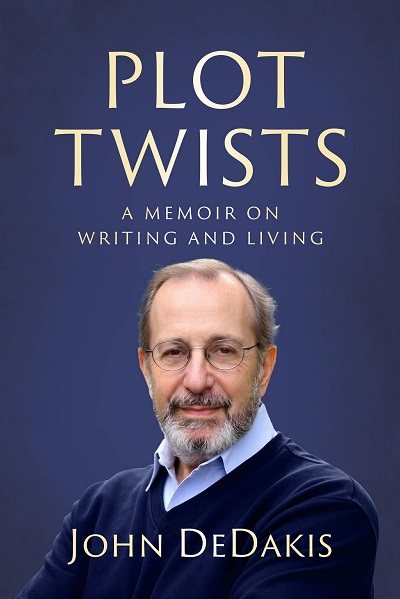
He writes mystery/thrillers, he’s a former military broadcaster, a publisher, and runs a boutique writers’ conference.
Is there anything this guy doesn’t do?
In this in-depth conversation, we also talk frankly about race relations.
“One-to-One with John DeDakis” goes 1-2-1 with novelist Austin Camacho.
See and hear it here: https://www.youtube.com/watch?v=c9WIYNVtv4s&list=PLXDV_HPUqtvvV-j0lyb2BsaZNSW3GCcDP&index=1&t=1s






What I did find was a banter between two people who have traveled similar paths in life who could've gone on a lot longer about how you feel about your writing and each other's writing. It was a lovefest of comrades. I don't qualify for a number reasons.
I grew up in racist central Wisconsin a little earlier than both of you, never went to the military for obvious reasons: my draft status was changed from S1 to 1Y as a throwaway. As far as diversity goes, I'm just now getting nationally connected to those of us with spinal cord injury through Zoom. It has always been amazing to me how little people know about those of us with spinal cord injury whose brains are not affected by the injury, only our bodies. But the general assumption is that if the body doesn't work well then the brain doesn't eithe –unfortunately.
Like the military, my college experience with civil rights in the early 60s and protesting against the war in the late 60s through a college ecumenical church group, I got exposed to life from other viewpoints. For example, my twin brother and I as sophomores in college were placed with the black editor of the University of Wisconsin's Agricultural Journal's family in an upscale home and found the family to be very nice to us. Showing us pictures of their children at Beloit College where they were star athletes. I was athletic in high school but never a star.
I have always been an extrovert, being dominant over my twin brother, but was very shy at public speaking until I learned in speech classes how to overcome that first line opening a speech. While I find approaching others in public from my wheelchair no problem whatsoever, I do like to have my books speak for themselves rather than have to push them.
I started writing my novels in 1997, so I was behind the curve with you two. Living in Houston and unable to travel to New York City, I didn't even try to get an agent and sent only a couple of stories to Playboy with one interesting response… To a sci-fi story… "Your story is too fantastical for Playboy." I read almost every story in Playboy and some of their regular writers regularly wrote what I would consider, duds.
I've always been a jack of all trades and master of none… Least of all selling and marketing. Least of all, talking bull or writing about bull because others liked it. So I have done it all, mostly writing from the seat of my pants, avoiding fantasy for realism as much as possible when writing science fiction, formatting, editing on my own because I couldn't find others willing to do it except for way too much money. I've opted to do my own covers because I find paying someone cost too much, was delayed too much, and didn't suit the story, but the artist's perception of the story.
I hooked up with a POD publisher who has helped me get the books on the market in a lot of different formats and I have copyrighted them with the Library of Congress myself. Unlike you I cannot go out in public very often to sell and sign my books, so I have, since they don't sell, taken giving my books away. However, I now have several people who insist on buying all of my books and won't allow me to give them free
My first encounter with a famous author was when I got his publicist to bring Alex Haley to Texas Southern University in 1982 where he wowed the crowds with his speech and was a real gentleman to talk to. Before that, two of my college advisors were authors of textbook series, and several of my professors had the top textbooks in their fields of study. Since then, I've had the luck to have met several famous authors at conferences. I co-authored several magazine articles with with an Austrian/American I met at a conference. He presented one of our articles at a conference in Vienna.
I worked in predominantly black Atlanta University for two years, followed by Texas Southern University for the next thirty. Within those institutions, early on, I found there was a ranking between the light-skinned and dark skinned with a lot of animosity expressed. I was looked on with great suspicion for most of my time there, finding friendship with the academics and with the staff rather than the administration that kept changing with the politics running everything from Austin.
Like you, I have always accepted a person by the way they acted toward me rather than anything physical about them. On the road for many years, I had to ask complete strangers to pump my gas and even check my oil. Most, regardless of who they were, were happy to do it without question. That's what's great about United States and much of the world. People from everywhere, except snobs are willing to be friendly and helpful.
Finally, while driving or riding with colored people, I have been stopped at least 8 times. The most embarrassing was when the owner of a distinguished Austin energy firm offered to pick up the president of TSU, a top assistant and I at the airport going to meetings and drove us by the Southside Mexican district as part of a tour, we were pulled over in his brand-new Cadillac Seville. Except for two cases that involved speeding in speed traps, we were able to go on our way.
Ron