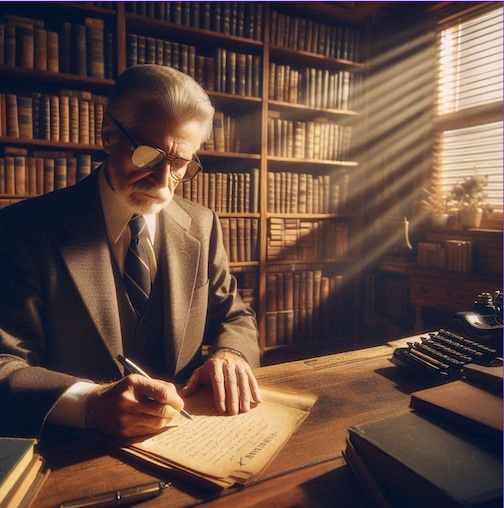
Rod writes his story in retirement
Agent Peter Karpinski and I were asked to report to FBI headquarters. We had expected to be assigned to offices in the field. It worried both of us. We were gay, but we thought we’d gone undetected even while training at Quantico.
We came to the front desk and were immediately escorted to the director’s office. I don’t know about Peter, but I felt very uneasy. I feared I might be reprimanded or even drummed out of the FBI by none other than the legendary J. Edgar Hoover.
I’d heard rumors he was homophobic. I worried that he had somehow found us out.
That was years ago. I’m retired FBI Special Agent Rod Forrester. And I can finally tell this dark tale. It’s a story that needs to be told for history’s sake. I’ll pull no punches, and I’ll name names long dead. Rod Forrester isn’t the name I was given, but it’s the only name I want to be known by for exposing the truth.
I was involved in one of the most diabolical plots of the 20th century, one that never saw the light of day until now.
# # #
I was born in 1942 in the little town of Oakdale, California, where my parents named me Roman Crye. They had come west in 1938 to escape the lingering effects of the Dust Bowl. They worked hard, and in time, bought a little dairy farm with a walnut grove. We were a poor but hard-working family.
By the time I was six, I knew I was different. Although I did my chores, I didn’t like farm work. I preferred my time with Mom learning to cook and sew. It was hard for me in school because I was a runt—skinny and pale, but able to outrun kids who taunted me with, “See little Romy cry!” I really hated that misuse of my name.
In high school, I lettered in football, basketball and track. Thanks to a growth spurt when I was 16, I transformed from a rather effeminate boy into a muscular man. Socially, I strove to hide who I was by relating to and even dating some girls. Privately, I fought to hide my desires. Still, I abhorred the homophobic locker room talk, and I never wanted to be the object of it. It was a like a knife to my gut when one of the other athletes openly declared he would “kill any homo I come across.”
I found schoolwork easy and got top grades. Girls wanted to date me because we had mutual interests, and I didn’t try to grope them like the other guys did.
During my junior year, I was surprised when my counselor asked me to apply to Stanford. My parents never finished high school, so I thought a school like Stanford was out of my league. Following my counselor’s lead, I got the necessary references and transcripts together and wrote an essay for my application.
In the spring of 1961, when I was set to graduate second in my class, I got a letter from Stanford. They had accepted my application and given me a full scholarship. That fall, I packed my trunk and left on the bus for Palo Alto, not knowing what to expect.
After orientation, I was placed in a freshman house and immediately immersed myself in academics, organizations, and campus life. It was a freedom I’d never had at home.
Before long, I realized that there were other gay men on campus. It wasn’t long before we formed a group. We were going to the City—it was taboo to call San Francisco “Frisco”—to scope out the scene. One evening, outside a gay bar in a dark alley, I lost my virginity to another Stanford student and finally knew who I was.
My major was psychology with a minor in mathematics. I studied hard and did well, enjoyed campus life, and regretted that graduation came too soon. The draft board would want me if I wasn’t employed, so I applied for an assistantship in the campus prison lab. That’s when I decided to pursue a master’s in criminal justice.
Near the end of my year-long studies, recruiters came to campus, and I interviewed for several jobs. My first interview was with the National Security Agency (NSA). I didn’t know what that was, but decided to investigate and possibly pursue a career with them. The interview went well and they asked me to do a second interview because of my math, statistics, and emerging computer science skills.
They flew me to their headquarters near Baltimore, an exciting new experience for me, but what I saw was too secret and too spooky for me to want to work for them. I told them “no” and flew back. Still, the NSA pursued, calling me and sending letters.
Then I was interviewed by a stern-looking older guy from the CIA. He asked me a silly question about intercepting and interpreting messages from a satellite. Unknown to me, he was referring to Sputnik, which only went, “beep, beep, beep.” It was a trick question. After that, he abruptly stopped the interview and, said, “You’re not CIA material.”
NSA still pursued me, even sending me a yo-yo in a box with “NSA” etched on it, asking me to “Stop yo-yoing around and join us.” But my mind was already made up.
In contrast, when the FBI visited the campus, the young interviewer seemed genuinely interested in me as a potential agent. I filled all the round holes with round pegs. After the interview was over, he immediately asked me, “How soon can you report to Quantico for training?”
Before I committed, I wanted to speak to my parents and my brothers, two of whom had joined police forces to avoid going to Vietnam. They all gave me a green light. So, I called the recruiter, accepted the offer, and received plane tickets to report for training on June 1, 1967.
# # #
An agent met me at the airport. We drove to a military base about an hour southwest of Washington, D.C., where Quantico was housed. The training was twenty weeks long and included the fundamentals of law, behavioral and forensic sciences, investigation, and interviewing. The physical training included defensive tactics, practical application exercises, and firearms. The academics were easy for me. The physical exercises were tough and exhausting but very satisfying as I improved at them.
Almost immediately, I spotted Peter Karpinski. Peter had earned a law degree at Northwestern University. Like me, he also had a degree in criminal justice from the University of Wisconsin, his home state, and also like me, he was gay. He told me one day when we got together during a break in our training and talked.
We offered each other support during the tough times, knowing that in the end, some of the FBI agent hopefuls would wash out. Our friendship grew, and by the time the twenty weeks came to a successful conclusion, we were fast friends.
During our time off, which was little, we shared our stories. Like me, Peter grew up near a small dairy farming town where his Polish family had homesteaded an 80-acre farm. He became a choirboy at the tender age of six because of his angelic voice. By the time he was eight, the priest had not only ushered him into training as an altar boy but had also seduced him.
I think that event served to ignite an ardent desire in Peter to pursue justice.
So, after graduating to full agent status, I got the surprising order to report to FBI headquarters in Washington D.C. As luck would have it, I spotted Peter in the dining room of the hotel the night I arrived and joined him for dinner. We realized we’d both been summoned by J. Edgar himself.
The following morning, we arrived at HQ together, excited and nervous about why we were there —especially when the door was closed behind us as we entered the director’s office.
J. Edgar Hoover stood behind his desk with his back to us, gazing out at the traffic below. Without turning around, he said, “Agents, please help yourself to some coffee. You’ll find a fresh pot in that little alcove on the right.” He pointed, still looking out the window. “And then join me at the table on the left.”
He was quite short of stature, belying his reputation, but his voice was strong and self-assured. By the time we seated ourselves at the table with our coffee, he’d turned around with a big smile on his face and taken a seat opposite us.
We awaited instructions. They were quick to come with little or no small talk. “I suppose you’re wondering why I’ve called you new graduates to my office and none of the others?”
We nodded in agreement.
“I have a special assignment for you. A difficult job. But you will have my full support.”
At this point, Peter and I exchanged nervous glances.
“I suppose you’ve heard the rumors,” Hoover continued. “Certain politicians aim to end my career. I’ve survived because I have dossiers on almost everyone of prominence in America, as well as some overseas.” He tapped a finger on his desk, not from nerves but to allow himself a moment to choose his next words.
“I’m tired, gentlemen. Tired. However, before I leave the agency, I still have a lot to accomplish. That’s why I’m starting a new initiative.”
I felt obligated to say something. “What would you have us do?”
“I picked you two because you’re gay.” He stared right at us with knowing eyes. “Am I right?”
I stammered. “Well…ah…ah—”
Hoover cut me off. “Here’s the situation. My battle with organized crime goes back to Special Agent Ness. We broke up the Midwest gangs violating the Prohibition Act—eventually arresting Capone on tax evasion. But the New York crime syndicate—the Mafia, La Cosa Nostra, or whatever else they’re called—have long eluded me.” He rotated his chair a quarter turn and flicked his fingers at the row of official photographs across one wall. “Their payoffs to city officials reach as far as the governor in Albany. Even FDR didn’t rout them out, because of his take. We protected him, hid the fact he was crippled from the public. He was a good man who didn’t deserve any disgrace after his leadership during World War II. But he was a sucker for beautiful women, like so many men in power.”
Hoover paused a bit with a pensive look on his face.
“But I digress. It’s the New York crime families who concern me—those Sicilians with their strong code of silence. Things are heating up. Threats are being made against our fornicator president and his brother … against Bobby Kennedy as well as Martin Luther King. Those threats are tying up my agents right now.” His crass remark and the disdain on his face surprised me. “I want to break up the New York families before I’m gone. You understand? As they say, ‘You capiche?’”
Peter answered, hesitantly. “I think we do. You want us to work on those cases that—”
“Precisely. I’m moving you both to Manhattan and giving you backgrounds that won’t reek of the FBI. Ferret out gay members from the prominent families. Befriend them, gain their trust by any means. I’ll authorize phone taps, money for bribes, listening devices—whatever you need. Cars, clothes, club memberships. Just get me what I need to bring them in.” He looked at us sternly and repeated the question. “Gentlemen, do you understand your assignments?”
We nodded in unison.
“The deputy director will fill you in on all the details, give you your new identities, and set you up with a place to live in New York City. Don’t disappoint me. Dismissed.”
# # #
We left the room with thoughts buzzing like hornets in our heads. Within a week, we had new names and identities and were set up in a posh apartment in New York City. I was now Rod Forrester, and I claimed a Scottish heritage. Peter’s name was changed to Thorne Novak, leaving his heritage somewhat in doubt. His new identity labeled him as from the Balkans. The families we were to target were well-known: the Gambinos, Colombos, Luccheses, Genoveses, and Bonnanos.
Our first task was to familiarize ourselves with various gay bars and restaurants. Our apartment was right around the corner from the Stonewall Inn, a place well-known for homosexual activity and a moneymaker for the mob.
By frequenting the Stonewall Inn and other gay hangouts, both Thorne and I soon found stuppagghiaru (Sicilian for submissive gays) amid the regulars at the Stonewall. The “omertà” (code of silence) protected these men from their own gang members, who sometimes behaved with brutality against gays.
Some of them were bona fide family members but weren’t allowed to join the ranks or ever be “made,” according to Mafia tradition. They were the outsiders and scapegoats of their families, living on the fringe without the power that made men had. Ridiculed by their own families and cast aside as finocchios (homosexuals), they were easy targets for our intervention. By befriending some of them, we were able to get a few to install wiretaps and listening devices in meeting places where business was discussed—places they weren’t allowed to go but knew about. Bribing maintenance people to do the work.
It was very rewarding but dangerous work. Thorne and I often went together to the clubs, so we’d have each other’s backs, especially when a target became friendlier with one of us. If Thorne hooked up, I would follow behind to ensure his safety, ready to intervene if anything went wrong. We heard countless stories about gays being beaten up or even killed.
Over the next several weeks, I managed to set up meetings with Tony Scarfino, a cousin of Don Gotti, at Broncos just off Times Square. It had been easy to take Tony under our wing because he was treated so badly by family members—they knew he was gay and called him “a dirty sgallettata” (a foolish or frivolous gay man). He was relegated to hanging out with the women and never allowed into any of the Gambino hangouts where the men went.
Tony especially resented the idea that because of his sexual orientation, he could never be made. From the women, he learned what the mob was planning to do, and he shared some of it with us. He was an invaluable asset.
Then one night, he didn’t show for a scheduled meet. But a guy spotted me and invited me to meet him in the alley out back, whispering in my ear, “Tony sent me.”
Outside, away from the crowd, he turned toward me. In the dim light, I caught a flash of brass knuckles. My FBI training kicked in. I ducked his swing and came back with a punch in his stomach that knocked the wind out of him. While he was doubled over, I came up with my knee to his Adam’s apple and finished him off. I left him in the alley, clutching his throat, gasping and choking from a crushed trachea. I never saw him or Tony again.
The guy who tried to beat me was clearly a picchiatore (a gang member sanctioned to beat up gays) who had probably targeted me because the Gambinos were on to Tony’s association with us. After that, Thorne and I stayed away from anyone from that family. People were getting whacked, and if our FBI cover was blown, we’d qualify as targets.
I was also in the Stonewall Inn when the police raided the place. The operation was much against the wishes of the Mafioso, who paid them regularly to leave the club alone. I was rounded up with the others. Thorne paid my bail. My case was dismissed later.
Most of the others were let go when riots broke out over the whole affair. It was a chaotic time, the beginning of many hits inside the families as they vied for power and the spoils of vice.
To be continued…
Copyright 2024 © Ronald W. Hull
4/7/24