Thorne, Waiting for Rod to Return Has Their Soup Delivered
Each day we worked in Morgantown, we hired a criminal justice student from the university to watch our rental car. We didn’t want what happened to DA Laurita to happen to us. Morgantown, a coal- and limestone-mining town, had a long history of violence and mob involvement with the unions.
Laurita was more than happy to share what he had with us, but the leads he gave us—leads that ran as far away as Clarksburg where the Famiglia Vagabonda (FV) headquartered—proved to be dead ends. We learned the Black Handers, a branch of the FV, operated out of Fairmont, thirty miles away. But wherever we went, we ran into omertà. The locals were either on the take or afraid to talk. Local law enforcement couldn’t tell us anything, either. They didn’t like anyone federal—a holdover from the moonshining days.
Then, in the early morning hours of August 1, 1972, two Esso service station occupants were found murdered on Monongahela Boulevard. They were Ray Austin, the owner, and James Spangler, his employee. Spangler had been shot in the back, Austin in the back of the head, execution-style. Both bodies had been dumped in a back room. A small amount of money was taken from the cash register, but nearly $1000 had been left behind.
Robbery was ruled out since very little was taken. That left a deal gone bad, a personal vendetta, or a Mafia hit as possibilities. There was little-to-no forensic evidence, typical of the mob, but we had no way to be sure they were involved. We turned to other cases.
The next year, we were pulled out of West Virginia. We worked a while for the Pittsburgh office until 1974, when I was called back to headquarters and Judy was transferred to Miami. We had developed into a very good working team, but I assumed I was to be transferred again. I knew that J Edgar Hoover was gone, so I was a little apprehensive about who was running things.
# # #
Arriving late in D.C. that evening, I just dropped my bags in my room at the same hotel and headed downstairs to the dining room. I expected to dine alone.
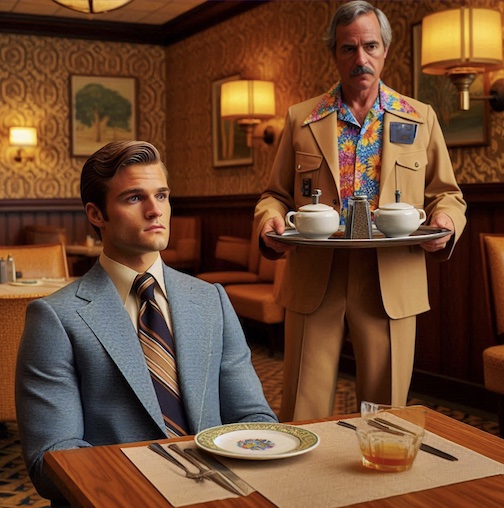
To my surprise, I saw Thorne waiting for me at our regular table. I was overjoyed to see him. We chatted, started with a glass of wine, and ordered our entrées. Then I excused myself to use the restroom. As I passed the entrance to the restaurant and went into the lobby where the restrooms were, I saw a man in a tan leisure suit with a flowery shirt at the front desk. He turned the other way when he saw me.
When I returned from the restroom, I saw that our waiter had left our soup and a basket of rolls on the table.
“Sorry you had to wait for me,” I said.
As I sat down, Thorne raised his spoon to his lips. Finding the soup still too hot, he lowered it back down—just as I came to a stunning realization!
“That guy! The one we saw here—the same guy! I thought that head of heavy black hair looked familiar! This time it’s flecked with white—but I just saw him in the lobby!”
Thorne said in a strange voice, “My lips! My tongue! They’re numb and swelling! It was something in the soup. I think I’m poisoned.
“Stay there, I’ll get the maître d’ to call an ambulance for you and see if I can catch the guy who did this. I know it was him.”
I left Thorne there and ran to the maître d’ with my FBI badge out, yelling, “Call an ambulance for my friend! He’s been poisoned!” I saw him start to pick up the phone. “Wait—did you see a strange man around here in a leisure suit?”
The maître d’ pointed to the kitchen entrance and answered, “Over there!”
I rushed in, nearly colliding with a waiter and a full tray of food.
Looking toward the commotion in the back, I caught sight of a leisure-suited man running toward the back entrance. I followed, holding my FBI badge in front of me as cooks, helpers, and waiters jumped aside. I tried not to slip on food spilled from trays that the guy ran into. He was pushing people aside in his haste to make his escape.
As I burst from the back door into the alley, I saw him heading for the street and feared I’d lose him. Then, to my surprise, Thorne stepped out from the building at the street and blocked his way. He tried to yell, “Halt! FBI!” But he couldn’t speak, so he fired into the ground in front of the man, hoping to stop him without deadly force.
That was enough to make him turn and run back toward me—where I waited for him with my gun drawn. We had him cornered. He stopped and put his hands in the air. I shouted, “FBI! You’re under arrest!” Thorne kept him covered while I handcuffed him.
I read the man his rights.
His only response was, “I’m CIA. You can’t touch me.”
I answered, “We’ll see about that.”
The maître d’ had already called the police and ambulance. They came quickly and soon other FBI agents arrived. We had jurisdiction over the D.C. police and saw to it that the man was taken to one of the FBI buildings to be held and questioned. Investigators went to the table and took samples of the soup.
The ambulance took Thorne to the emergency room. He still couldn’t talk, but he was breathing easier. The swelling of his lips and tongue and the numbness was lessening, thankfully.
I sat with Thorne at the hospital until he was released, at about 3 a.m. We returned to my hotel room, hungry and tired, but filled with too much adrenaline to sleep. We ordered breakfast.
As we ate, Thorne told me all about his previous assignment. He’d arrived in Detroit just as Jimmy Hoffa had returned from prison. While in prison, Hoffa had had a feud with a Detroit Mafia street boss named Anthony Giacalone. That conflict made it difficult for him to function there, but the FBI suspected he was looking for ways to regain control of the Teamsters and do it legitimately. But he had another alternative.
“Howard Hughes left Las Vegas on a stretcher in 1970,” Thorne told me, “but before that he’d pushed for gambling reform that led to the Nevada Corporate Gaming Acts of 1967 and 1969, allowing him and other interests to buy into casinos and hotels.”
It removed the stigma of organized crime that had built the gambling hideaway.
“We tracked Hoffa there often,” Thorne told me. “He was gambling big, negotiating with gangsters and casino owners. We followed the money. We found huge sums of the Teamster Pension Fund were used to buy into Las Vegas in a way that dwarfed what Howard Hughes had invested. But we found no illegal activity in that flow of money.”
Thorne paused. He sipped his coffee, then continued.
“So that was the end of that. Our team was reduced two years ago, and I’ve been working back here at headquarters since then. I heard you were coming and wanted to surprise you. But almost dying from poison and chasing down a CIA agent wasn’t what I had in mind.”
We both laughed. Then, as the gravity of the situation sank in, we hugged as tears flowed freely from both of us.
As expected, we were called to headquarters to tell our stories again and to be briefed on what was happening with the investigation. Nearby, they had found a car with fake plates and serial numbers removed. Inside was a change of clothes and some nasty tools like hedge trimmers and a straight razor. There was also a large sum of cash hidden behind a back door panel.
Preliminary tests of the poison found in both soup bowls showed it to be cross between bee venom and black mamba venom, a formula that had not been analyzed before. But it was the cause of the instantaneous swelling that would have resulted in Thorne’s suffocation had he consumed more than a taste of the soup, to test the temperature against his lips.
“It felt like Novocain at first,” Thorne said. “But when my lips and tongue started swelling, I thought I was dead for sure. Then I knew you were in danger, so I took off through the front door to help you.”
When the waiter was questioned, he told investigators that he’d delivered our order to the kitchen and placed it in the window for the line cooks, which is when he saw a guy in a leisure suit loitering by the kitchen entrance. The waiter thought maybe he was waiting for someone who worked there. The waiter left and returned a few minutes later with an order from another table, by which time our soup and rolls were in the window ready to be served. Apparently, while he was away, the perpetrator moved in and delivered the poison. He left quickly so he wouldn’t be observed, but he wasn’t quick enough to keep the waiter from noticing him walking away alone.
From their testimonies, no one in the busy kitchen saw him until he came running through.
We weren’t allowed to question the suspect, but he wasn’t giving up any information, anyway. After much discussion, it was decided by those higher up that it was a CIA matter, and he was transferred to CIA custody.
We only hoped that the CIA would give the murderer what he deserved. But we were never informed about it: after the CIA took him into custody, he disappeared. In a way, I was glad. Prosecuting him would’ve been messy, and Thorne and I would have been in the news.
# # #
At the end of July 1975, Hoffa disappeared. The Detroit office determined that the case there had produced no actionable evidence, so Thorne was assigned back to HQ indefinitely. Our reunion didn’t last long, however. I was soon transferred to Atlanta to investigate civil rights leaders.
In 1980, I had to spend a few days in D.C. for a case I was working on; and as soon as I got there, I contacted Thorne. We arranged to meet each other at a gay bar and restaurant we knew. I was glad to catch up with an old friend.
We had just about finished our dinner, when, out of the corner of my eye, I saw someone familiar at the bar talking to a young man there. It was a hot summer night, and both were flamboyantly dressed. But that hair on the head of the shorter, older man—it was almost completely white—caught my eye. I watched him, recognizing the way he moved. I was amazed to see him again, apparently a free man—in a gay bar. Our CIA suspect was out on the street, and I feared he was doing it again: killing gay law enforcement officers.
We watched as he and the young man left out the back door for the alley where many liaisons took place. Quietly, I signaled for Thorne to go out the front, and I followed the two out the back door and into the alley. The only thing moving out there was a cat scrambling out of a trash can.
In the meantime, Thorne had gone looking for a nondescript black sedan on the street. He found one about a block away. He entered the closest alley and waited.
I followed as quietly as I could until I found the two men making out in a small alcove. The young man faced the wall and braced himself against, using his hands to steady himself while the older man pulled down his pants. The light was dim, but I saw the older man reach around and bring out a garrote from his back pocket.
I stepped out from my hiding place and yelled, “FBI! You’re under arrest!”
The CIA man seemed startled for a moment, but he grabbed the young man whose pants were down around his ankles, stepped behind him, and made him a human shield. He pulled out a pistol and held it to the would-be victim’s temple.
The young man suddenly bent forward, and I didn’t hesitate. In the darkness, at close range, I pulled the trigger.
The sound of my gun exploded off the walls in the narrow alley. The young man cried out in terror. The CIA agent stood still for a second, a look of shock on his face, then fell backward. As his grip loosened, the young man dropped to his knees.
Thorne arrived from the other direction short of breath from running.
“I had my gun on him before you got there, but I didn’t want to shoot him in the back. Glad you made it easy on me.” Thorne reached down and helped the young man up. He was shaking so hard he could barely get his pants back on.
It turned out that young guy was a recent addition to the D.C. police force. Using my access to the FBI information network, I learned that within the last ten years, 37 FBI agents, state police, and local police officers in several states had mysteriously died after sustaining a disfigurement like the one we’d found on the victim at the hotel, back in 1971. I have no proof, but I assume they were all gay.
The FBI never determined who the perpetrator was, but I remain convinced that the CIA had sanctioned what he was doing, for reasons I never understood. I later learned that homophobia was rampant in the late 70s and early 80s among many police agencies. Harassment, verbal abuse, wrongful arrests, and even violence against gay men were common during those years but kept under wraps. The information I’ve revealed here was never revealed to the public, probably because the CIA was involved. But I believe the public needs to know. That’s why I’ve written this memoir detailing my involvement.
Later in life, Thorne suffered from the after-effects of his poisoning by losing his sense of taste and developing chronic nasal congestion. When he died of AIDS in 1993, I was at his bedside holding his hand.
Some speculate that the disease was manufactured in a laboratory; some religious fanatics swore it was God’s revenge. Whatever belief the public holds to now, AIDS did far more damage to the gay community than that clandestine CIA plot ever did.
As for me, I simply treasure my memories of Thorne. He saved my life, as I had saved his. I’ll never forget him.
Copyright 2024 © Ronald W. Hull
4/7/24