|
|
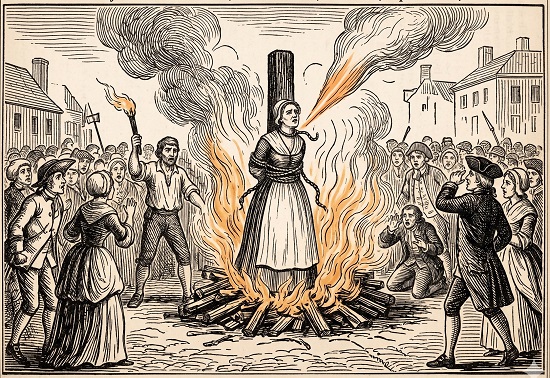 In 1731, Catherine Bevan and her servant Peter Murphy were executed at New Castle, Delaware for the murder of her husband Henry — she by burning, he by hanging. The only woman ever executed by burning for murdering her husband in colonial America, she denied to the last that she had acted any part in it.
On Friday, September 10, 1731, two people were executed at New Castle, Delaware. The Pennsylvania Gazette covered it in a single paragraph. It was enough.
Peter Murphy and Catherine Bevan had been convicted of murdering Catherine's husband Henry — "reckon'd near 60 Years of Age." Henry had been complaining to the neighbors that his wife and their young servant beat and abused him. The neighbors had also noticed that Catherine and the servant seemed rather too intimate.
When Henry died suddenly, a magistrate at the funeral found the coffin nailed shut before any company arrived. He had it opened. The coroner's jury looked at the bruises and rendered their verdict: violent death. Catherine and Murphy were arrested the same day.
They both denied everything at first. Then, confined separately, Murphy confessed. His mistress had sent him to buy Rats Bane. When he couldn't get it, he brought Roman Vitriol instead. Catherine dissolved it in wine and gave it to Henry. Henry vomited it up. Catherine then told Murphy to beat his master until he was too weak to resist. Murphy beat the old man until he couldn't stand. Catherine twisted a handkerchief round Henry's neck to strangle him, while sending Murphy off to tell the neighbors her husband had taken a fit.
Murphy returned before the neighbors arrived. Catherine told him: "I have had two hard Struggles with the old Man since you went away, and he had like to have been too strong for me both Times, but I have quieted him at last."
At trial, Murphy swore against her. Catherine denied everything.
She was convicted of petty treason — the legal category reserved for a wife who murdered her husband. Under law imported directly from England, the punishment was burning. Murphy, as the servant, was hanged.
The Gazette reported the execution ground with its customary economy of feeling: "The Man seem'd penitent, but the Woman appear'd hardened."
Before he died, Murphy partially recanted — she had not tied the handkerchief, much of his court testimony was false — but stopped short of exoneration: she was "the Promoter of all that happen'd, and consented to what was done."
The plan was to strangle Catherine before the fire reached her. The executioner, who had never burned anyone before, lit the fire too soon. The first flames shot directly at the rope around her neck, burnt it off instantly, "so that she fell alive into the Flames, and was seen to struggle."
She was 50 years old. The only woman ever executed by burning for murdering her husband in colonial America. She denied to the last that she had acted any part in it.
Catherine Bevan's story is exactly the kind that Delaware Behaving Badly: First State, True Crimes was built around — ordinary people, extraordinary circumstances, and a historical record that turns out to be stranger than anything invented. Available now.
|
|
Web Site:
Dave Tabler
|
|
|
|
|






Quite frankly, I was shocked that England in the 1700s still had a barbaric punishment of burning at the stake. Especially since Catherine, by all evidence a murderer, was not made of the devil that got the whole witch burning activity going in Europe in the middle ages. Fire must've been a very terrible way to die where death would be wished for more quickly.
The headlines show a woman killing her husband recently. I don't doubt that it occurred many times throughout history. Probably most succeeded without punishment.
Ron