Category: Education/Training Publisher: Writers on the Move Publishing
ISBN-10: 0999294911
Type: Non-Fiction
Pages: 259
Copyright: July 17, 2020
ISBN-13: 9780999294918
Price: $6.99 (eBook)
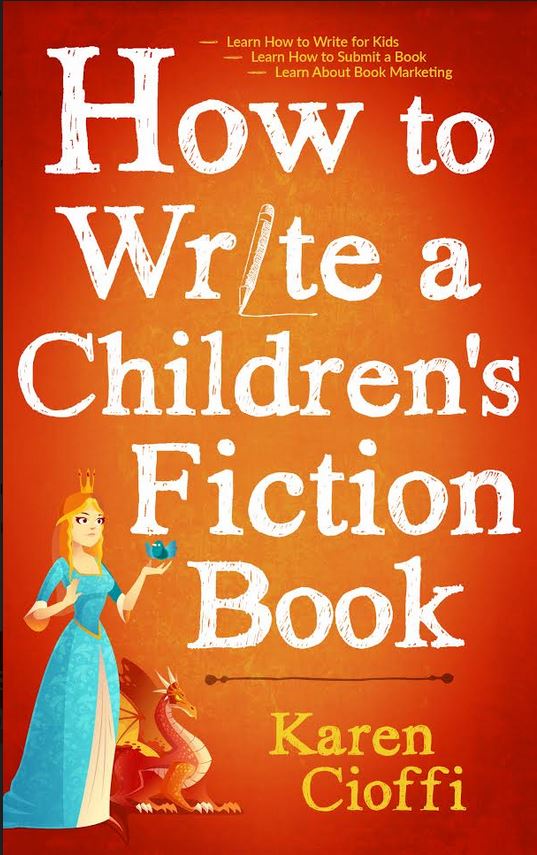
How to Write a Children's Fiction Book covers it all, including examples and assignments. It's well over 200 pages of no-fluff content.
Learn to write your own children’s book with How To Write A Children's Fiction Book!
Is one of your dreams to write for children? Or, maybe you’ve already started, but are finding it more difficult than you thought.
When you think of writing for children, what do you think of?
Do you want to enlighten a child? Do you want to scare a child? Do you want to provide a child with a life lesson? Do you want to make a child laugh? Do you want to bring the child through a suspenseful mystery or bring the child on a fantastic journey, broadening his imagination?
Are you thinking of writing a picture book? Or, maybe you'd like to write a chapter, middle grade, or young adult book.
Whatever children's genre you're interested in, How to Write a Children's Fiction Book will show you how to actually write for children.
Section titles include: Grabbing Your Reader's Attention; Building Your Character and Dialogue; Story Fundamentals and Strengthening the Middle; and Creating a Sound Ending. The first section includes children's books genre differences and how to find story ideas.
This book also includes tips on revisions and editing, finding a publisher (if you're going the traditional route), and book marketing tips.
And, there are lots and lots of examples and resources. Along with this, each section has a DIY assignment to help you get started and bring your story to life.
Being a writer, like being any kind of artist who creates something from nothing, is an amazing ability. It’s almost like magic. And, you are in control. You decide what to create. The only limit you have is the cap on your imagination.
This 220+ page book by award-winning children’s author and children's ghostwriter Karen Cioffi is actually a ‘course in a book’. It gives you all the basics of writing fiction for children, finding a publisher or agent, and marketing books. And, each section has a DIY assignment.
How To Write A Children's Fiction Book discusses everything related to writing fiction for children. It's a detailed ‘writing, publishing, and book marketing’ map from Point A to Point Z.
Excerpt
The Story Beginning Basics
There’s no way of getting around this, you need to have a ‘grabbing’ beginning to your story; this is also called a ‘narrative hook.’ And, that hook should start in your very first sentence. This is what will ‘grab’ and ‘hook’ the reader in.
Having a beginning that makes the reader want to keep reading is essential for two reasons:
1. It will encourage the child to want to read your book. Today’s lightning fast society warrants an immediate ‘hook.’ Kids are used to having immediate gratification, whether through video, CDs, or TV.
According to an article at USAToday.com, “So much media, so little attention span,” both school psychologists and teachers find that more and more children can’t seem to sit still. David Walsh, an educational psychologist, said, “It's become harder over the last 10 years to keep kids' attention. The expectation is to be constantly entertained and, if they're not entertained, they quickly lose interest."
The article goes on to say that “the problem intensifies after third grade.”
You can see that ‘grabbing’ the reader at the get-go is essential.
2. If you’re going the traditional route, it will usually be the determining factor as to whether or not the gatekeeper (the editor or agent who receives your manuscript) will decide to invest in it.
And, the gatekeeper most often will only skim read your first page, possibly only read your first paragraph, so you MUST make it count.
Once you hook the reader in, the rest of your story will need to sustain her interest.
So, how exactly do you begin your story and captivate your reader?
One good way to get an idea of how to structure a “grabbing’ beginning is to analyze what works. As mentioned in the Introduction, read what’s being published. This will certainly give you a guideline as to what agents and publishers are looking for in today’s books. There are also examples in the following pages.
Along with this, you will need to know that there are three basic elements to a children’s story: character, setting, and plot. They work together to weave an engaging story, right through to the end.
There are also general guidelines to the children’s book itself – knowing these guidelines will help you write the beginning. The guidelines are:
The Beginning: The set-up and introduction of the protagonist
In the beginning you’ll introduce your protagonist, your main character (MC), and you will need to find a way to make the reader care about him or her. You might also bring in other characters, including the antagonist (the MC’s trouble–maker).
The beginning of your book is where you will also set up the dilemma or problem the MC faces. You might use an inciting incident here – something that triggers the initial problem. The beginning is the lead-in to your story. It’s what will make the reader want to find out what happens, causing him to read on.
The Problem: Obstacles or complications
This element of the story establishes the actual problem or complication the MC faces. In this section, you can add up to three stepping stones or obstacles for the MC to overcome, depending on the genre you’re writing in. When one is overcome, the next one pops up.
Protagonist’s Choices or Paths
Here the MC will make choices that will lead to fulfilling his wants or needs, or overcome his problem and related obstacles. Usually the choices or decisions made will cause him to grow in some way; maybe he’ll become wiser, smarter, stronger . . . In fact, in every good children’s book, the MC changes in a positive way as a result of overcoming the obstacles and problem.
Tie It All Together – Your Ending
Your ending will tie your story together. Any innuendos you planted in the story need to be brought into the open and resolved – there can be NO loose ends. The ending should provide a satisfying conclusion for the reader.
Now that you understand the basis of a children’s story, let’s get into creating an ‘out of the ballpark’ beginning.
Professional Reviews
Carolyn Howard-Johnson
Many of my editing clients first come to me because they’ve run into trouble with their first book. The ones that come to me with the most difficult problems are veteran writers who are attempting a new genre and assume that what they know about writing and the publishing industry is enough.
I imagine that a doctor starting a new specialty would not make that mistake. Nor would a computer programmer intent on applying her skills to the marketing or human resources department.
I agree that past experiences and knowledge will surely be useful for them just as they will for any writer. I have tons of stories about how seemingly unrelated experiences in my own life eased my way into publishing. I also believe in getting help in a variety of places. Writers’ conferences. Critique groups. Writing classes. Having said that, the most frugal and organized way to get the information we need for a new writing project is, ta da!—a book.
There are many such books by experts out there, but if the new genre you are ready to try is a children’s book, Karen Cioffi’s How to Write a Children’s Fiction Book is waiting for you. It is a perfect example of the reason I think books make the best learning tools for taking on something new. That is, it is complete. It is organized, all in one place. And it come to you from an expert. In Cioffi’s case, she has published many of her own children’s books, but she also has over 200 ghostwriting clients world-wide. So, she could ghostwrite for you or you can pick her brain all in one book and have the fun of writing a children’s book yourself.
One of the best parts of her book is a chapter called, “Writing a Children’s Book: Basic Genre Differences.” Trust me, it will prime you for knowing you should read the rest with stylus, pen, or Post-It notes at hand. In just a few pages, she’ll have you choosing the age group of your audience and refining what kind of a book for children it will be. Your story may be better as a bedtime story, a board book, a picture book for young children. Maybe a chapter book for children as young as six?
You get the idea. But an overall picture like this will save many starts and restarts, many disappointments. That same chapter offers reading suggestions as examples that will help you decide and may inspire you, too.
Cioffi doesn’t miss a bet. She warns writers of the no-nos. We have all seen and been amused by books (even series!) of children’s books that touch on themes and topics—from snot and farts to the classic wicked witch stories. Many of them have been bestsellers. Nevertheless, Cioffi will make sure you don’t assume the children’s literature scene is an anything-goes-landscape.
But more than anything else, there are writing techniques an author has used successfully in a book that should be avoided or altered for a children’s book. Check page twenty-six for one example or do a find on “point-of-view.” The traps here seem nearly infinite: Dialogue. Sentence structure. And on and on. In fact, authors may find some of Cioffi’s tips useful in whatever writing they do from this moment on.
Here is the upshot. I am stowing Cioffi’s book on the keeper shelf in my office. I have a collection of children’s stories inspired by my travels—many of them based on local legends and myths--stored in the bowels of my computer. I will drag this how-to book our and read it again—cover to cover—before I do any rewriting from my first draft.
Linda Wilson
A comprehensive guide that offers a step-by-step approach
Anyone wondering how to write for children and where to begin would benefit from Karen Cioffi’s book. A thorough reading of Cioffi’s book cover-to-cover would be an excellent way to begin the path to publication.
I started from scratch not knowing anything about writing for children and recently finished my first children’s book, the first in a series for young children. A lot of time—years—and effort would have been saved if I’d had this guide to follow.
Cioffi’s book begins with the most important aspects every children’s author needs to know, including how to choose your target audience, genre differences, and ten basic rules for writing for young children. The book then goes into detail, such as how to create a story, the use of dialogue, action, and imagery; and the all-important skill of showing vs. telling. Also, how to revise, edit and research; how to find a publisher; understanding contracts, and how to locate marketing resources.
The first draft of book two in my series is done, and even after studying children’s literature for many years, I have found that there’s no end to learning the craft. I made a major change in my draft due to advice I read in Cioffi’s book. So, even experienced authors can find reminders of the goals they’re striving for.
Cioffi’s book would be an excellent resource for any children’s author.
I received a complimentary copy of this book in exchange for my honest review.
Crisis Management for First Responders is for first responders to be able to help victims of critical incidents as well as their own personnel who are affected by the trauma they witness or experience themselves.
Suicide Awareness for First Responders helps you to better understand suicidal people, how to help them, what to do at a scene of suicide threats or completion. Suicide threats and completion among first responders is also covered.
Crisis Management for First Responders is for first responders to be able to help victims of critical incidents as well as their own personnel who are affected by the trauma they witness or experience themselves.