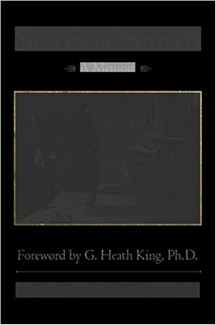
Autobiography of my life as a survivor of Satanic Ritual Abuse.
Satanic abuse and human sacrifice are real, but except for the rare public eruption caused by the finding of corpses evincing ritualistic mutilations that include occult symbols cut into the skin, beheading, and the removal of the heart and other organs, they remain hidden, if uneasily, from public consciousness. All too often, victims suffer in silence and disappear in silence. The experiences of those who manage to escape their horrific circumstances are often dismissed as works of the imagination or as evidence of psychopathology. At best, their complaints are treated as common criminal matters and their tormentors as common criminals.
The larger conspiracy falls outside the limited jurisdiction of local law enforcement authorities whose inquiries do not go beyond what is required to solve a local crime. Consequently, the network of murderous Satanic cells continues to proliferate and their crimes remain. Information about the inner workings of these cells is hard to come by as members who attempt to flee their control often become victims themselves. Sometimes they do escape and are immediately incarcerated in mental wards because the serial rapes, iron branding, human sacrifice and cannibalism that they describe defy belief and the managerial nomenclature of mainstream psychology. Compounding the problem is the psychological trauma, often manifested as multiple personality disorder, caused by years of isolation and sexual abuse. For only by dissociating from their own self and fragmenting into other personae can the victims survive.
Such is the story of Madeleine Boudreau Shepherd ofEnglandwho has written a raw, powerfully primal account of her membership from childhood in a Satanic cult, her narrow escape naked through the woods and onto a public road, confinement in a mental hospital, and her ongoing struggle to gain control over her own life, and avoid capture and retaliation. It is the story of irreducible subjugation and vulnerable rebirth.
G. Heath King, PhD
Excerpt
Satanic abuse and human sacrifice are real, but except for the rare public eruption caused by the finding of corpses evincing ritualistic mutilations that include occult symbols cut into the skin, beheading, and the removal of the heart and other organs, they remain hidden, if uneasily, from public consciousness. All too often, victims suffer in silence and disappear in silence. The experiences of those who manage to escape their horrific circumstances are often dismissed as works of the imagination or as evidence of psychopathology. At best, their complaints are treated as common criminal matters and their tormentors as common criminals.
The larger conspiracy falls outside the limited jurisdiction of local law enforcement authorities whose inquiries do not go beyond what is required to solve a local crime. Consequently, the network of murderous Satanic cells continues to proliferate and their crimes remain. Information about the inner workings of these cells is hard to come by as members who attempt to flee their control often become victims themselves. Sometimes they do escape and are immediately incarcerated in mental wards because the serial rapes, iron branding, human sacrifice and cannibalism that they describe defy belief and the managerial nomenclature of mainstream psychology. Compounding the problem is the psychological trauma, often manifested as multiple personality disorder, caused by years of isolation and sexual abuse. For only by dissociating from their own self and fragmenting into other personae can the victims survive.
Such is the story of Madeleine Boudreau Shepherd of England who has written a raw, powerfully primal account of her membership from childhood in a Satanic cult, her narrow escape naked through the woods and onto a public road, confinement in a mental hospital, and her ongoing struggle to gain control over her own life, and avoid capture and retaliation. It is the story of irreducible subjugation and vulnerable rebirth.
G. Heath King, PhD
Professional Reviews
Scars of Satan
Satanic abuse and human sacrifice are real, but except for the rare public eruption caused by the finding of corpses evincing ritualistic mutilations that include occult symbols cut into the skin, beheading, and the removal of the heart and other organs, they remain hidden, if uneasily, from public consciousness. All too often, victims suffer in silence and disappear in silence. The experiences of those who manage to escape their horrific circumstances are often dismissed as works of the imagination or as evidence of psychopathology. At best, their complaints are treated as common criminal matters and their tormentors as common criminals.
The larger conspiracy falls outside the limited jurisdiction of local law enforcement authorities whose inquiries do not go beyond what is required to solve a local crime. Consequently, the network of murderous Satanic cells continues to proliferate and their crimes remain. Information about the inner workings of these cells is hard to come by as members who attempt to flee their control often become victims themselves. Sometimes they do escape and are immediately incarcerated in mental wards because the serial rapes, iron branding, human sacrifice and cannibalism that they describe defy belief and the managerial nomenclature of mainstream psychology. Compounding the problem is the psychological trauma, often manifested as multiple personality disorder, caused by years of isolation and sexual abuse. For only by dissociating from their own self and fragmenting into other persona can the victims survive.
Such is the story of Madeleine Boudreau Shepherd of England who has written a raw but powerfully primal account of her membership from childhood in a Satanic cult, her narrow escape naked through the woods and onto a public road, confinement in a mental hospital, and her ongoing struggle to gain control over her own life, and avoid capture and retaliation. It is the story of irreducible subjugation and venerable rebirth.
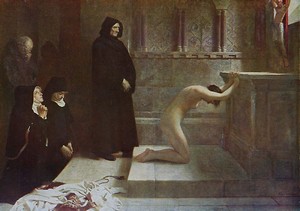
It is highly significant that the Satanic DaMuer Ritual alluded to the narrative takes place on the Feast of St. Agnes as a demonic counterpart to her martyrdom. St. Agnes was known for her capacity to endure torture. Like the victims of Satanic worship, in particular those of the DaMuer Ritual, she was one of the youngest of the Christian martyrs. St. Augustine gives her age as 13, about the age of Madeleine when she was given over to the cult. Perhaps most significantly, she was like Madeleine led to martyrdom from the lap of her mother. The mutilation ceremonies described by Madeleine are mirrored in the mode of Agnes' death by the sword (according to St. Ambrose), a method I would tend to believe over the account of fire given by the metrical panegyric of the censorial Pope Damascus, who said that Agnes' only concern during the fire torment was to veil her body with her long flowing hair so as to obscure the gaze of the heathen.
I have been able to trace seminal elements of Satanic cults to the animal sacrifices, branding iron initiations, and probable sexual abuse of the Magis cult of Mithra, whose apostles were Roman Legionnaires with a proscriptive, hostile relation to femininity. Two years ago, I visited the island of Capri where there is a cult of Mithra grotto in a cave which was the scene of cult rituals. Significantly, it was in Capri that the dissolute Roman Emperor Tiberius lapsed into depression and paranoia after allowing the execution of Christ. It is also of consequence that the sexually repressed Nietzsche visited this grotto during a visit to Capri, where he stayed for six months. It could well have left an indelible mark on his psyche, for thereafter he rationalized and aggrandized his suffering in an attempt, I think, to eclipse the immolation of Christ. Like the misogynist Tiberius he died mentally deranged. None of these dramatis personae ever faced their "shadow self"--the dark side in each of us which must be recognized before it can be integrated and thus tamed. Jung drew upon the metaphor of St. Francis of Assisi extending his hand to the wild wolf, which benignly eats from it. If, however, it is repressed, it will implode in clinical carnage, affecting all in its gravitational field.
The stone table of oblation that Ms. Shepherd describes in the moors, for me, crystallized this cave in Capri--and her divergent fate. The trajectory of her suffering is precisely the opposite: the emergence from the cave to the light of sanity. One of the most illuminating scenes is the moment when, in a state of amnesia from the trauma, Madeleine remembers her surname, "Shepherd"--as Dr. Hamilton read Psalm 23, "The Lord is my Shepherd..."
Relating this story is integral to the healing process. As light is inimical to evil, her exposure of this hidden world penetrates to its vulnerability more creditably, lucidly, and effectively than a consortium of metaphysicians, ecclesiastics, and psychologists. An observation of Thoreau comes to mind, "There are a thousand hacking at the branches of evil to one who is striking at the root."
Madeleine's account cuts through all civil overlay to the viscera of evil, striking at the root of a morbid erotomania. We encounter in these pages the body and the spirit of a woman laid bare. There is something in the depth and scope of her exposure that has an affinity of the courage of Lucrecia, the violated Roman woman who was viciously raped by the king and depicted by Martin Luther's friend Lucas Cranach. The nudity of Cranach's painting, "The Rape of Lucrecia," contained an important message beyond the violation itself. Lucrecia responded by appearing naked in the center of the city, proclaiming the violation against her, and demanding justice, thus shocking the leading families of Rome and leading to change. Like Madeleine, it was her way of telling her story and choosing honor over servitude. In so doing, she contributed. Dr. G. Heath King
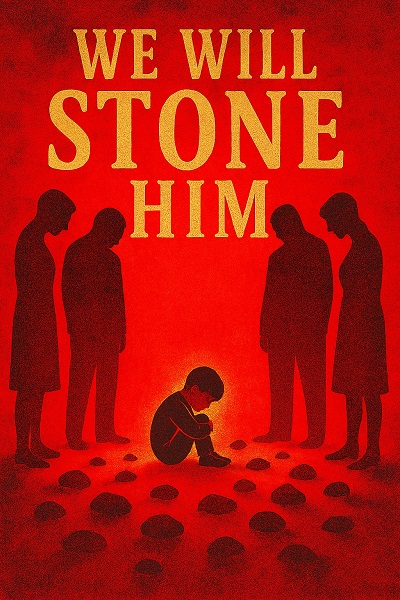
We Will Stone Him is a raw, unfiltered trauma memoir about surviving childhood abuse, emotional manipulation, and the lifelong wounds that follow. This true story marks the beginning of the Rising From The Ashes Trilogy, John Gambacorta and his survi