From NeoVerse Drama to Performance Poetry
Slough Press, a decades old Texas small press known for taking risks, published a new book that has been in the works since the mid 1980s. Intoxication: Heathcliff on Powell Street documents the experimental poetry theater of Hedwig Gorski. The book includes memoirs and photographs from the five months during which the events surrounding one production took place in 1978.
The conceptual art process behind Hedwig Gorski’s 1978 avant garde literary art, the verse drama Booby, Mama!, seems impossible to pull off.There was no money, and it used “found” text and “street” actors who were drunk, stoned, or filled with existential angst living on the fringes of society.The troupe members spent spring and summer in an abandoned house on Powell Street near Spellman’s Bar, a local hamburger joint where Lucinda Williams and other gravel road stars performed.
Joy Cole, embodying the performance poem’s character Red Light, became artistic soul-mate, nemesis, and, eventually, Gorski’s dearest departed friend.Portions of inebriated Cole’s epistolary journal document with candor and compassion how such mythic creations materialize and survive.Images by award winning photographer, Lauren Piperno, letters, and other texts complete a performance artwork that stunned even the infamous world weary bohemians and individualists engaged with Austin’s anything goes Romantic Period.Altogether, it paints an atmospheric landscape of the town that summoned and intoxicated so
many beloved dreamers and artists of the time toward intense self actualization.
Excerpt
Excerpt from the dialogue of the hermaphrodite character Krzysta in Gorski's 1978 found-text verse play Booby, Mama!:
"The skinny kid put her little-girl, pretty pink lips on an orange from the garbage sucking cool sweetness from the inside; as the green mold on the stiff skin couldn't resist the pull of her little-girlness and snuck inside as she sucked."
(OWNER fingers in sign language as she speaks.)
"'You don't have enough money to buy a piece of candy,' fingered the owner to the deaf girl."
Professional Reviews
Book Review of Intoxication: Heathcliff on Powell Street. Reconstruction: Studies in
Reconstruction 7.3 (2007)
Intoxication: Heathcliff on Powell Street by Hedwig Gorski and Joy Cole Slough Press: 2006.
<1> There have been many archives of the avant-garde, but what would an avant-garde archive look like? Undoubtedly it would be one that, as Derrida asserts, is never finished. But whereas Derrida's vision of the unfinished archive hinges, ironically, on the inherently monstrous nature of the relationship between primary text and commentary, one can also think of the unfinished archive as something that leaves us feeling incomplete - the archive as haiku rather than kudzu. This is the approach that Hedwig Gorski takes in assembling the somewhat unwieldily titled Intoxication: Heathcliff on Powell Street. Although the slim volume bills itself as "An exposition of bohemian Austin, Texas, in 1978," one comes away from the work feeling that he or she has seen very little of Austin or the bohemia that existed there. Rather, one is reminded of Peter Wollen's translation of a Situationist film title of 1959, "On the Passage of a Few People Through a Rather Brief Period of Time."
<2> This feeling of incompleteness, undoubtedly, results from the book's subject matter. As Gorski lets us know in the "Afterward," of all places, "the contents in this book offer a mixed-genre literary archive historically documenting people who once existed in a milieu that has largely vanished" (69). And, even when that milieu existed, it did so on the hinterlands of existence, literally and figuratively intoxicated, homeless, beaten, and declared unfit. It was the perfect milieu to embody and perform Gorski's avant-garde play Booby Mama! whose written instantiation forms the second section of the book after the "Prologue: Diaspora." Although the press kit asks, "Is Hedwig Gorski our own American Mayakovski," in Booby Mama! she plays the role of Alfred Jarry, the French absurdist most famous for his works Ubu Roi and The Adventures of Doctor Faustroll, Pataphysician. Jarry, along with a character named "Red Light," together form the abiding conscience of Booby Mama!
<3> The play begins with Jarry writing to his mother, which introduces the theme of mother-child separation via the structuring trope of the letter. This correspondence is broken by the entrance of Red Light, played by Joy Cole who, declared an unfit mother in real life, seems a natural counterpart to Jarry's own anarchism. True to her name, she utters her first words to "Old Man" in the manner of a prostitute: "You look like you need some new blood" (7). An hermaphrodite character, Krzysta, continues the theme of what Gorski refers to as the "errant mother" (xiv) by describing a breast that fires out excremental pinballs like a machine gun. This latter image, in true hermaphrodite fashion, conflates the "passive" breast whose excretions must be suckled with the "active" phallus/gun. The new mother, the errant mother, is no longer situated in one place as the nurturing hearth but is, to use Deleuzian terms, a "war machine" without location, not subject to chance in the first instance but releasing its pinballs in a sort of stochastic writing.
<4> In fact, chance, or what Derrida has called destinerrancy, is what this play reclaims as a positive value of the mother. In trying to figure out what makes this play radical, a contribution to art history in a philosophical rather than an archival sense, that is what this particular reader has landed upon. Of course, when the mother is infused by this property she in some ways ceases to become a mother even as she remains one, not in order to become "human" as traditional feminism would have it, but in order to enter a becoming that does not stop coming, a monstrous becoming that has been allowed and even valorized in the male avant-garde but has, for the most part, been denied women artists and even more so, has been denied the mothers which Western culture has consigned to house arrest even as they go to work or elsewhere. In an astounding revaluation of values, this play steals the virtues of contingency from the male avant-garde and redeems them for the bad mother as the avant-garde artist par excellence. For the adventurous reader, it is a seductive vision, enough to make Alfred Jarry want to shed his guise as the "Supermale" and wear a dress so that, as he does in Booby Mama!, he may become something else entirely, the undefined and messianic character of "Writer."
<5> Joy Cole, the messianic bad mother whom Gorski credits as being the central muse of Booby Mama!, is the author of the book's third section, "Letter to Krystal," whose eponymous figure is one of the children Cole was declared unfit to raise. "Letter to Krystal" is actually a collection of dated letters to Krystal, a prologue letter to Gorski, and several journal entries. All these sections are dated, but it is unclear whether any of the letters that make up the "Letter" were actually sent to Krystal. In the "Afterward" Gorski writes that Joy, after learning that she had cancer in the lining of her heart, "phoned from California to [say] that the only copy of Letter to Krystal was stored on the floor of an old green pickup truck . . . parked on the East side of Austin in front of Krystal's rent house" (90). She gave Gorski permission to use the "manuscript" in any way she saw fit if she would return it to Krystal afterwards.
<6> Much like the description of the manuscript's history and location, "Letter to Krystal" is a work of strange itineraries. It has many alternate titles, including "wasted city," which is fitting for one of the manuscript's first major digressions:
. . . ruins . . . see them everywhere. The foresight of past
creators . . . exploded . . . spent . . . but the druids still dance
at Stonehenge . . . sometimes I see them dancing at
after ours . . . kathleen . . . and people still travel daily to the
Parthenon . . . the pyramids are still sacred . . . oh
cheops . . . what . . . did you know . . . over 2,000 years
ago . . . LET US KNOW . . . (26)
In this passage one sees that delicate balance of irony and sincerity characteristic of Cole's writing. This balance allows for both humor and love, as an inseparable twinning, to become the abiding force of not only Cole's consciousness, but the avant-garde Austin scene as a whole. Although Gorski plays the part of Alfred Jarry writing to his mother in Booby Mama!, in many ways that twinning of humor and love is embodied more fully by Cole, and it is in that twinning that Cole could, I think, be viewed as Gorski's muse.
<7> The avant-garde archive as ruin, the bad mother as nurturing muse, these are possibilities and haunting spaces we could turn and return to in considering the significance of Gorski's Austin which, like Derrida's Austin, is unrecognizable in productive ways.
I love this book because the author views her past crazy artwork several decades later after getting a Ph.D. in literature. There is tension throughout even in the diction. One is not better than the other--both new and old are authentic and fascinating, at least to someone like me who enjoys collecting "people."
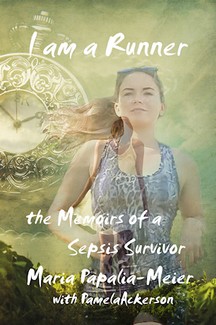
Sepsis knocked her down and out. Faith, hope, and gave her the strength to get back on her feet. I am a Runner She fought the river of death They said she'd never run again
She proved them wrong...
Inside the Methadone Clinic. Addiction to heroin, methadone, and other opiates. Destruction. The primal addiction" of the child, power and control over your own life, the institutions and the characters, the love between a mother and son. This book i