Category: History Publisher: Blue Spectrum Books
ISBN-10: 0997396709
Type: Non-Fiction
Pages: 233
Copyright: July, 2016
ISBN-13: 9780997396706
Price: $14.00 (eBook)
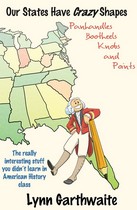
This book describes in layman's terms how our country ended up with such an odd mix of big, large and odd-shaped states.
If you've ever wondered why Michigan ended up with the Upper Peninsula instead of Wisconsin, or why Missouri has that odd bootheel, or why the states in the east tend to be small and squiggly while the states in the west are bigger and boxy, this book will give you the answers. These are the interesting stories about the people and the circumstances that formed our states, and you never learned this in your American History class.
And did you know that we used to have a state named Franklin?
Professional Reviews
Great research, well written
Lynn Garthwaite has put together a fascinating collection of information about the shapes of our United States. Great research delightfully written, provides background and conversation for both youth and adults. My 16-year-old grandson wanted my copy, but I'll have to get him his own - I don't want to give it up. As billed on the cover, it really is "The really interesting stuff you didn't learn in American History class!"
50 States — 50 unique and interesting stories
Sometimes you start reading a book and soon you are telling everyone, “You HAVE to read this interesting book.” I’m not a history nut, but since reading “Our States Have Crazy Shapes,” I’ll never look at the map of the U.S. the same. I feel like I am in on some secrets.
I suppose like most people, I went first to my home state of Minnesota. We were the 32nd state to be admitted in 1858, which is 101 years before Hawaii and Alaska became states.
I learned that most of the states on the top of our country that share a border with Canada are at the 49th parallel. Many states’ borders were drawn so that states received equal access to a river or one of the 5 Great Lakes in order to move things, before the railroads came. Sometimes that made for weird lines, especially in the eastern part of the country. Whereas in the middle of the country, Thomas Jefferson got his wish to have almost equal-sized states
The story I share most often is about the astronomers who were hired to survey the country and develop the outlines of the states. English surveyors in 1763-1767 worked using the stars to determine the southern line of Pennsylvania. Once they decided where, men with axes cut a line through the trees. Years later when GPS equipment checked, they discovered that the post at the SW corner of Pennsylvania was only 23 feet off.
Great book for grandparents to share with grandchildren—or for people of all ages who like to “learn new stuff.”
Lynn Garthwaite sneaks up on you, entertaining you while she educates you...
I bought a copy of the book after hearing Lynn describe it at several networking meetings as she was writing it. Lynn has a wonderful way of telling stories so that you're learning really fascinating background and facts while she entertains you. This a a fun book to read, and you will be surprised, as I was, by how you cannot put this book down, it keeps you fascinated and wanting to continue reading further, until sadly, the book is at an end. I learned so many very cool facts about how our country became the country it is today, and was really intrigued by many of the "almost" governmental decisions, that could have lead to things turning out differently.
I am buying copies for my family, and friends, and clients, as they will all enjoy Lynn's very fluid writing style and her amazing ability to entertain while she educates. Fascinating book, and one that you will enjoy!
A Viconian Cycle/ Babylonian Captivity Memory Silence Re-Founding of Southern history out of Dublin GA and the KBPS7 Trial. In psychology this is a Wounded Pride case.
A work in American history and existentialism Which is an Invitation to connect and create the dots in your life to other revolutions like the Cuban Revolution.
This book explores how U.S. presidents Dwight D. Eisenhower and John F. Kennedy failed to stand up to Soviet aggression during the early Cold War—despite America's overwhelming nuclear advantage.