|
the troy bookmakers
amazon
Category:
Literary Fiction
Publisher: The Troy Bookmakers
Type: Fiction
Pages: 270
Copyright: June 1, 2015
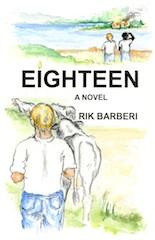
EIGHTEEN is a novel in which the weight of family history collides with one boy's emerging moral compass. On the day, in 1957, that he turns eighteen Milton Van Nuys is confronted with decisions most people spend their lifetimes avoiding. Memories, beginning with his father’s death ten years ago, frame instances of greed, racism and conflicting loyalties that pull him in different directions. He lives on a dairy farm with his mother and has a domineering uncle, both of whom figure in a family past simmering with secrets. Milton's struggle is not only to identify the good, but also to act on that knowledge, as he is propelled to end his day in a way he never would have foreseen.
Rik Barberi’s stories have been published in THE COUNTRY AND ABROAD, HOT METAL PRESS, THE MACGUFFIN, THE BERKSHIRE REVIEW and SIXFOLD. His writing, including EIGHTEEN, is set in the fictional Taconic County in the HudsonValley.
Available at your favorite bookstore.
Bookstores order at richardbarberi@me.com
Excerpt
1
MILKING TIME
On my eighth birthday Father gave me a slingshot. I was surprised because I had already received my presents: a new International-Harvester hat from him and a dress-up shirt that Mother had sewn. After the noon meal with birthday cake we took a rest because it was Sunday. Father lay in the hammock, Mother wrote letters at her fold-down desk in the dining room, and I went up to my room where I looked through an old SATURDAY EVENING POST from the pile in our hallway. Some were twenty years old. I always read every cartoon. Later, Father asked me to help stack the bales that remained on the hay wagon.
Our feet crunched on the cinders as we walked down our driveway and crossed the road to the barn. The cinders, some of them shiny as a marble, were a byproduct from the coal that the paper mill in town had burned in the past. I liked to walk by Father's side and feel his strong fingers grip my hand. Whenever we were in the pasture bringing the cows in, I would walk behind him on the cow path. From there I couldn't miss his slight limp, the result of a childhood bout with polio, which made him appear weaker than he was.
Though I was too small to be of much help with hay bales, working in the barn always made me feel grown-up. Father pulled me up onto the Farmall tractor to sit on his lap. It was only a year old – the one thing that was as new as the Colonel's. That's what everyone called Mother's brother, who had the next farm down the road – Colonel Hamilton. Because fuel had been rationed during the war, all the farmers had waited until it was over to make the switch from horses. Father backed the hay wagon up the concrete ramp and through the wide door of the haymow on his first attempt. Em, one of the hired hands, always took two or three tries. The barn smelled of new hay. Pigeons flew high above in the rafters, mad about the disturbance. Instead of climbing onto the hay wagon when we got off the tractor, Father reached behind a dusty shelf and came out with a slingshot. I stared at it. I had recently announced that my neighbor friend Bobby Baxter had one and could hit a chicken with a radish at twenty feet. “No wonder Jenny Baxter has to purchase eggs at the store,” Mother had said. “Scared chickens won't lay. I doubt he'll ever understand how his actions reflect on his family.”
It was Mother's way of reminding me that if I ever did such a thing it would cost our family money. More to the point, people would think we weren't smart enough to raise our own eggs. My parents never missed an opportunity to underscore the importance of family reputation. After some begging, Bobby had allowed me a try, but my efforts posed no threat to the chickens.
I never imagined my parents would understand the need for me to have my own slingshot.
“Happy birthday,” Father said in handing it to me.
We sat down on a hay bale. At first I didn't say anything, but turned it around in my hands and checked the stretch of the rubber, a strip of old inner tube. It was my finest present ever.
“I came across that oak branch fixing fence last week. Right away I noticed that perfect fork, just like the one I had.”
“When you were eight?”
Father considered the question. “Probably not, but you're smarter than I was back then. You already know not to shoot at people. Or animals.”
From the floor below, where the milking stanchions were located, came the squeak of the grain cart wheels. Em was already putting down grain for the cows. Outside we saw them come slowly toward the pasture gate and bunch up, certain they were late for the afternoon milking and just beginning to get verbal about it.
“You should have given me this with the cake so Mother could see it.”
“Mother might not understand the need for a slingshot,” Father said.
I was puzzled over the idea of keeping a secret from Mother, because it was something like lying.
“It's okay, Milton. Women have plenty of their own needs that men don't comprehend.”
Even an eight-year-old knows he has nothing to gain by questioning something that's going his way. If Mother ever asked whether I had a slingshot, I’d have to tell her. I pulled back the piece of inner tube as far as I could and released it. It fell lifelessly back to place, reminding me of my attempts with Bobby's. I wasn't strong enough to work it. Father took it and placed a pebble at the midpoint of the inner tube.
“Hold your left arm straight out and pull back as far as you can with your right,” he demonstrated. “Get your eye directly behind the pebble and look between the two posts of your slingshot. Whatever's in the center is what you're bound to hit.”
The air snapped when he released the taut rubber. The pebble bounced off the side of a wooden box next to the far wall.
“Yippee!” I cried.
Father stood up to retrieve the pebble, but immediately sat back down on the hay bale. I took the slingshot from him and ran over to pick up the pebble. I tried several times to imitate Father, but the stone just fell to the floor. Holding my left arm out straight was easy, but my right arm could only pull back a few inches on the rubber. I ran back to him for another demonstration – to see again the possibilities. But he was now lying down on the bale with his feet on the floor.
“I believe I need more rest son. Let's go back to the house. It being Sunday's making me lazy.”
He told me to put the slingshot in its place behind the shelf and then help him up. Initially, he took my hand, but then decided to put his hand on my shoulder and push himself up. I didn't know what to make of it when he put what must have been all of his weight on me. And it seemed strange to be going to the house with milking time nearing. At the doorway Father leaned against the wall and told me to get Em. Now I was worried enough to run down the concrete ramp. Just as I turned toward the door to the lower level of the barn the Colonel pulled up in his new car.
“I'll get the Colonel,” I yelled back to Father, because the Colonel would know what to do.
“No,” Father called weakly. “Get Em.”
But I was already calling the Colonel's name as I ran out to the road where he sat in his sleek sedan. He drove it in close to the barn and got out to help Father. With Father's left arm across the Colonel's shoulders and his right hand gripping my shoulder we got him to the car.
“My chest is bursting, Colonel,” Father strained to say.
Dark thoughts crept into my mind, but I was reassured by the strong grip on my left shoulder.
“Something's always wrong with you lately, Hench,” the Colonel said as Father struggled to get into the car. “Don't worry. We'll get you through it.”
At the house, Mother came running down the steps when she saw us assisting Father. Any other time she would have been embarrassed to greet the Colonel at the front door wearing her apron. The two of them helped Father into the house and onto the sofa. Mother told me to get some lemonade and go outside. I took the worry on her face seriously, because one of her favorite sayings was: “That's not a problem, it's a challenge.” For a while I swung back and forth on the tire that hung from the big locust tree that tilted toward our house. Later I switched to the hammock that was stretched between two sugar maples. Directly above me a gray squirrel jumped from one tree to the other, bouncing up and down on the branch where he landed. I waved when Doc Billings drove up and went into the house with his bag. I considered helping Em, who was down at the barn alone, with the milking. Jake, the other hired hand, had the day off. I had seen him earlier walking towards town. There would be a lot of full pails for Em to carry, but I couldn't lift the pails anyway and I wasn't allowed around the stanchions without Father there. Jake always said the cows might mistake my blond hair for hay.
It seemed like hours before Doc Billings got back into his car. Usually he carried lollipops, but he didn't even look my way. Maybe it wasn't hours, but I thought I had dozed off in the hammock. The Colonel came out on the porch and waved me in. He held the door open for me, but didn't speak. Mother was sitting in a chair next to the couch, crying. Father lay there motionless, a hand hanging over the edge of the couch. I took the hand in both of mine. It was limp, lifeless. For perhaps ten seconds I held back the tears, then dropped the hand and buried my face in Mother's lap. I was still crying when I felt the Colonel's hand touch my head. When I looked up I saw his other hand on Mother's shoulder.
"Don't worry Lucille. We'll get you and Hamilton through this," he said, using my full first name, as was his custom.
I wanted to grab the Colonel's hand, but didn't. I felt guilty wondering whether he'd be able to teach me how to use the slingshot.
I STEP out onto the front porch of Cecil's Tavern and my ears fill with the sound of water crashing onto rocks. The Huygens Kill, at high water from all the recent rain, is spilling over the dam that is diagonally across the road. The dam is lit up by the lights at the paper mill, which runs three shifts. The mill, with its big thirst, has been there forever and is the reason for the dam. I have allowed Bobby Baxter to keep me here until midnight closing time even though we both need to be up early to milk cows. He insisted on helping me get the jump on my birthday. Two months ago, I did the same for him. I cross the road and make the short walk to the bridge that carries the Valley Road over the Huygens Kill. The steel railing is cool to my touch as I lean over to see the water bursting on the rocks fifteen feet below. A swirl of mist and noise rise up at me. The noise bangs on my ears and the mist settles on my tee shirt, raising goose bumps on my skin. I should be home in my quiet, dry bed. I turn away from the commotion and look upstream where the flat water flows soundlessly out of the darkness and forms a pond behind the dam. An abandoned rowboat lies low in the water on the shore behind Cecil’s. Ten miles upstream is the outlet of Hamilton Lake, which forms the Huygens Kill. The Valley Road is named for the stream it parallels all the way down from the lake. Putting aside school, the Huygens Kill valley has been the backdrop for my whole life.
I'm ready to change my life and the Colonel is the one to help. Specifically, later this morning after breakfast, because “your eighteenth birthday is the proper time to discuss your future,” the Colonel says. In spite of the importance he has given it, I don't think he's mentioned it to Mother because she hasn't remarked on it. I expect he'll talk about increasing our cow herd. No doubt everyone thinks I’ll spend the rest of my life milking cows, but I have my own ideas. Mother doesn't involve me in her financial matters, but anyone with two eyes can see our farm barely makes enough to get by. Our twelve-year–old Chevy pickup shakes off another part every time we drive to town. I can’t remember ever buying a piece of furniture. Mother says you don't replace something just because it's old, a category that she stretches to include anything held together with used baling wire. And that's old baling wire, probably saved by my grandfather, because everyone's been baling with twine for umpteen years, according to Em. It only takes a short hike down to the Colonel's to have a comparison. A peel of house paint doesn't fall to the ground before they have their brush out. You can't find a cracked window even in their barn. When such things are pointed out to Mother she says, “We certainly aren't in a race with my brother.” But since graduation it's seemed like I'm racing something and if you're in a race you need a plan. I have one and want to talk to the Colonel about it.
The crashing water calls my attention back to the falls. I spit as far as I can and watch it drift down to the water and vanish in the froth. Below the rocks the water calms before disappearing back into the night. Once, on a lark, Mother and I took a Sunday afternoon to search out the point at which the Huygens Kill flows into the Hudson River. We came on it where a boat club has an old dock and several picnic tables. The stream is quiet there as it passes under a railroad bridge and joins the Hudson. Eventually the water reaches New York City and the ocean.
A whiff of cigarette smoke and then a slap on my back yank me away from imagining my own way down the Hudson.
“You're a grown up son-of-a-bitch,” Bobby announces loud enough to be heard over the falls. “You can drink legal tomorrow like the rest of us.”
It's a friendly gesture, but his size makes it unintentionally jarring – about like I would smack a cow to lift his foot off mine. Not that I'm small. I shot past Mother long ago. But Bobby's like a tree. It seems he'll never stop growing.
“It's already tomorrow,” I say. I have to beat Bobby with words, since I can't compete with him physically.
“It ain't tomorrow til sunup, know-it-all.”
He knows I'm right, but Bobby doesn't like to be wrong and will keep at it until I either agree with him or quit arguing. I could go on about how his brain isn't big enough to take in the idea of the solar system, but I let it go this time. The pounding water draws our attention back to the cascade. In drier times rocks are visible, but with the recent rains they're covered by the flow. Every drop of rain that falls on the western side of the Taconic Range eventually finds its way to this spot.
“Someday when time is slow,” Bobby shouts, “we'll get us some old tire tubes and run this ripple.”
“That's one you'll have to do alone. I'll take the slow time.”
“Milt, if it weren't for me, you'd turn out one boring son-of-a-gun. No guts, no glory. Might as well stay in with the women and put up jelly.”
“And be alive to eat that jelly. This is right where my Uncle Johnson died years ago.”
That catches his interest. “No kidding? He went over?”
“That's what Mother says. I think he was about our age.” Saying it sends a shiver through me. “Ain't a thing can go over that in one piece.”
Bobby takes the challenge and runs to get a wooden orange crate from the bed of his pickup. He tosses it off the far side of the bridge and comes running back. The crate appears from under the bridge and shoots over lip of the falls.
“Yahoo,” Bobby yells.
In about thirty seconds pieces of the crate begin to surface a short way downstream.
"Needed more nailing," he says.
You can't allow Bobby to get too far along with an idea. He's hard to rein in. The thought process never interferes once he gains some forward motion.
“Besides, that was just an old orange crate,” he says, flicking his cigarette into the churning water. “Ain't no test.”
He points to the rowboat on the shore above the bridge.
“I saw it before,” I say, “but I bet it’s Cecil’s.”
“Nah. He ain’t no fisherman.”
I don’t know that and I doubt Bobby does, but we cross the road and go over to where the boat is shoved against the shore. It's beat up and partially filled with rainwater. There aren’t any oars. Watching it break up on the rocks might make Bobby forget about the tire tubes. But then I notice the new rope on it. When I point that out, Bobby just waves a hand with his “Who gives a damn?” gesture. As usual, he has more beer in him than I do, but he'd do the same cold sober. He unties the boat and kicks it out into midstream. What I really should do is get in my truck and drive home, but instead I run back to the bridge with Bobby.
“Now a real test,” he says as the current catches it.
A man comes out of Cecil's and walks over to us just as the boat passes under the bridge. “What's down there?” he asks. “You boys see a shark?”
A smart aleck. That’s okay if it’s someone you know, but I’ve never met him. And he has a mean stare that comes at me sideways because he keeps his face turned away and slides his eyes toward me. I don't want anything to do with him, but Bobby wants to share the excitement. That's one reason Bobby's fun to be around. He can talk to people without even thinking about what he's going to say.
“That rowboat's about to have its strength tested,” he says.
The three of us lean over the rail to watch the boat come on. It floats quietly until its nosedives over the edge. Uncle Johnson flashes through my mind. Mother always speaks fondly of him. I don't know if he was in a boat, but seeing it fall gives me a sickening feeling.
“Hey, that's mine,” the man shouts while Bobby's yelling encouragement to the doomed boat.
In less time than it takes the man to grab my arm and repeat himself, large pieces of wood show up below the rocks. I jerk my arm loose of his grip while he watches the remains of his boat float away.
“Son-of-a-bitch,” Bobby says. “It's a man-eating spot, alright.”
“Son-of-a-bitch is right,” the man says. “Question is, which one of you sonsabitches owes me for that boat.”
Not only is his expression mean, but in confronting us he turns his head, revealing an ugly scar running up the right side of his face. Now I know why he kept it turned away. It appears to be a burn, worse than I've ever seen. It has a shine to it. It's difficult to look at him without staring at the disfigurement and my anger fades toward pity. It's creepy to think about ever touching it. How does he wash his face? I wait for Bobby to respond.
“Which son-of-a-bitch you talking about?” he says, now facing the man.
“Which one you wanna be?”
“Ain't no man with half a face gonna talk to me like that,” Bobby says.
The man stares at Bobby. I know what he sees – Bobby’s right ear – because you can’t miss it. Along with his size, it’s what people always notice about him – how it hangs out on a right angle from his head. For a few seconds they compare each other’s imperfections. There’s no telling what Bobby will do if a person mentions his ear. The man senses this and turns to me.
“I know who you are,” he says. “Mrs. Van Nuys wouldn't want her boy closing down Cecil's.”
Even if Mother has some inkling of who this man is, she'd be willing to deal with the iffy information by ignoring it. With Mother, ignorance is bliss, which can be aggravating, but sometimes I can work it to my own advantage. In recent months Cecil has served both Bobby and me while we were still underage. On those nights I tell Mother I was at the poolroom in Tilberg. She allows me to play pool, but not without reminding me of the distress it would cause my grandmother. So what? My grandmother is dead. “Instead of wasting your time and money poking balls across a table and praying they drop into a hole,” she says, “do something worthwhile.” When I ask her where she learned the basics of pool she changes the subject.
I'm not interested in talking to the owner of the boat. My anger returns with his threat to tell Mother, but Bobby gladly takes the challenge.
“You need to get the facts before you start insulting folks. Milt might have been the first to see the boat, but the man who did the deed skedaddled and hung a left over there,” Bobby says, pointing toward the intersection on the other side of the bridge, “heading for Dingman's Corners.”
I saw it first? Technically that’s true, but Bobby protects himself by leaving his own name out of his version of the events. He’s quick with an answer and all the more convincing with his size, which was an asset in his position of tackle on the football team. He moves his weight easy as dancing.
“What'd he look like?” the man asks.
“Too dark to tell. All we know is he said you owed him money, jumped in his car and drove off.”
“Had to be that God damn Jerry Knickerbocker. He was just in Cecil's.”
The man walks away cursing Jerry Knickerbocker. It's a good night for Bobby. He's seen plenty of action and dodged the blame. He's proud as a first-time momma cow. But I'm madder at him than I am at the man with half a face, who will eventually blame me for smashing up his boat after Jerry Knickerbocker sets him straight.
|