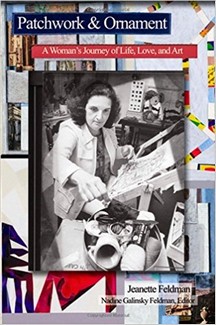
Category: Biography Publisher: Gal In Sky Publishing Company
ISBN-10: 0967441617
Pages: 168
Copyright: January 2010
ISBN-13: 9780967441610
Artist's memoir of growing up in the Great Depression and using art and culture to find a way out of poverty. Includes four-color photographs of art and travels.
Born during the height of the Great Depression to an immigrant mother and a disabled father, Jeanette "Jenny" Feldman found her way out of hopelessness and poverty through her study of art. Her work has been displayed in galleries and exhibitions in New York, Texas, and New Mexico, and although her success was limited, art remained the driving force to a rich and creative life.
As an artist, Jenny made many collages, and this book has been written in a collage-style format...short essays, stories, and poetry combine to create rich and interesting textures. Full color images of art, travel, and family add perspective to Jenny's thoughts, opinions, and work.
Patchwork & Ornament was selected as a finalist in the 2009 Texas Writers' League Manuscript Contest, Memoir category (under the name Pentimento).
Excerpt
The Good Jewish Ladies of Allerton Avenue
I would stand at a window in our Freeman Street apartment and watch for my mother’s return from her Thursday trip to a temple on Allerton Avenue. She went there to collect food for our family, gifts of food to the worthy Jewish poor of the Bronx from the more worthy Jewish ladies of the Temple.
The Jewish ladies of the Temple had husbands who still had jobs in the ever-worsening Depression of the 1930s. There were temples closer to us, including a large one a block away, but the one on Allerton Avenue was solo in running what we now call a food bank. Kosher food was given on Thursday so that Shabbat dinner preparations could proceed without delay on Friday.
My father was a heart patient. He had angina pectoris, had many heart attacks, and was hospitalized for long periods. Because of his health, he was unable to work. We were on home relief and received food stamps for groceries plus surplus commodities in sacks, such as corn meal and grainy skim milk solids. The Allerton Avenue food made a great contribution to our meals.
My mother went on the trolley carrying two fabric shopping bags that she made from scraps of curtain materials, fashioned with side panels and strong wide handles.
In the winter, the Freeman Street hill near our home was a terror for me, slick with ice and snow. I would get down the hill by hugging the faÇades of the small shops that lined the sides of the street. Yet each week, my mother went down that hill and then came back up. I would see her head first in a hat or scarf; then her face, always stern, then her body emerging with her bags in tow. I would wave to her as she got closer to our apartment house. She would climb the two flights of stairs to our place.
She did this every Thursday to provide whatever she could for her family. When I was a child, I didn’t think of the cost to her self-esteem, of what all of this—can I call it begging?—must have done to her. But then, her whole life had conspired to cheat her of self-esteem. She was beaten by her life, the way it would unfold: the sick, invalid husband with heart trouble, the asthmatic child, the poverty, the lack of hope for the future, and the shame of never having enough extra food for guests, not even for coffee and cake. Her pride, gone.
And yet, and yet, she did it, every week, every week, she went with her submissive face and her two shopping bags, got on the trolley, walked to the temple, took the food for her family, and thanked the good Jewish ladies of Allerton Avenue for their help.
The story of Ron Hull, paralyzed in a surgical accident back in the dreaded polio epidemic days, was able to overcome most of the stigma and stereotypes and "pass for normal" for 30 years. As Ron's paralysis increased gradually through the next 20
A book for every Muslim and everyone wishing to know about their way of life. The Diary of the Camp Manager at Mundihar following the South Asian Earthquake - October 2005. An account of life after the Earthquake in one of the largest of the 161 camp
This book has been eight years in the making. It is mostly a jumble of thoughts written down in old spiral notebooks and hidden in the bottom drawer underneath various manuals for software packages and hardware long since turned obsolete.