Kindle Edition
Amazon
Gal In Sky Publishing Company
Gal In Sky Publishing Company
Category:
Self-Help
Publisher: Gal In Sky Publishing Company
ISBN-10: 1500986925
Type: Non-Fiction
Pages: 144
Copyright: October 2009
ISBN-13: 9781500986926
Price: $1.99 (eBook)
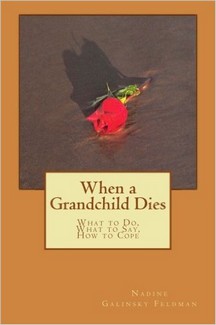
Support, comfort, and encouragement for grandparents who have experienced the death of a grandchild
When a grandchild dies, grandparents grieve both the death of the grandchild and the suffering of their children, the bereaved parents. Often they tend to other family members while their own grief remains unexpressed or unsupported.
When a Grandchild Dies offers ideas on how to experience and integrate grief, how to communicate with other family members, and how to find healing from one of life's worst tragedies.
Excerpt
CHAPTER ONE
THE UNTHINKABLE
Only love and death change all things.
—Kahlil Gibran
Losing a grandchild is devastating beyond description. When you first carried hopes and dreams for your grandchild in your heart, you never expected that young life to end—yet it did. As one grandmother said, “Then came the worst day of my life. I had come home from my walk, relaxed and hopeful. When I returned, my husband was talking with my daughter on the phone and tried to mouth some words I couldn't understand. He picked up a piece of paper and wrote: “Baby Dead.” Although the grandmother knew that the baby was seriously ill, the actual event came as a complete shock.
Each story of a brief life and tragic, untimely death is unique, yet common threads run through all the stories. No matter how young the grandchild was at the time of death, the grandparents I spoke with had developed a bond of love. “I never thought I would have such strong feelings as I do,” a friend of mine told me after being present at the birth of her first grandchild.
There is a magic to the grandparent/grandchild relationship. Relieved from the primary responsibility for raising the grandchildren (in most cases), grandparents are able just to relax and enjoy them. Grandparents are the people we can turn to when we have dreams to share or problems that need fixing. Grandparents know all the funny stories about Mom and Dad when they were children.
Just as no parent expects to outlive a child, certainly no grandparent expects to outlive a grandchild. This is not the normal order of things!
Sometimes the death of a grandchild is sudden and unexpected as in the case of a little girl who died suddenly while in the midst of a temper tantrum, or the young boy approaching manhood who was gunned down. Other times there are years of struggle with illness or disabilities. Whenever and however the death occurs, there is no way to prepare for it.
Whether your grandchild died as an early miscarriage or as an adult, with a life and future cut short, the death may cause you to question values and beliefs you have carried with you for a lifetime. Your friends may not understand your pain and begin to keep their distance. And, being a parent yourself, you may find yourself putting your own grief aside to try to help your child, only to find that you cannot help her; in fact, she and her spouse may even turn away from you in anger.
You may find your pain not noticed or taken seriously. You may have been left to grieve alone. The rest of the family, in their own pain, does not stop to recognize that Grandma and Grandpa are hurting, too. Or they may think that because of your age and experience, you should be stronger somehow. As they look to you for your usual guidance and leadership, they are bewildered to see that you too are wounded and distraught.
You feel helpless as you see your own child suffering one of the greatest losses anyone can endure. This is not a hurt that can be kissed away. No magic words, no chicken soup, and no amount of hugs can make it all better.
Yet your sense of parental responsibility never goes away. Bereaved yourself, you feel pressured to somehow “fix” the problem, sometimes unintentionally making things worse and creating estrangement. You feel confused as everything you say or do is taken the wrong way.
There are no instruction manuals to turn to, and even if there were, chances are the chapter on “What to Do when a Grandchild Dies” would be missing. There is little guidance from the past from which to draw strength and example, so, given the uncharted territory, mis-takes are going to be made.
Your relationship with your bereaved son- or daughter-in-law also plays an important factor in your grieving process. The death of your grandchild may exacerbate an already difficult relationship or bring out prob-lems and issues previously unknown. The resulting grief from the sense that family has been lost is an additional, horrific blow.
You may find yourself puzzled at how your spouse is grieving. Perhaps you have had a wonderful marriage and now find yourself unable to turn to your spouse for support.
As a grandparent, you may be 35 to 90 years old. You may be a white-haired grandmother knitting in a rocking chair or you may be a corporate executive. You may be married or single. Grieving grandparents are a diverse group!
What you all share, though, is one of the worst tragedies that can befall a family. Your love knows no bounds: “Your grandchildren are perfect,” one grand-mother said. Another grandmother grew misty eyed as she shared a favorite memory of her granddaughter.
“She loved Santa Claus, and she loved Pappasito's (res-taurant). Everyone gets tickled about that. She had a birthday party there. She'd just look around. We never missed a birthday, a holiday, nothing. There was so much life in her.”
As I spoke with grandparents and read their letters and e-mails, common themes emerged. Most did not have a support system to turn to and were trying to be strong for their children while their own hearts were breaking. Almost unanimous was the feeling that their grief was misunderstood and minimized by other members of the family.
The idea for this book came about after I had my second pregnancy loss in nine months, a stillbirth. My mother called and asked if I could help her find a book for grandparents, because she had been unable to find one. I was shocked to find few resources beyond some booklets. Grandparents deserve their own book!
Because I have never been a grandparent, I interviewed who had experienced the death of a grandchild in order to get their perspective. However, I have included some of my own stories when relevant, as well as those of the grandparents.
It is my hope that families will learn to grieve together rather than waste precious time by arguing whose grief is worse. When a child dies, everyone connected to that child suffers, and everyone deserves to have that suffering validated.
|