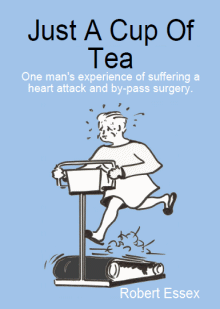
Click here to buy this book!
Lulu
Robert Essex Books
Category:
Health/Wellness
Type: Non-Fiction
Pages: 110
Copyright: Jan 1, 2001
Drawing on my personal experiences of suffering a heart attack and subsequent by-pass surgery 'Just A Cup Of Tea' is designed to help other sufferers of heart attacks and their families cope with the trauma this terrifying illness causes.
ABOUT TO UNDERGO HEART SURGERY?
HAD A HEART ATTACK?
When I had four heart attacks, and later heart surgery, I could not find a book to read, that would help my family and I get some idea of what to expect, and indeed, to help us have some comprehension of the involvement for not only the person about to have the procedure, but the involvement for the family as a whole, with support and understanding, and undertaking all the jobs that were done by person affected, before the event occurred.
The aftermath of a heart attack or heart surgery (CABG), Coronary artery bypass graft, or both, is a serious matter indeed, and you will be interested in how other people dealt with and survived exactly what you are going through, or are about to go through. You will want to know because it is your life, and it suddenly become very important, and why shouldn't it, you only get one (as far as we know).
I wrote this book about how I coped with it, an ordinary mans approach. What my wife was suddenly faced with and how she dealt with it, and what my family did.
I had never written a book before, but I have continued writing, as following the whole episode, I have a different stance on life.
I was sacked from my job, we lost our home, and went through many trials and tribulations on the run up to the operation. We even had a Bank Manager who would not give us a loan in case I died on the operating table, but they are not all bad!
The book has been received well by the people selected to read it, and the consensus of opinion is that it will help you if you are starting on the journey down this road.
You will find it funny in parts, and serious in others. I have been honest in what I felt at the time, and in what I have written.
Robert Essex
Excerpt
It was May, a day just like any other day.
When I got up at 7am I had a light breakfast as usual.
When I drew the curtains it looked more like June. The sky was blue and it seemed that every bird was singing. It was great to be alive.
I was fifty-two years of age; I had no medical problems to speak of, now, or previously. We were in the middle of a house move. The contracts were to be exchanged the following day. We both loved the house that we were to move into, or so we thought.
I had started a new job as a shop manager after giving up my previous position as a sales representative, where the pressure was on all the time for sales targets to be met – sell more, or else, and I was covering in excess of fifty-thousand miles a year. Most of my eating was done in the car, on the move – fish and chips, or fast food, sandwiches or biscuits, anything I could eat on the move.
I had no problem with tea. I had one or two cups during each call, to which I added three teaspoonfuls of sugar to each cup that I drank. On average, I had about thirty cups a day. It was great for my energy levels as I burned up energy rapidly. I thought nothing about the detrimental effect. I suppose I really did not think that my life would, or could, alter in any way. I enjoyed being on the move all the time, meeting different people, many of whom treated you like one of the family (when they got to know you) and to be kind, they would feed you lunch – the wife or mother of my clients would include me if I happened to arrive at the right time, not always, but quite often and after all, what harm would it do? I was hungry. I burnt off the energy very quickly and I was not overweight.
Although I liked my job, company car and good pensionable salary, the pressure was beginning to build up and having been offered a position as a shop manager, it seemed like a good idea at the time. What I did not realise, or think about, was that the pressure to get sales would still be present. There were the overheads, rent, rates, pay, all the regulations which seemed to be specifically designed to make life as difficult as possible, the tax, VAT and how to get the money in when the job had been completed. All was not as it at first seemed, but I was, as always, the eternal optimist.
On this particular day I did not get into work until 11am, as I had to see the building society and bank with regards to the impending house move to tie up the loose ends.
The shop was fairly quiet when I arrived, so I had a cup of tea and went out to see a customer. I arrived back at 1.30pm, had another cup of tea, worked at my measurements and produced an estimate for the customer ready to post off. I heard the door go and a customer came in wanting about 6 feet of vinyl flooring. He made his choice and I seized the roll (which was quite heavy) and put it on the floor, rolled it out, cut 6 feet, gave it to the customer, who paid and departed. I then went back to the roll of vinyl on the floor, bent down to pick it up, then my life was to change, at least for a while.
It felt as though an express train had hit me in the chest. I knew at once what it was. The pain radiated into my neck and up. It was across the upper chest area and then my left arm went dead – only for a little while. I then felt a pain like nothing else. My left arm felt as if a balloon had been inserted and was then blown up. I really felt my arm was going to explode.
Within about five minutes, the chest pain was more like a crushing weight. The arm pain was in waves. I experienced a sort of hopeless doom and the only thing I could think of was getting to the phone to say good-bye to my wife. The idea of getting medical help did not occur to me immediately, I was convinced I was finished. Why?
My father died of a coronary in 1966. He had been having chest pains and what seemed like violent indigestion over about a year. He had attended hospital and was given TNT tablets some weeks before his death. Of course, the doctors knew it was his heart, but in 1966, as far as I am aware, angiograms did not exist, certainly not surgery.
He was sent home to pack a bag and told to report back to the hospital. He collapsed and died in the kitchen after packing a bag prior to going back to the hospital.
All of my uncles died from heart attacks and it was indeed unfortunate for them that medical science had not, at that time, progressed to the stage of investigating angiocardiography to determine what was blocked and what could be done, i.e. CABG (coronary artery by-pass graft).
You will have realised by now that my family had a long history of heart disease. This therefore, was in my mind and came back immediately as the first violent pain hit me in the chest, so I obviously thought I was finished, because that information had been recalled from where it had been slumbering for many years.
You will therefore understand my need to make that call. When I did however, my wife was out, I couldn’t believe it, I had so little time left, or so I thought.
The rear door of the shop banged open and one of the fitters came in. He took one look at me and said: “God Almighty! You look rough!”
|