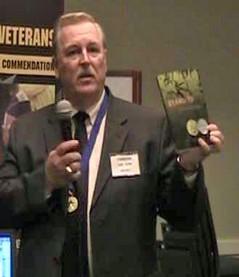
This timeless story tells of a young soldier who went into battle and the emotions he faced while there. An intensely personal story of growth during jungle combat in Vietnam. PLUS a first hand account of the battle at Ben Het Special Forces Camp, the only US verses NVA tank battle during the Vietnam conflict.
While many authors have written books about Vietnam, very few of these authors have actually experienced the horrors of this war. Retired Lt. Colonel Frank Evans brings to the table his experiences in combat. Evans is a Nomineeof the 45th Georgia Author of the YearAward in the Memoir Category by the Georgia Writer’s Association. He also was awarded the prestigious Founder's Award for 2009 by the Military Writer Society of America.
His memoir, Stand To…A Journey to Manhood, is an amazing book written by a heroic man who served his country with great honor. From his depiction of the picturesque aerial view of Cam Rahn Bay to that of the barbed wire, metal planking, and squat huts housing weapons of death and destruction, Evans’s Stand To… provides a vividly detailed glimpse into what it was like to become a man on the battlefields of Vietnam.
His memoir depicts how the struggle for survival brings about closeness among men. Evans and his comrades worked for a common goal, despite the danger threatening them, to stay alive and to defeat the enemy. They became a brotherhood with single mind and purpose. This work is relevant to today’s soldiers as they face the same emotions Evans faced. The lessons he learned while in Vietnam shaped the way he views the current troubles that soldiers face today in Iraq and Afghanistan.
The author offers a unique command of the material quite dissimilar from many other war story memoirs. The structure of the manuscript sounds almost like a historical fiction novel taking place during the Vietnam War. The author brings the characters to life while combining appropriate amounts of dialogue and narrative to keep the reader engaged and moving forward. The Prologue succinctly sets the foundation for the work and shares the author’s motivation for writing.
When his Vietnam tour of duty ended, Evans decided to continue his military career with the U.S. Army. Today, he is a proponent for the men and women of the armed forces. He stresses the benefits in education, experience, and travel to be gained by serving in the military. Yet Evans is also realistic about the strain military life can place upon a family. His recounting of his own experiences enlightens readers about the realities of serving one’s country.
He details his view of the only battle in the Vietnam War that involved United States Army tanks against North Vietnamese Army tanks. This battle at Ben Het Special Forces Camp in March 1969 was the second time that the NVA used tanks in an attack on an isolated outpost. Only a year earlier they had overrun another Green Beret camp: Lang Vei. This time, the NVA failed in their effort to inflict a defeat during their Operation Dien Bien Phu.
Excerpt
We approached the small hamlet in the dark, and it was difficult to determine exactly where the buildings were. We settled quietly into temporary positions and waited until the dawn gave us enough light to move into our final cordon.
The air was cool and the stillness was unnerving. A few sounds pierced the night as the inhabitants coughed or shuffled around inside the buildings. From one house, a hungry baby cried for a moment until its mother provided it with nourishment.
The horizon slowly began to turn gray with traces of illumination announcing the beginning of dawn. This was BMNT, or the Beginning of Morning Nautical Twilight. Outlines of buildings were now discernible as we again began to move silently.
Within a few minutes we were in our final positions. We now heard more movement in the hamlet as the inhabitants began to stir. The search teams were in their positions and every soldier was alert for any signs of movement. Weapons were pointed in the direction of the hamlet, covering any potential escape route.
A very loud voice on a speakerphone sliced through the air, magnifying an unseen speaker’s words in Vietnamese.
Although I did not know the exact words spoken, I knew that the villagers were being told to come outside and they would not be harmed. Suspected Việt Cộng in the hamlet were informed that they were surrounded and should lay down their weapons and surrender. No one would be harmed if they cooperated.
The distinct loud crack of an AK-47 automatic weapon interrupted the Vietnamese words coming from the loudspeaker. The firing was a hundred meters off to my right.
Immediately an M16 answered, followed two seconds later by an M60 machinegun. The red tracers of the machinegun could be seen as they pierced the grayness and ricocheted off into the sky. Soldiers began to shout and angry Vietnamese voices could be heard. The AK-47, spewing green tracers, fired again on full automatic but was silenced by the resumed firing of several M16s and the lone machine gun. A moment later, another M16 fired.
Then the firing stopped.
I could hear the voice of someone shouting orders and saw the movement of several helmeted figures running towards the hamlet.
“Hold your fire, men. Sounds like it’s over. Keep a watch on your sector in case anyone tries to break through."
My radio spoke, “Three-Six, this is Six-One. Over.”
My RTO handed me the handset to my radio. “This is Three-Six,” I said.
“Roger, Three-Six. That firing was from the Bravo element on your right. Hold your fire and position. They have one bad guy down, and there may be more headed your way.”
“WILCO.”
I passed the orders to the squad leaders and resumed waiting. The baby began to cry again and this time the mother couldn’t immediately silence it. The cry of hunger was replaced by a cry of fear.
Loud noises were all around. The firing in the north had stopped. Several Vietnamese voices called out from the direction of the hamlet. They were answered by Vietnamese commands over the loudspeaker.
A few minutes later, several Vietnamese walked slowly out of the buildings and approached the edge of the hamlet. In the group were two old men, an old lady, and a younger woman holding a baby. A small child walked by her side. Except for the woman with the baby, they held their hands high.
Vietnamese National Police quickly moved forward to direct the group to a safe location as the search teams moved into the buildings. It was now light enough that I could see the buildings and the other platoons spread out at the edge of the woodline.
“Sergeant Singleton, I’m going to walk over to the Bravo element and see what’s happened. I’ll return in a few minutes.”
“Roger, sir. Be careful.”
I walked toward a group of four soldiers looking down at a figure on the ground. They held their weapons casually and appeared to study the fallen figure.
As I walked up to them, a Staff Sergeant said, “Well, sir. There’s one who didn’t get away.”
At his feet lay a Vietnamese man dressed in black pajamas with a US Army pistol belt draped diagonally across his chest. He was wearing sandals, and a straw conical hat lay at his side. Typical VC clothing. The figure was lying in a grotesque position. He was literally sitting on his own shoulders, having been cut in two at the waist by small arms fire. It must have been the M16s and the machine gun I heard firing. As he tumbled from the impact of the bullets, the lower portion of his body had catapulted over his head and landed on his shoulders. Blood and intestines were strewn around him.
The sight was horrible, but I couldn’t turn away. This was the first dead body I had seen other than a distant cousin I had seen in a casket several years before. My cousin had been killed in a car accident and was prepared for burial by a local funeral home. Billy had looked like a wax figure and seemed to be at peace. The Vietnamese at my feet had also died violently and unexpectedly, but he remained untouched as he had fallen in battle. The skin was pale, the body frail looking. He was obviously a VC, since an AK-47 lay a few feet away and his Chicom grenades were still attached to his belt. I felt no anger towards him, but I did feel a strange sadness.
“What happened?” I asked
“He came running out of that house over there once the loudspeaker started. The National Police have another VC who was with him. He’s only wounded. They’re interrogating him.”
A young specialist holding a machine gun said, “Yeah, this guy came out shooting and we all opened up on him. The guy behind him kept running, and Staff Sergeant Williams was behind that tree over there. As the second VC ran by, the Sarge just stepped out and shot him in the shoulder. He was the lucky one.”
Williams broke in, “I’m not sure that he’s that lucky if the National Police are interrogating him.” I had to agree. Williams continued, “I was aiming at his chest but he moved aside as I pulled the trigger. He took a round above the elbow, spun around, and fell down. That’s when I grabbed his SKS carbine and stuck my rifle in his face. Figured a prisoner might be useful.”
“Good thinking, Sergeant. The interrogators are probably thanking you right now.”
I looked down at the dead VC again and turned back towards my platoon, thankful that the dead soldier wasn’t one of ours. Even so, it was awhile before the sick feeling in my stomach went away.
My RTO walked up to me and said, “LT, the CO called and said our scouts discovered four more VC with carbines hiding in the weeds near the trail about one hundred meters over there.”
“Where are they now?”
“The National Police have them. It appears four or five more were wounded and got away. Blood trails are all over the place. They escaped through a tunnel in the cemetery. He said to be alert since there may be more VC in the area.”
“OK. Pass the info to the squads.”
A search of the hamlet revealed another VC hiding in the ceiling of one building. Several more weapons were captured, including a B40 rocket launcher under a pig trough. The mission was a success, with no friendly casualties.
Professional Reviews
A Journey that Needed to be Shared,
Vietnam veteran and author E. Franklin Evans has captured something very special in his personal war memoir, "Stand To...A Journey to Manhood". We get a good glimpse back into the life and times of a "young man" caught in the vortex of war. The reader is treated to a well written accounting of his experiences surviving both the traumas of battles and people. It is historic, personal and entertaining.
This is one of this decade's "Top 10 Best Memoirs" on the Vietnam War experience. The story is emotionally presented through the eyes of a young Army officer - but it is clearly written with the introspection of a much older author. He looks back at that time and place in his life in an attempt to understand and come to grips with these events. It is truly a journey and one that most readers will find well worth taking with this author.
The book gives us some insights on what it was like in one of the remote Special Forces Camps. The readers will find themselves fully engaged and on the edge of their seats as they read about the heavy fighting that took place in and around these camps. The book is about life and death and about those brave young men who lived and died a long time ago. But it is obvious that these events for men like Evans, will never seem that long ago. In their hearts and minds it is just like it happened yesterday.
This book gets my fullest personal endorsement and recommendation.
Reviewed by W.H. McDonald, Jr. for Military Writer's Society of America
Stand To...A Journey to Manhood
"Stand To...A Journey to Manhood" is not just another Vietnam War book filled with clichés about this most misunderstood war. I can almost recite some of the stereotypes about the war that I have read in other books/memoirs. This is fresh, this is new. A memoir of a young Lt. Frank Evans, infantry officer, who started as a grunt officer and ended his tour of duty with the Special Forces at the battle of Ben Het. This battle was the only battle between American forces where enemy tanks also took part.
But, what made me really like this book? The humor that the author was able to inject into the story. His knife fight with a Christmas turkey, fighting Viet Cong elephants, and an elusive VC chicken, all made this otherwise serious look at the daily grind and terror that the average infantryman went through an enjoyable diversion. But, when the author needed to take you into the heat of the battle, especially Ben Het, he did so with great detail.
The book is 260 pages with 34 very much appreciated short chapters, and has many personal photos that the author was able to bring home.
This is an outstanding book.
War Stories-Stand To...
August 1966 - From the first page of chapter one, Vietnam's impact on American families, one death at a time, is evident: "Noooooooooo. They've Killlllled himmmm!" is a wake up call; the nightly Five O'clock Follies war news is all too real.
Raised in the shadows of the World War II generation and weaned on film heroes like John Wayne, Errol Flynn, and Randolph Scott, young war-age men like Evans believed America could never lose a war, being killed in action was out of the question, and those who died did so in glory and in one piece. And yet here it was: Evans' boyhood friend, Glenn, was dead in Vietnam.
A short two years later, Evans had crossed the lines from high school, college student, military enlistment and graduate from Infantry Officer Candidate School. As his aircraft descended into Vietnam, he remembered everything that had brought him to his awaiting destiny.
Thrown as fodder in to the Vietnam jungles, young Army Lieutenant Evans quickly earned his platoon's respect and trust, and the confidence of his superiors. He would need both as they fought along the borders. With bone-weary words blurring into pictures, Evans' recalls to life the memories and wandering shadows of the Vietnam War we all remember: life, death, and dreams revisited. Thundering convoys, air strikes, green tracers--red tracers--and both meant sudden death.
Vietnam borders, phantom Laos-Cambodia choppers, and charred bodies in the wire, all combined to an unnatural fear as you stalked the trail. A wariness crept in to your DNA. Bamboo viper snakes beckoned for a quick two-step ... a short dance with death; elephants packing supplies on the Ho Chi Minh Trail; jungle covered extinct volcanoes; LPs...One Click, Yes...Two No; Choi Hoi good-bad guys; razor sharp elephant grass; LZs, OPs, Montagnards, White Mice, Intell VC Prisoners. Fogged memories piled up and depressed the spirit to bedrock...a MOH medic... NVA bunkers, dust off sky buckets, and never underestimated staff wienies and lifers. And you recognized anew the old truth: Anywhere in a combat zone it was dangerous, and fatal, to let your guard down!
Stand To is more than a war story of misery, pain, and emotions checked at the border. It is a story of survival from enemies and friendlies alike, where both are deadly on this explosive journey to manhood. Just as important, there are glimmers of the humor that keeps combat soldiers sane, including a knife fight with a turkey, and VC chickens, that demonstrate the vitality and nature of American warriors.
Stand To...where forgotten truths are stirred from the dust and a part of your soul remains buried forever. You've lived the memories through the decades ... if not, then you weren't there. Stand To ... A Must Read!
Don Poss,
Webmaster,War Stories
TRUE STORY. Bella survived an abusive powerbroker father with organized crime ties, a drug-addicted mother and a physically/sexually abusive brother. Shocking & inspirational. When she couldn't cry, she tattooed a crying angel to cry for her.
After a long awaited weekend visitation caused by false allegations of sexual abuse, Glen got to see his children for the first time in over two months. He promised them that they would never be apart again and then they disappeared.