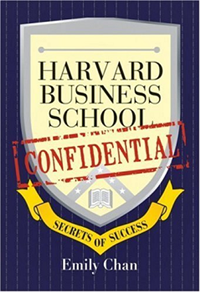
Harvard Business School is the iconic business school. An admission ticket to HBS is a hot commodity and an HBS degree is highly respected in the business world. This book, written by an HBS grad and seasoned businesswoman, tells you why. It is a distillation of the most valuable and pragmatic but yet easiest to learn concepts taught at HBS.
Author's Bio
Emily Chan graduated top of her engineering class at Stanford University and has an MBa from Harvard Business School. She was a consultant with The Boston Consulting Group (BCG) for over eight years, and also worked as a corporate strategist and an independent consultant in Greater China. Based in Hong Kong, she is now Director of Pacific Merit Ltd. (PML), a family-owned direct investment company that invests in distressed assets in the US, Europe, and Asia. PML’s portfolio includes assets in biotechnology, media, and real estate.
Table of Contents
Part One: Personal
Chapter One: How Money Works
Chapter Two: You Can Negotiate Anything
Chapter Three: Speak So People Will Listen
Chapter Four: It's Who You Know
Chapter Five: It Is Bigger Than You
Part Two: Operations
Chapter 6: Process Management
Chapter 7: Human Resources
Chapter 8: Marketing
Chapter 9: Sales
Chapter 10: Finance
Part Three: Strategy
Chapter 11: The Big Picture
Chapter 12: Filling in the Blanks
Chapter 13: "Plans are nothing. Planning is everything"
Chapter 14: The Classics
Chapter 15: Final words
Appendix
Index
Excerpt
Know the BATNA
by Emily Chan,
Author of Harvard Business School Confidential: Secrets to Success
Using the "real interest" approach helps identify a win-win agreement. Understanding the importance of the "Best Alternative to a Negotiated Agreement" (BATNA) can help you maximize the win for your side. The advantage in negotiations often does not depend on how big and powerful each party is, but on who has a better BATNA: who can better afford to walk away without an agreement.
The power of BATNA is seen in everyday life. When supply is less than demand, the seller has a strong BATNA. If you won't agree to a price, many other customers will do so. In a depressed economy where supply is more than demand, buyers have all the leverage. They can always buy from another seller if they cannot get the price they want. Even toddlers understand BATNA; when they scream in a restaurant, they capitalize on an intuitive sense that their parents must either yield to their demands or risk more embarrassment and inconvenience.
The power of BATNA is also seen in more complex business situations. A classic example is the battle between Sky Television and British Satellite Broadcasting (BSB) in the early 1990s to dominate British satellite television. It would be a lose-lose situation if both firms were to stay in the market and compete vigorously. It would be a win-win if they could negotiate a deal for one to pay the other to exit. These are the estimates for the financial implications as documented in a HBS case study:
For BSB: Loss of £190 million if both BSB and Sky stay in game and fight; profit of more than £2 billion if Sky exits; loss of £180 million if BSB exits.
For Sky Television: Gain of £700 million if both parties stay in game and fight; profit of almost £3 billion if BSB exits; loss of £70 million if Sky exits.
Figure 2.1 displays the financials in a 2_2 matrix.
It would be a win-win if they could negotiate a deal for one to pay the other to exit. But who has a stronger negotiating position in this example? Some would say Sky has a stronger position, since it would still make £700 million even if BSB does not exit the market. BSB is weaker because it would lose £180 - £190 million if Sky chooses to fight. So BSB must negotiate for Sky to exit.
However, that is not true if you look at the BATNA more carefully. Compare the fight versus exit option for each company if they fail to reach an agreement. If no agreement is reached for one of the players to exit, then:
For BSB: Fight versus exit means losing £190 million instead of £180 million. The difference is relatively insignificant. So BSB has flexibility of choosing whether to fight or not should Sky decide to fight. It has a strong BATNA.
For Sky: Fight versus exit means £700 million profit compared to a £70 million loss!
Figure 2.1 Comparing Results
BSB fights
BSB exits
Sky fights
BSB loses £190 million
Sky makes £700 million
BSB loses £180 million
Sky makes almost £3 billion
Sky exits
BSB makes £2 billion
Sky loses £70 million
Not possible (BSB and Sky
will not both exit)
Sky has no choice but to fight. If it has to fight, then it will increase its profit substantially (from £700 million to £3 billion) if it can negotiate to pay BSB to exit. In fact, theoretically, if BSB does its homework and understands Sky's BATNA, it would know that Sky should be willing to pay anything up to £2.3 billion for BSB to exit! In the end, Sky did pay BSB to exit the market.
REFRAME
A young man asked a priest, "May I smoke while I pray?" The priest answered angrily, "Certainly not." Another young man asked the same priest: "May I pray while I smoke?" The priest answered, "Good child."
Another story -- as Professor Deepak Malhotra of HBS tells it -- when President Theodore Roosevelt of the United States was campaigning for reelection in 1912, his campaign office made a brochure. The brochure included a picture of the president, together with information on his campaign. Three million copies were made, but only days before the brochures were supposed to be distributed, the campaign office realized they did not have the rights to use the picture. The rights belonged to a privately owned studio (call it Studio X). There was not enough time for a reprint.
The first reaction to solving the problem would be to send a representative to negotiate with Studio X as soon as possible. But this approach could have cost millions as copyright law allowed the copyright owner to demand up to a dollar a copy. What did the campaign office do? They sent a telegram to Studio X with the following content: PLANNING TO PRINT 3 MILLION COPIES OF CAMPAIGN SPEECH WITH YOUR PHOTOGRAPH. HOW MUCH ARE YOU WILLING TO PAY FOR OPPORTUNITY? Studio X quickly responded: APPRECIATE OPPORTUNITY, BUT CAN ONLY AFFORD $250. The campaign team accepted graciously.
These two stories illustrate the power of reframing (a concept also referred to as framing): gaining an advantage by changing the perception of a situation. Reframing is especially powerful if you can reframe to appeal to the interests of the other side of the negotiation. There are two ways to reframe: change the context of the situation or change the meaning of the situation. "Context reframing" means taking the same behavior, experience, or event but seeing it in a different context. The story about smoking and praying is context reframing. The behavior, praying and smoking at the same time, remains unchanged. What is changed is the context of the behavior -- whether it takes place when one is smoking or when one is praying.
The story about President Roosevelt's brochure has an element of "meaning reframing." Meaning reframing is taking the same situation and context but changing what it means. . . .
The above is an excerpt from the book Harvard Business School Confidential: Secrets to Success by Emily Chan. The above excerpt is a digitally scanned reproduction of text from print. Although this excerpt has been proofread, occasional errors may appear due to the scanning process. Please refer to the finished book for accuracy.
Author Bio
Emily Chan, author of Harvard Business School Confidential: Secrets to Success, graduated top of her engineering class at Stanford University and has an MBA from Harvard Business School. She was a consultant with The Boston Consulting Group (BCG) for over eight years, and also worked as a corporate strategist and an independent consultant in Greater China.
Based in Hong Kong, she is now Director of Pacific Merit Ltd. (PML), a family-owned direct investment company that invests in distressed assets in the US, Europe, and Asia. PML's portfolio includes assets in biotechnology, media, and real estate.
Professional Reviews
The Globe and Mail Newspaper - Canada
IN ADDITION
In Harvard Business School Confidential (John Wiley, 230 pages, $23.95), globe-trotting executive Emily Chan takes a more conventional approach to management education by sharing lessons from the esteemed MBA school she attended.
The book is pitched initially and at the end to younger people starting out on their careers, but the material she covers will be useful, if sometimes familiar, to business veterans. In easily accessible chapters, she covers negotiations, communications, marketing, finance and planning, offering thoughtful, practical advice. It's not structured with all the trappings of a course and, indeed, in reality extends beyond Harvard to other interesting material she has encountered, whether from books or colleagues.
But it is always intelligent, an eclectic business compilation that will offer some new ideas for most readers.
Review by Allbooks Review
Genre: Business
Title: Harvard Business School – Confidential
Author: Emily Chan
One of the toughest things about business school was the books. Dry application of theory presented in clinical absolutes that, like battle plans, failed at the first contact with the enemy. That is why, as a businessman, I found Emily Chan’s presentation of practical and useful business wisdom and strategies so refreshing. Harvard Business School Confidential is a field guide and whether you are CEO of a multinational corporation or job searching, she presents the, yes; theory, but more importantly, real life experience, relevant case scenarios and the secrets of making it all work.
Personal, Operations and Strategy. These are the broad categories Chan uses; she then breaks each one down into easy to assimilate chapters with titles like, “Plans Are Nothing, Planning Is Everything”. Each chapter giving the reader ideas to contemplate or new approaches to old problems. Consider the issues we all face in business and how they apply to the categories above; planning, promotion, communications, placement, process and control, among just a few. Chan presents them, explains them and offers solutions, incite and strategy that makes real-world sense. I found the writing compelling, the layout logical and professional and, most importantly, the message pertinent and compelling.
I highly recommend Harvard Business School Confidential to anyone in business, interested in business or contemplating attending business school. In fact, I would recommend this as a prerequisite for first year business school candidates. It would help make the theory make sense.
Reviewed by reviewer Gregory J. Saunders, Allbooks Review, www.allbookreviews.com
Publisher: John Wiley & Sons,
ISBN: 978-0-470-82239-5
Price $13.57
Available: Amazon
Nov. 2009
January Magazine - Harvard Business School Confidential by Emily Chan
It would be inaccurate and possibly even ridiculous to suggest that Harvard Business School Confidential (Wiley & Sons) distills four difficult years into one very lucid book. And yet, when you read it, that’s more or less how it makes you feel.
We get right down to business from the very beginning: there’s just no messing around:
Most parents and teachers would tell you: Study hard in school, get a good job, receive a good salary, and live happily ever after.” …. There is nothing wrong with getting a good job if you just want a stable life …. However, to most Harvard Business School (HBS) Students, “getting a good job” is a means, not an end.
HBS, author Emily Chan tells us, “teaches you to differentiate between two types of income: linear and investment” and then she goes on to explain “How Money Works” in a chapter of the same name. If you’re not a Harvard Business School Grad; if you’re just a normal schmuck, like me, some of this is absolutely mind-blowing stuff. Chapter headings offer hints as to why: “Speak So People Will Listen,” “It’s Who You Know,” “You Can Negotiate Anything,” and my personal favorite, “Plans Are Nothing.”
A year-and-a-half, maybe two years ago, I wouldn’t have cared about a whole lot of this stuff. Now, though: the world has changed. There’s things I didn’t care about then that I know I need to care about now, before it’s entirely too late. Harvard Business School Confidential gives one the feeling that understanding it all is an attainable goal.
Bring the ZING into your marketing and advertising. Be More Successful is a perfect guide for new, aspiring, and established authors. Start using the tips before you finish reading--writing wisdom from Wall Street Journal Bestselling Author
#4 on the Wall Street Journal Best Seller List -- Successful Authors spill their secrets to getting a book written, published, and having incredible book sales!
Bring the ZING into your marketing and advertising. Be More Successful is a perfect guide for new, aspiring, and established authors. Start using the tips before you finish reading--writing wisdom from Wall Street Journal Bestselling Author