Category: Pets/Pet Care Publisher: Purdue University Press
ISBN-10: 1557535116
Pages: 235
Copyright: March 15, 2009
ISBN-13: 9781557535115
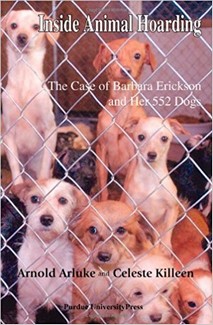
Inside Animal Hoarding: The Case of Barbara Erickson and Her 552 Dogs, is a non-fiction story which profiles one of the largest and most intriguing cases of animal hoarding in recent history. Celeste Killeen's investigation pries open the door to Barbara Erickson's hidden and closely guarded life, offering an in-depth view of animal hoarding. Dr. Arnold Arluke's discussion follows the Erickson story with current research on animal hoarding and how it ties into the Erickson case. This integration of investigative journalism and scholarship offers a fresh approach with appeal to a broad audience of readers, those new to learning about the phenomenon, and those with first-hand experience in the animal welfare field.
Inside Animal Hoarding: The Story of Barbara Erickson and Her 552 Dogs, published by Purdue University Press, profiles one of the largest and most intriguing cases of animal hoarding in recent history. Celeste Killeen's investigation pries open the door to Barbara Erickson's hidden and closely guarded life, offering an in-depth view of animal hoarding. The chaos and torment discovered by local officials who had responded to the ramshackle farmhouse in eastern Oregon was described as otherworldly, unbelievable. But, it was only the sad ending to a lifelong story of betrayal, abuse, and abandonment. This comprehensive look at how animal hoarding developed in one woman’s life offers the rich detail and context so important in understanding how to recognize, respond to, and maybe even prevent this compulsive behavior.
Dr. Arnold Arluke's discussion follows the Erickson story with current research on animal hoarding and how it ties into the Erickson case. Drawing from his background in sociology and extensive study of the human animal relationship, Arluke offers further insight about animal hoarders, how they see themselves, how society deals with them, and why people find them so perplexing.
This integration of investigative journalism and scholarship offers a fresh approach with appeal to a broad audience of readers, those new to learning about the phenomenon, and those with first-hand experience in the animal welfare field.
Excerpt
I froze as the stagnant smell seeped into my car. I slid the seat back for legroom and pulled on a brand new pair of knee-high, rubber boots. I grabbed my camera and opened the car door, and stepped out. A few feet away, the front gate opened to a makeshift walkway of empty dog food bags that had been trampled into the mud. Otherwise, the yard was a wasteland kneaded by hundreds of tiny paws, each imprint forming a murky, orange puddle. I hopscotched across the empty bags toward a once-white, clapboard house, holding my breath against the pervasive, acrid smell. As I drew closer, hundreds of muddy paw prints became visible, tracking up the sides of the house to hip level. Higher yet, the roof sagged and dirty brown cobwebs drooped from the eaves.
At the end of the walkway, I jumped from the last dog food bag onto the bottom plank of the steps, clomped up to the porch and tugged at the screen door. It was boarded and locked.
“I never had a key since they moved in.”
The voice belonged to the landlord, Verda Palmer. She’d come up the steps behind me as I peered through one of the sediment-encrusted windows. “The back door’s jammed shut, but they broke a window on the right side of the house,” she said, pulling on the door handle. “You can get in there if you want, but we’ll have to go around.”
I stepped off the porch, following Verda as we slogged through the mixture of mud and feces to a pathway carved through the dense pile of rubble abutting the house. We tromped along, using surface roots as stepping stones. Verda poked at the debris with her stick. “There’s my fan I let them borrow last year,” she mumbled. She stopped to lift a piece of dank carpet and probed the plastic beneath. “This used to be a nice place until the Ericksons come along,” she added. The tiny house—Verda’s rental—was in Harper, Oregon, a place I had never before visited, even though it was only a couple of hours from my Boise home.
“When was that?” I asked.
Verda sighed. “About five years ago,” she said. “After the old tenants moved out, I was cleaning the house with my friend, Helen Dawson, when Barbara stopped by and asked if she could rent it. She looked nice and pleasant, and she had a wad of money in her hand. She said she would plant a garden and take good care of the house and yard. She offered me four-fifty a month, more than I ever got for the place before.”
I paused to snap a picture of the house. “Did she tell you about the dogs?”
Verda shook her head. “Barbara said they had three dogs, her babies, but they would stay outside. So, I said okay. Come to find out, they had thirty dogs.”
I made my way to the rear of the house, while Verda rummaged through the trash. In the back yard, the grounds were divided into pens using plywood shelters, lean-tos, and tarps strung across the corners of the fence. Large plastic bowls, empty and gnawed, were scattered about. A scrawny cat lay in the path, lifeless in a glove of mud. I stepped over it and went on until a pair of overturned, cracked wading pools forced me off the path and into an obstacle course of broken appliances: refrigerators, stoves, washing machines, and dryers—all smeared with paw prints. Mattresses strewn about the yard absorbed the sewage like giant sponges. Enormous dunghills of faded dog food bags filled with feces blotted the area. One pile bore the decomposing bodies of seven dogs, and more animal remains spilled from a bag split open by the rain.
At the far corner of the house, I spotted the broken window Verda had described. It was covered with damp cardboard—easy entry if I took out the shards of glass. After knocking away a few jagged pieces of glass with the rakehead, I peeked inside and was hit with a malodorous blast of fecal ammonia. I straddled the window sill, and eased into the very dark, ice-cold house. With little aim, I snapped digital images with my camera, images of a table, the floor, a small metal chair facing a television, a card table piled high with homemade cages. The floor, once crowded with dogs, was covered with brown paw prints and trampled-on waste. Garlands of cobwebs hung from the ceilings and doorways. I also took several pictures of the kitchen counter—a crowded display of empty food containers, rotting produce, dirty ashtrays, air fresheners, crumpled cigarette packages, and dog-grooming products, all sprinkled with mouse droppings.
A hallway, gated by an excrement-slathered sheet of plywood, led to the back rooms of the house. Halfway down the narrow hall, I found a bathroom where cans of hair spray, bottles of shampoo, and air fresheners were scattered across the gold-speckled Formica counter, along with an uncapped tube of toothpaste and an overturned can of Comet. Two, cracked-and-smudged mirrors hung on a wall painted candy cane pink. A small shelf above the sink held an ironically tidy display of shaving soap and cologne along with several, small jars of face cream and an economy-sized jug of Drano. Across the room, a shredded shower curtain hung from a crooked and bent rod. The filthy tub was filled with clutter, and a dry toilet, ringed in rust, sat in the corner.
In one bedroom, a lacy cobweb draped the window, trailing across the wall to an empty bed frame. In the next room, I found another bed frame and two dressers, one cluttered with dirty clothes and newspapers, along with an orange gasoline can and a pellet gun, the other a sort of dressing table topped by a mirror smeared with paw prints and, oddly, a pristine, blue cruet that seemed out of place in this house. Dog food dishes were scattered across the floor, all empty except one that held the partial remains of a Chihuahua.
I continued through the house, snapping pictures until I reached the back door. I grabbed the dented doorknob and jerked. Verda was right. The door was jammed tightly shut. I pulled as hard as I could. Wood splintered and the door burst open. I stepped onto the porch and looked around. Verda had made it to the back yard and was rummaging through the debris.
“There’s a dead dog on the comforter over there.” She smiled wryly. “I unrolled it ’cause I thought it might be Bob.” Barbara’s husband.
Professional Reviews
Dr. Myrna Milani
I’d written a review of another mass media bond-book and had fully intended to post it this month when I received a copy of Inside Animal Hoarding: The Case of Barbara Erickson and Her 552 Dogs by Arnold Arluke and Celeste Killeen (Purdue University Press, 2009).For me, the subject matter was so pertinent and well-presented it seemed to me that every self-proclaimed animal-lover, everyone involved in shelter or rescue work in any capacity, every veterinarian, vet tech, behaviorist, and trainer, and indeed anyone engaged in animal-related activities of any kind should read this book.
But why? What makes this book so different from all the other bond-related books out there?
The most obvious—and refreshing—difference is the form. In a previous book review I wrote about the shift in publishing from books written from the inside, i.e., by those with firsthand knowledge of a subject, to those written from the outside, i.e. by professional journalists. Inside Animal Hoarding: The Case of Barbara Erickson and Her 552 Dogs provides readers with a rare opportunity to compare and contrast these different ways of addressing the same subject and to learn from both.
The book is divided into two parts. In the first part, journalist Celeste Killeen describes her efforts to understand how someone who claimed to love dogs so much wound up keeping so many under such deplorable conditions. What intrigued Killeen from the first day she saw and heard the news reports describing the dramatic removal of the dogs from their wretched surroundings was that, in spite of all the opinions offered by experts—law enforcement officers, veterinarians, shelter workers—apparently none of them had actually talked to Barbara Erickson. How could she or anyone could hope to understand what compelled this pathetic old woman to keep more animals than she and her husband could possibly care for properly based on such secondhand opinions? Unlike a lot of people who were intimately or tangentially involved in the case, Celeste Killeen was more interested in why it happened than the consequences. And because I’m a firm believer that the only chance we have to prevent or eliminate any negative behavior is to understand why it happened in the first place, I quickly became immersed in her narrative.
Instead of interviewing Ms Erickson using a list of questions that reflected what was import to her as a journalist, Killeen listened to Erickson, which was not always an easy task. And rather than perceiving the obviously false claims the woman made as evidence that she was mentally deranged and therefore nothing she said had merit, Killeen recorded their conversations and took copious notes. Then she interviewed those who had known Barbara Erickson, her husband and others who interacted with the couple and/or the case, made more notes, and asked more questions. And like all good reporters, she checked any facts using multiple sources.
After she did all that, Killeen pieced together a narrative of events based on what she learned during this process. Unlike some journalistic offerings, she does not present her version as the truth. Quite the contrary. She fully acknowledges from her own response to the event that hoarding is a subject that elicits strong emotions. And as most of us know, there’s no shortage of people who erroneously equate the strength of their emotions and the personal opinions that accompany these with truth. Fortunately for the reader, Killeen is not one of them.
Had the book ended there, it would have joined that increasing population of books written by journalists that presume to represent the truth or to which naive readers assign that power. But Inside Animal Hoarding does not follow that possibly more entertaining but, to me, ultimately more frustrating and irritating path. Instead in Part Two of the book Arnold Arluke, Professor of Sociology and Anthropology at Northeastern University and author of many books and articles on human-animal interactions, discusses the case of Barbara Erickson and her 552 dogs in terms of what is actually known about hoarding.
Arluke begins by providing an overview of hoarders that, like closer examination of most animal-related phenomena, reveals some similarities to the common stereotype but challenges some aspects of it, too. For example, there are different kinds of hoarders and different degrees of hoarding within them. The thought that some rescuers fall into this category may not be surprising to some, but may be quite disconcerting to others.
Using news reports, Arluke then describes how the media perpetuates the long-standing view of hoarding as eccentric behavior. How this is defined and what emotional spin is put on it may be more of a function of human bias than objective reporting, with hoarders portrayed as cruel, “loving too much,” and everything between. Opinions of humane society and other animal-care professionals as well as members of the law enforcement community regarding what motivates a hoarder were also presented in the media as if these were based on known facts. Given the endless repetition of such reports, it’s no wonder that the public comes to accept these opinions as true.
The reality is that we know precious little about what causes some people to amass large numbers of animals. In fact, after reading Arluke’s discussion of possible theories and contributing factors, it strikes me that while hoarding is often viewed in terms of numbers, it’s more a question of that person’s fundamental view of animals. That is, it might be possible for us to be hoarders of a socially acceptable number of pets if the symbolic meaning we placed on those animals blocked our ability to see them as beings of a different species with their own unique physical and behavioral needs that it was our responsibility to fulfill. In that case, it would be the willingness to cling to any belief about them and/or our relationship to them that blinds us to their needs that would be the real problem.
Arluke closes with discussion of why animal hoarding cases so fascinate us, turning once again to the role the media plays in this and our views of hoarding. His analysis of what journalists emphasize in these cases probably will surprise many. Those who have read or watched such reports may have realized just how biased these accounts are just as I did. Pondering this was a real eye-opener for me and led to some much more personal and deeper thoughts—which Arluke points out could be another reason why these reports so intrigue us. True, it could be that we’re drawn to descriptions of hoarders because these people are so alien to our own beliefs about the humans and animals with whom we live in our communities. But it could also be that we’re attracted to them because, on some level, we all acknowledge that we’re more alike than different.
Animal Sheltering Magazine, Humane Society of the United States
Looking at a Hoarder
New book provides insights into the problem of animal collecting
Over the past decade, animal hoarding cases have increasingly made the news—but that may not mean there are more hoarders now than there were 20 years ago. It may simply mean that people have become more aware of hoarding as a community problem, one affecting vulnerable animals and vulnerable people.
That’s a relatively recent viewpoint. The cultural understanding of hoarding has grown, and more communities now realize that intervention in an animal hoarding situation will often require the expertise of multiple agencies and organizations.
The latest contribution to the growing perspective on hoarding is Inside Animal Hoarding: The Story of Barbara Erickson and Her 552 Dogs. The two-part narrative—the first written by a social worker, reporting on a particular Oregon hoarding case, the second by a sociologist who provides a broader perspective on that case and the general issue—is a compelling read.
Celeste Killeen, the social worker, tells the story of Barbara Erickson, whose farmhouse was raided in 2003. “Based on preliminary investigation and rumors, the deputies expected to find fifty to one hundred dogs living on the tiny farm. Instead…the officers found over five hundred diseased and emaciated dogs suffering under conditions that could only be described as otherworldly,” Killeen writes.
Killeen uses some unusual tactics to tell Erickson’s tale. While much of her part of the book is straight reporting based on her experiences researching the case and her interviews with the Ericksons, their neighbors, and local authorities, at times Killeen also draws on interviews reconstruct incidents and conversations from Erickson’s childhood. These scenes provide terrific narrative tension and insight, but may make readers wonder about the accuracy of the events they depict, many of which took place decades prior to the 2003 raid.
Sociologist Arnold Arluke draws on previous research into hoarding to expound on Killeen’s account of the Erickson case, providing a broader scope and linking the specifics of Erickson’s experience to evolving cultural understanding of hoarding and a variety of theories on causes, prevention, and treatment.
Puffy strays and something happens to make him decide he will never run away again. Judged "Outstanding" at the 2013 Writers Digest SPB Awards. Named among the best in family-friendly media, products and services 2019 by the Mom’s Choice Awards®.