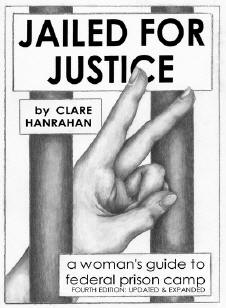
How to navigate an abusive and punitive system and keep your purpose and your Written by and for women who may consider the risk of prison for acts of peaceful protest and for those who stand in support in our movements for change. Of practical help to anyone facing time with the Bureau of Prisons.
Updated & Expanded 4th edition. Written from my six month experience as Inmate 90285-020 at Alderson Federal Prison. Offers an insider’s view of the daily routines, work assignments, living quarters, medical facilities, chain of command and provides insight into the lives of some of America’s imprisoned women—who are the fastest growing and least violent of the 2.2 million U. S. prisoners.
The 4th edition includes insider's views of other women's prison camps and an extensive resource guide and check list for preparing for prison.
Excerpt
Processing Into the Prison World
Take a deep breath as you step over the threshold into the prison world. Remember who you are and why you are there, and don’t ever forget that you are being held in the hearts and prayers of many people. Move through the experience moment by moment. Be prepared for a severe limitation of choice, significant reduction of personal status, loss of some civil rights, and a denigrating and demeaning attitude from your keepers. It is part of a systematic effort to maintain power and control.”
A minimum security prison for women operates with much of the destructive dynamic present in abusive family relationships. Control is maintained through isolation and the threat of more severe reprisal for continued resistance or defiance. Self-esteem is undermined with insidious intent. Heed the good advice of one of the elder women I encountered in my first week of prison, “Speak little, smile often, and live in the precious present.”
Professional Reviews
Resource for Radicals
By Brian Burch, Editor, Resources for Radicals, Toronto, Canada.
The United States is a country where you can be imprisoned for handing out leaflets, crossing an aritficial boundary on public lands or speaking out for peace and justice. Among the many people who have been jailed in the United States in recent times is Clare Hanrahan, imprisoned for her actions in opposing the School of the Americas (recently renamed the Western Hemisphere Institute for Security Cooperation), a place where Latin American police and military are trained by the U.S. military to put down dissent. Hanrahan was sentenced to six months in a U.S. federal prison camp. She did not use violence or force against property. She did nothing more extreme than cross an arbitrary line that symbolically quarantined a place of state-sponsored training in violence from those who advocate freedom from violence and oppression.
This book uses Hanrahan's experiences in the women's Federal Prison Camp at Alderson, WV as the basis for some practical suggestions and information for U.S. women facing similar sentences. This book deals with everything from strip searches to meals to relationships with other inmates to pre-release planning. The advice is put forward in a straightforward manner, openly dealing with some difficult areas without making her experience seem overwhelming. Much of the story that is told in this work is the story of someone trying to maintain dignity and power in a situation where those are rare commodities. Knowing the rules and expectations before going into custody certainly helps in this struggle.
There are realities in Hanrahan's experience that cut across the prison experience--any woman in a federal prison camp would experience them. They range from dietary concerns to lack of consistent, quality medical care. The ongoing threat of sexual harassment from male guards is a reality the broader community should be called upon to help address. There is specific advice for activists, particularly dealing with supporters. This includes visits, correspondence and after release.
With growing criminalization of nonviolent dissent, more and more people will end up in prison. Activists, and specifically U.S. women activists, should read this book. It is a encouragement to live out an effective life of resistance. It will help readers in the activist communities to stay strong in resistance to war and injustice, even in the face of growing state opposition to compassion.
An eye-opening look into the world of human trafficking. Pilar thought she was destined to die until she met Becky. A fairy tale ending to this story with the help of Tess is called Justice. It was time for someone to hit back because the courts in S