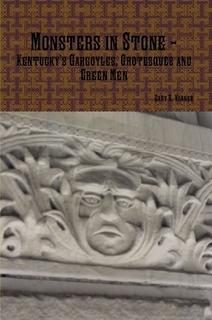
An examination of the many curious architectural features on Kentucky's 19th century buildings from Louisville, to Lexington and Richmond to Lancaster and Covington. Includes over 40 photographs and illustrations, index and bibliography. 100 pgs.
Kentucky, one of four Commonwealth states, became the 15th state of the Union in 1792. It was the birthplace of both president’s Abraham Lincoln and Jefferson Davis, was explored by Daniel Boone, saw numerous battles during both the Revolution and Civil War and is mostly known for its bourbon,moonshine, tobacco and horses. It is also home to hundreds of buildings, some on the National Register, which are adorned with thousands of gargoyles, grotesques and Green Men.
Why or how these images came to be part of Kentucky’s architecture, or for that matter the architecture of most of 19th century America, is subject for discussion. Perhaps they were a decorative fad at one time or functioned as metaphors for a troubled time. Regardless of their origins, they existed in the dawn of time and remain in man's universal unconsciousness—occasionally rising over time through the works of artisans and masons.
This book is a photo story of these incredible carvings and details the history and meaning of the archetypal images gracing the 18th and 19th century buildings of the Blue Grass state.
Available in Kindle for $3.99 and paperback for $9.95.
The Kentucky Tourism Cabinet has also made this book available at the Kentucky Artisan Center in Berea, Kentucky.
Professional Reviews
Kentucky Monthly Reviews Monsters in Stone
Architectural Bogeymen
A place as serene and peaceful as Kentucky could not possibly be home to scary monsters and gargoyles--could it?
It seems that the Commonwealth has lots of these hidden and not-so-hidden oddities within the architectural gems across the state. These scary lizard-men, bug-eyed gargoyles and even demon-like creatures are perched high atop some of Kentucky's most sacred buildings.
Author Gary R. Varner, an independent folklorist from Berea, has been studying these symbols and has compiled more than 40 photos and illustrations to teach the reader about them-what they look like, where to find them and, perhaps most interestingly, why they are there.
Easy to read and interesting to think about, this book will ensure you'll never again walk past an 18th-century cathedral without looking up to see if there are any frightening faces glaring down at you.