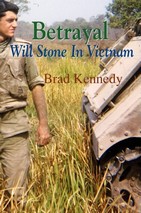
Betrayal tells the story of Will Stone in another time, another place, another war. Forty years ago, like today, Americans were called upon to choose whether the nation would set aside its racial prejudices and move forward to a more integrated society. It was the time of the Cold War when Americans had, as they have in today’s “global war on terror,” been led by fear to fight in foreign lands, in this case fear of a monolithic movement to world communist domination led by the Soviet Union.
The Cold War got hot in many spots around the world, but none was more deadly for American troops than Vietnam. For America, that war officially began in August 1964 with little public concern and ended in March 1973 with intense public criticism and over 58,000 American battle fatalities.
Early in the story, Will Stone’s life changes when he witnesses racial injustice firsthand. It determines him, as a matter of principle, to take his turn serving in the Army, including volunteering to go to Vietnam. It also opens his eyes to the world as it is, not as he would have it.
Will’s experiences in Vietnam raise questions of American foreign policy and military strategy, but they go beyond that to the human level: What price must a man pay to remain moral? Are we all brothers? What is worth dying for?
At times, this novel contains graphic and disturbing scenes and uses raw language, including racial epithets. Don’t read it unless you want to know what war is really like. Just as good words can be used for bad purposes, bad words can be used for good. Literary fiction may rely on imaginary or composite characters and contrived situations, but its aim is to reveal truth, to expose and question the human condition.
Will Stone was changed by his experiences in Vietnam. Readers should expect nothing less for themselves.