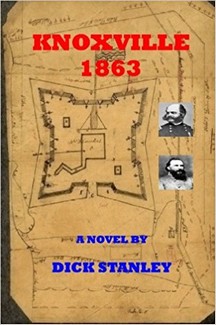
Gettysburg held. Vicksburg has fallen. Now Rebel flags ring Knoxville in East Tennessee. Can the ragged and starving Mississippi and Georgia veterans of Gettysburg climb the icy walls of Fort Sanders, to wrench the railroad hub away from the occupying Union army? Inside are New York troops who have never won a battle, led by a young lieutenant. In Washington, President Lincoln awaits the answer, one more key to saving the Union, freeing the slaves and victory in the Civil War.
Lovers of historical fiction will find much to ponder in the 1863 Confederate siege of Knoxville, Tennessee. President Lincoln considered Union victory there a key to winning the Civil War. The siege and its battle of Fort Sanders involved some of the war's most famous personalities and units. They are brought to life from available histories, diaries and memoirs: Gen. James Longstreet (Gen. Lee's "Warhorse") and his First Corps of the Army of Northern Virginia---including Barksdale's Mississippi Brigade, and Parker's Boy Battery of the Sixth Virginia Artillery. Gen. Ambrose Burnside, whose Ninth Corps hopes rested with Lt. Samuel Benjamin's Second U.S. Artillery, and the Seventy-Ninth New York Cameron Highlanders. At stake: Control of the Smoky Mountains railroad hub which produced rifles, ammunition, and clothing for the Confederate armies. Could the Union keep it when the ragged and starving Rebels outnumbered them ten to one?
Knoxville 1863, as much history as fiction, is available at Smashwords in multiple e-book formats and Kindle at Amazon.
Excerpt
1. The Sector Without Fire
Saturday, Nov. 28, 1863, Noon
Clayton’s old bay, Warrior, was skittish again, a riding horse so disliking pulling a carriage that, from time to time, he would shake his head, up and down, and from side to side, trying to free himself from the confines of the harness.
But we were close enough to the fort now that I could get down and carry the boxes the last few yards if I had to.
“Ma’am, you shouldna be out here,” said a young soldier rushing up to meet us. “It’s too dangerous. You’ll have to turn back.”
He had a pleasant Scotch burr to his voice and the two stripes of a corporal, in light blue on his dark blue woolen overcoat. The color marked him as infantry, as did the brass bugle clipped to his cap. Despite the coat, his teeth were chattering.
The corporal pulled Warrior’s head down, and the old horse instantly gentled under a man’s familiar control. He might have been acting up because he had smelt the sour odor of gunpowder on all sides as we proceeded through the interior of the defensive lines. The corporal began to walk the bay and the carriage around to turn me back to town.
“I’m here to see First Lieutenant Samuel Nicoll Benjamin,” I said, as forcefully as I could, pushing my long veil back away from my face. “I’ve brought him a good dinner.”
That stopped the soldier for a moment, and I got down quickly and picked up the two paper boxes from the seat. I tried to hold them in one arm so I could lift my poor old skirts out of the mud. Mercifully, the sleet that had been falling all morning had stopped.
Seeing that he was now going to have to get me back into the carriage before he could turn me back to town, the corporal wisely gave up. He tied Warrior to a splintered stump in the midst of a big patch of dirty snow, and came around to take the boxes from me.
“Much obliged,” I said.
“Is the lieutenant expecting you ma’am?”
I didn’t want to tell the truth, which was that the lieutenant was not expecting me, and give the corporal another reason to turn me away, but I didn’t want to lie, so I didn’t reply.
He was a respectful young man, as you might imagine a soldier to be when confronted by a determined (but I hoped still charming) young widow in full mourning black, so he didn’t press for an answer.
I wasn’t supposed to be out and about but staying shut up at home, as was proper. But that was not for me. A few months of stay-at-home were plenty for me.
Shanghai Escapist grabs the faint-of-heart right from the get-go and serves up an ultimatum: What would you do if caught in the same circumstances? From the opening scene, the reader is tossed into the maze of daily intrigue as it existed in 1960s-70
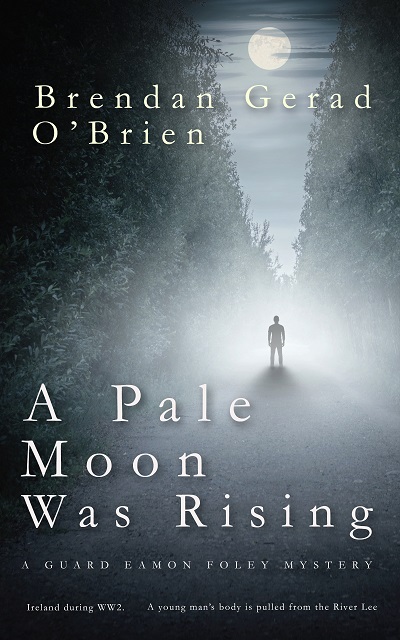
Ireland 1944.. A young man’s body is pulled from the River Lee. He’s wearing a distinctive silver ring that belonged to Paudy Daly, the eldest son of the notorious Mixer Daly. Why?