The American Revolution they never taught you in school. This is the story of Michael Fields’ path from the south Jersey haven of Smuggler’s Wood to the defense of Fort Lee and the destruction of Lenapihoking. Follow his rise to the command of a Privateer fleet in the Caribbean and on to his influence over the outcome of the Constitutional Congress in Philadelphia. Through these nexus of history, a story of courage and the love of a man for his family, his friends and his country, weaves a tale of the iron that brought about the birth of the United States.
Synopsis: This is the story of Michael Fields, a young merchant in colonial New Jersey, who operates on the Passaic and Hackensack river valleys with his friend Calik, an Aquackanunk Indian. Their sail boat, named PASSAIC FALCON, enables them to carry goods from New York City to the resorts on Barbadoes Neck and later to smuggle messages and weapons to the patriot militia preparing for war.
When his smuggling is uncovered, Michael is forced to flee to the South Jersey haven of Smuggler’s Wood where he learns the Artilleryman’s trade from a one armed German named Count Rhordon. His skill is brought to the attention of Alexander Hamilton and wins him a commission in the artillery battery defending the Hudson River.
After the battle of Fort Lee, he returns to Smuggler's Wood and leads the local militia standing against a British punitive raid. As a reward for his heroic actions he is awarded the command of a frigate and presented with Letters of Marque and Reprisal.
Michael revives the name PASSAIC FALCON and sails to the Caribbean with his new wife, Stella, and their daughter. Their Privateer fleet attacks the British Naval forces on the high seas, frees slaves on Jamacia, sways the Siege of Pensacola and finally fights their way out of the disastrous Battle of the Saints. Beaten, battered and torn, he remains in the Caribbean with his family, living in their castle overlooking the bay at Port-a-Petrie on the island of Guadeloupe.The Treaty of Paris ends the war and his letters of Marque and Reprisal expire.He returns to Smuggler's Wood with his family, his fleet and his wealth.
The wages of war have been a tax upon his body, and with his health failing, Michael dedicates himself to aid the delegates from New Jersey to the Constitutional Convention. His friend Calik has been designated a delegate to the convention from the Iroquois Confederation, their reunion is heart felt but failed as the Indians retire from the convention and flee west.
The author is a native of New Jersey and a world wide traveler. He holds 7 copyrights for novels and short stories.
Excerpt
Today, there were two officers and a skinny man on tired looking horses, leading a squad of 20 soldiers on foot, followed by four wagons with two drivers on each. As the column rumbled past, the boys fell in line behind and followed them to the Kingsland green. Frederick and Eric were already there, anxiously searching for their friends. They were still out of breath from the run up the hill from the tallow vats where they had been working and had reserved the best spots on the green for themselves and their friends. The boys settled in together at the edge of the green to watch the performance. At the crisp order from the Sergeant, the troops halted in front of the tavern. Michael looked at his friends, their eyes were wide and giddy with anticipation. They waited for the drums to beat out a cadence and the soldiers to perform their drill. But this time it didn’t come.
The soldiers were different than they had been the day the heroes came home. This time their uniforms were dirty and sweaty. They smelled of weeks in the field without washing and had a mean, tough look about them. The officer in charge opened a scroll, a royal proclamation and, from his saddle, read to the gathering people. The boys couldn’t hear all the words but some floated over the crowd to them and a cold hand gripped Michael’s stomach as he heard; “Unpaid taxes”... “smuggling”... “treasonous books.” The words rang in his ears. Everyone bought untaxed goods! His thoughts wandered and then, as if he had been struck by Pastor McGlocklin for falling asleep at Sunday service, he remembered the books at home his father had warned were “treasonous.”
The formation broke on order and the troops began entering the homes and shops around the Green. Within minutes, property had been seized from almost every building. The shopkeepers cried out against the tax levies and fines they were ordered, at bayonet point, to pay. As each house was entered, the crowd on the Green grew more angry.
The officer in charge of the detachment addressed the people, shouting over the murmurs of the crowd, “These searches are being done to find smuggled furs and rum, untaxed lead, glass, paper and tea. We are here to collect the King’s taxes needed to protect you from the marauding savages of the nearby wilderness.” The grumbling grew louder and complaints against the searches were called out from the anonymity of the crowd.
“We can protect ourselves,” came a call.
“You’re just stealing our property,” came another. The word “looter” was chanted for several minutes while the mounted Officers road back and forth in front of the gathering crowd.
Michael separated himself from his friends and whispered, “I gotta go home.”
“Us too,” whispered James as his brother nodded in assent. Frederick and Wilhelm nodded their heads in unison and the five boys slipped into the cover of the maple grove. As soon as they were out of sight, they broke into a run and scattered toward their homes.
-*-
Edward turned from the glowing inferno of the forge where he and Thompson were working over a replacement cog wheel for the pump. He held up the new casting for inspection and Thompson grunted his satisfaction. Edward’s eyes refocused to the road leading to the forge where three armed soldiers were walking into the yard. Without a word, they began rooting through the Blacksmith’s shop, inspecting his raw materials, finished goods and supplies. Edward and Thompson grew concerned as the soldiers, with exclamations of disgust at finding nothing of value, turned their attention on the only two men in the shed. They advance slowly, cautiously, their muskets held across their bodies, bayonets shining in the sun. A tall skinny civilian, who had kept in the background as the soldiers routed through the shed, slid between them and advanced on Edward and the Blacksmith. He scribbled on a piece of paper and presented it to Thompson. “What in blue blazes is this,” he bellowed? He crumbled the paper in his hand and threw it into the fire. “It is a levy, a tax, on your supply of lead,” responded the skinny man, “and that,” he said gesturing to the charred note, “can earn you a year in jail.” Edward watched the soldiers as they began moving to the left and right of the big man, readying their muskets. “You will pay the tax or be arrested,” said the civilian. Their expressions seemed to vary between boredom and expectancy. Or maybe it was a cold stare of lifelessness, like a fish brought on board dead. Or maybe they were just spoiling for a fight, something to divert their boring routine. Whatever it was, he didn’t like the look he saw on their faces. The soldier on the right caught his eye and held it! Edward braced himself, tried to look away but when his eye returned, the soldier was still waiting to catch his eye. He knew he was being measured, judged to see if he were the type to cause trouble. The soldier made a small noise with his lips and nodded his head slightly in Edward’s direction. The second soldier lowered his musket and pointed it at him and then swung it back over and leveled it on Thompson’s chest. The skinny civilian piped up in a whining and insinuating voice, “You will pay the levy or be arrested.”
Edward backed a step away from the soldiers, scanning the room for something to put in his hand. He saw an iron rod and estimated it weighed 15 kilos. It would be heavy but it could be used as a weapon. He took a step to the side, moving toward the rod and put his hand on the table where it lay. The sound of the soldiers’ musket being cocked focused Edwards attention on the muzzle of the weapon pointing at him from less than ten feet. In a voice barely above a whisper, the soldier said directly to him, “Stand as you are.” There was no movement in the shed. Edward’s chest labored for breath. Beads of sweat froze on his forehead and his stomach twisted into a knot. He spoke again in that same lifeless tone, “You don’t want to get hurt now do you?” The skinny man spoke again, “This can be easy or very distasteful.”
The Blacksmith looked around him and slowly moved to the place where his cash money was kept. In a loud voice and a gesture of compliance he said, “Now boys, no need to get excited here. I have enough cash on hand to pay the tax.” Keeping an eye on the soldiers, he carefully reached up to an overhead storage and brought down a small wooden box, opened it and removed the required amount from his till. He held the coins in his hand, his eyes daring the soldiers to take it. The skinny man stepped forward, snatched them away and scurried out of the shed. The soldiers, still holding their muskets at the ready, backed out of the forge and departed the blacksmith’s yard.
“We deserve more from the Crown than tax collectors,” grumbled Thompson. He spat into the fire and turned to Edward, “They’re headed for your house next, I’ll wager. I think you should get there first. Send your family back here, they won’t return to where they have already inspected. I’ll have my boy alert the families near the orchards.”
“Yes,” Edward nodded his head, his jaw tightened and a sharp line of muscle stretched down his neck. His response was taught and angry, “I’ll send Michael down to warn the river families.” He nodded to his friend and turned to the path through the forest leading to his house and set off at a quick trot. It would be easy to beat the soldiers there, remove his family’s treasures and hide the books he knew would cause him trouble if the King’s agents found them.
Edward approached his house and saw the distaff on the porch abandoned. His wife and daughter had been making a quilt for one the guests at the Kingsland Manor house and seeing the fabric lying unattended made his heart pump with fear. He called out, “Elizabeth! Anne! Michael!” Anne came out of the north yard driving several piglets into the woods. “Father,” she called, “Michael told us soldiers are stealing people’s property. They can’t take our things, can they?”
Just as he was about to answer, Michael came out of the house carrying a large, heavy looking box. He looked at his father, who knowing what was in it, nodded to him and entered the house calling again for his wife. Elizabeth met him inside with a grim look on her face and called encouragement to Anne who was driving half their chickens into the forest. Michael waited as his father hugged his mother and sister and sent them fleeing through the forest to the safety of the blacksmith’s home. He helped Michael carry the box containing most of the books that had been in the house to the edge of the forest path leading to the river.
“Michael,” he said. “I want you to run down to the river families and tell them what is going on here. Tell them soldiers are looting our homes!”
Edward watched his son vanish into the forest and returned to the house. Above the fireplace, mounted on the wall, hung a nearly new, Pennsylvania Rifle, powder horn and shot bag. Edward took them down and carefully checked the load and primed the pan with fine gunpowder. He would not be caught again without a weapon! With only a brief thought of his wife and family, he strode out of the house and started toward the Kingsland Green where he knew the main body of soldiers would be.
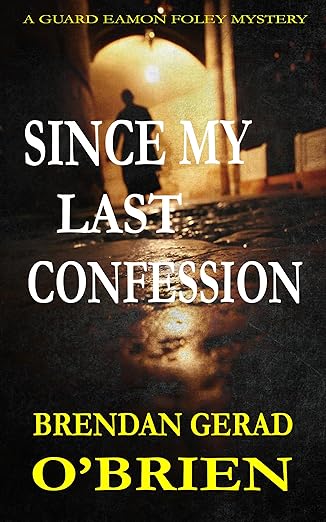
Tralee, Ireland. September 1948.
An arrogant, and highly agitated, priest arrives home after 40 years.
Days later he's dead. Suicide? Or did his past catch up with him?
Dublin 1941. A brutal murder. Mistaken identity. And barman Eamon Foley is running for his life.
Nine months later Foley is in a crowded pub, and his brother-in-law is shot dead.