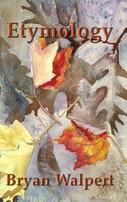
A debut collection of poetry that reaches to the heart through the head--an interest in science, in history and above all in language.
Etymology is a dazzling first collection from an award winning poet. Bryan Walpert uses language with the dexterity of a verbal magician, pushing at the boundaries of perception and meaning to take risks, tell stories or smuggle in jokes. Moving deftly between touching, but never sentimental, observations of human relationships and luminous accounts of objects, natural phenomena that take on meaning, Etymology is an intelligent, innovative lyric inquiry into discourse and sense.
“Like sweeping dusty slivers of glass and mirror with one’s fingertips, in these carefully formed poems, we see through and see opaquely away and toward ourselves. There’s science here. There’s art and history and language. But Walpert weighs his clear-sighted intellect against a sense of the head’s own intimate futility: That it knows whatever it constructs, it is done and undone in praise to a confoundingly strange and vulnerable heart.”
James Hoch
“In Etymology Bryan Walpert communicates with graceful humor and sharp intelligence his fascination with the lineage, history, and origins of words. ...a brilliant, playful and heartfelt calculus demonstrating that metaphor is poetry’s etymology and as such he reminds us that the power of language is rooted in the contrarities of human speech.”
Michael Collier
Professional Reviews
Etymology
Etymology
By Bryan Walpert
Review by Keith Nunes
Erudite (learned; showing great learning, says the Oxford) comes to mind when reading Bryan Walpert’s debut collection of poems Etymology. Erudite with gusto, though – no dry explanations of the great meanings of words and things in our universe but rather, a genuinely poetic look at life
through a microscope. What Walpert does for the reader is expand the mind while consoling it. We are taken on a trip into the inner reaches of words and when there, we are entertained with lines such as:
“Shade / is a cold cloth on the head ...”
“... to the shallows between your lips”
“… as dawn slips the mooring of dark”
“When I touched you, / it wasn’t ownership”
“… as my mop drank the day / from the tiles.”
"Everyone… needs a room in which
to pass the time, a square
of carpet on which to sleep
then wake in a patch of sun"
Then there’s a wonderful image created in ‘Waterside Pavilion Without Rowboat’:
There is a rowboat
floating by that gazebo.
Or it was there,
yesterday. Look harder.
Paint as if you remember.
Paint as if you have drifted
up to yesterday, surprising it.
In ‘Ode to My Father’s 14th Month in Retirement’ he finds new ways to couch phrases that have long been trodden on:
Cherry trees warm the blossoms
that held their breaths through
winter …
…the azaleas, planted
twenty years gone by
with a younger man’s back…
Away from the delving there are poems with simple lyrical beauty as in ‘Twin Lakes’, which has two moons and a boy growing for all to see:
When I turn my head the full moon is cut clean
by the peak, then rises faster than I knew
possible through the clouds. Its twin in the lake
floats at the far edge, at the center. A fish jumps.
Then he completes the circle and offers an inspiring view of what he sees: “The brightest moon/ of
my life is wading, like a child, to shore.”
I particularly enjoyed ‘Operation, October’, in which the writer sees himself as a spitting image of his
father but untouched in comparison to his father’s skin which is under the knife of a surgeon; and ‘The Scientist, My Wife, Explains Satellite Imagery’ which manages to interweave some fascinating facts with a love story that raises the question of sex in an inventive way.
Although this his first book of poems, Walpert is well established as a poet and academic. He won the 2007 New Zealand Poetry Society International Poetry Competition, is poetry editor of Bravado magazine, which comes out of the Bay of Plenty, and is a winner of a National Tertiary Teaching
Excellence Award for teaching creative writing in New Zealand. He is a senior lecturer in the School of nglish and Media Studies at Massey University in Palmerston North.
This background all makes perfect sense when you read his works, which stand as an intellectual and imaginative exploration of human relationships and poetry itself. Never overly emotional, Bryan is actually restrained and amusing and can turn a pretty mean metaphor which makes for a colourfuland enlightening read.
from A Fine Line, the bimonthly magazine of the New Zealand Poetry
Society, edited by Laurice Gilbert.
Etymology
Mary McCallum
O Audacious Book
denim sends a signal similar to azaleas
hundreds of miles from here, and a blue
skirt from the sky looks red
These lines from "The Scientist, My Wife, Explains Satellite Imagery" by Bryan Walpert in his first collection of poetry Etymology.
I heard him read on Thursday night at the Writers Read series Massey University hosts at the Wellington campus, and at the drinks afterwards (a nice touch at this event) I bought the book. As a creative writing tutor at the uni, I work with Bryan who is an award-winning lecturer in the School of English and Media Studies, although until Thursday I hadn't read a single one of his poems nor heard him read. I was very interested to hear what this man, who has a wealth of intelligent things to say about other people's poetry, would do with the blank page.
Needless to say, the poems are clever and - as the title indicates - involve some marvellous word-plays and layering and unlayering of words, but the palms of these carefully chosen words also cup sentiment and blow on it and make it flare. This was a surprise. In fact, Bryan talked about how the 'sentimental' isn't as acceptable as it once was in poetry and how he often uses the prism of science to view emotional stuff because it provides distance.
Hence a poem like the one quoted above, which has four exquisitely-written stanzas on how satellite imagery works, and between each one the lines: (Take off/your clothes, my/love, turn out/the light.)
Opposite that poem in the book is one called Gravity which uses physics to explain gravity - something Bryan expanded on at the reading but I am still trying to come to grips with - and to explain (delightfully) lovers rolling together in bed.
Bryan is a science geek (in the nicest possible way) his gaze goes in with the surgeon's knife and out into space with the astrophysicist. He is also a romantic (in the nicest possible way) -there are many moons and many birds and many nights and dawns in his poems. He stills the world while he watches those things and language slips in. There is a lot of slippage - from word to word and line to line and idea to idea. As Bryan's colleague and poet Ingrid Horrocks said (in the nicest possible way) on the night, the poems are hard to read, but for that very reason they are also hugely rewarding.
Bryan writes tenderly of his father and his wife but those poems are also muscular and tightly formed [if I have any criticism at all it's that his poems sometimes feel too controlled and, now and again, too tidy at the end.] The reader realises early on that for Bryan language explains and justifies, and creates. It's as if he believes words came first, and then physics and then flesh, and even then I'm not sure about the flesh. It's as if, and you often find this with poets, without words there is nothing. [Look at this in the lovely poem Still Life with Gerund: 'A child would fill her/like thinking...' ] But even then Bryan questions that assumption - gently, quizzically, rationally, in the way you'd expect of a science geek.
No Metaphor is one poem that has stayed with me strongly since Thursday, having heard it read, and then reading it over now.
A tuba and a man stroll through
the grass, a pretzel of flesh and brass
you could say, I guess, except it's
only a man wearing a tuba ...
It's a skirl of thoughts and words and metaphor that twist and turn in on themselves, like -well - like birds ...
...no need for a word about
the blackbirds, which ripple to earth behindthe man like the folding of a fan --
just not as final or as fast as and,
overall, more like birds landing in grass
In the Whirlwind is a poetic storm that frees history from the cages of corruption and puts it in the hands of everyday people. Words are weaved into a new fashion statement that has nothing to do with runways but everything to do with projects!
First Edition Translation of Teselas by Carmen Crespo X111 César Simón Poetry Prixe 2016 Translated from Spanish by Robin Ouzman Hislop and Amparo Arrospíde