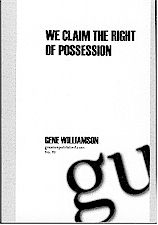
Book-length narrative poem of 17th century dispute in upper Chesapeake Bay between Virginia fur trader William Claiborne and Maryland, leading to piracy, open war, and the first major naval engagement in American waters.
William Claiborne arrived in Virginia in 1621 from Kent County, England, a 21-year-old surveyor who quickly rose to prominence and political power. This presented unique opportunities to explore Chesapeake Bay and barter with the Algonkian Indians. On early voyages up the bay he sighted, purchased, named, and settled Kent Island, the base from which he launched an extensive and profitable trading enterprise.
Claiborne soon learned that territorial rights in English America were loosely defined and often ignored. The English king awarded Lord Baltimore a proprietary grant to Virginia territory that is today's Maryland, absorbing Claiborne properties and igniting a territorial dispute that would evolve into a colonial extension of the English Civil War between the king and the parliament. Claiborne was hailed both pirate and hero in his tenacity never to surrender Kent Island,
a theme he would repeat for half a century: We Claim Right of Possession.
Excerpt
He stands leaning to one side/then the other on the rolling deck/of the merchant vessel George/rapt in thought gazing beyond starboard rail/at the bay as threatening at its mouth/as the ocean gale/weathered outside the narrow Virginia capes./To the north waves of white caps outreach the eye/looking south dim gray shadow of land/washed by tides of the Chesapeake/the bed of a prehistoric river on whose banks/mastodons and camels roamed.
Professional Reviews
Exciting and Highly Visual
I am pleased to report that I did enjoy Gene Williamson's book-length narrative poem, WE CLAIM RIGHT OF POSSESSION:The Saga of William Claiborne. At first I was uncomfortable with the free verse form, but after a few chapters I got into the flow and enjoyed the story very much. I began to realize that it was factual and not loaded down with modern day versions of imagined dialog from an earlier period. This story of Claiborne's territorial war with Maryland in the 17th century is exciting in a highly visual way that carried me along to the end. The textural synopsis at the back of the book is helpful and contributes to making the narrative poem alive and meaningful. I discovered that because of the poetry, it is the kind of history you can enjoy reading more than once.
--Dr. Ellis Berne, Potomac MD
Best Poetry Story I've Ever Read
In WE CLAIM RIGHT OF POSSESSION, your way of writing reads more like a novel in that the characters are so damn good you get the reader really involved with them. Not in a historical way but on a personal level. You bring history and real people to life, to the point of feeling you know these people. I love that about your writing and your books: they always leave me wanting more. You write each event in such a way I don't want it to end.
I think you have mastered a poetic form with this book unlike any I have read before. I love the continuity. The flow of line-by-line style is so to the point that it is easy to follow the entire story. The poetic form doesn't distract from the story with difficult "poet ego" but, as I said, moves the story along with an ease of reading that makes the book nearly impossible to put down. I got so involved that I wanted to read cover to cover without interruption.
I appreciated the appearance of simplicity of form, even though I know it had to be hard to maintain the structure of the poem and still be accurate, build scenes and characters. In fact, the characters were created in such an interesting way, so subtle and yet so intense, I couldn't forget who was who, where they belonged in the chain of events, and how the actions they took early on affected and changed everything in the future.
I also love how they are dressed! Such detail in poetry! It enabled me to bring each person to life. It even enabled me to know and feel how the weather was at the moment in time based on how the clothes were blowing in the coastal winds or stifling hot in the southern heat. I think that impressed me most...being able to see the characters in such detail in my mind's eye.
This is the best poetry story I've ever read. I really feel like this saga of William Claiborne is a major work. I can't wait to read it again.
--Denise Atwell, Owner, MadPoets.com
Take a poetic look at notable Virginian
Hampton native Gene Williamson took an unusual approach to writing about the life of William Claiborne in his fourth book about the history of the Chesapeake Bay area. WE CLAIM RIGHT OF POSSESSION:The Saga of William Claiborne, (GreatUnpublished.com, $15) is a book-length narrative poem. It describes Claiborne's prominence as a political official, land owner and fur trader in Virginia and his 50-year territorial dispute with Maryland.
Claiborne settled on Kent Island, which he discovered, purchased, and named in 1628. In 1632, loyalist Lord Baltimore challenged Claiborne's right to the land, leading to America's first serious naval battle. The conflict was a Colonial extension of the English Civil War.
For readers not familiar with Claiborne's story or the events surrounding the boundary conflict in Maryland and Virginia, a short history, definitions and a timeline follow the poem. --Amanda Haskins & Melissa Simpson, Hampton VA Daily Press
The authors of Savannah: Brokers, Bankers and Bay Lane: Inside the Slave Trade (Civil War Savannah), received the 2012 Award for Excellence in Research from the Georgia Historical Records Advisory Board. The Award was issued by then Georgia Secretary