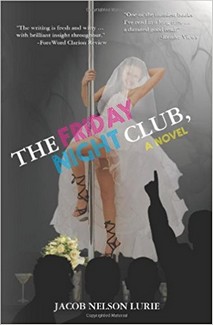
Davis Robertson is in mid panic attack. His fiancée is walking down the aisle, the love of his life sits watching, he's sure an attack by vengeful strippers is imminent, and there's a little matter of a gun wielding, RV stealing tow-truck driver out to kill him.
Davis' struggle kicks off four days before the wedding when a reunion of college friends causes dormant memories of his reckless youth (the Heaven/Hell party involving a paint-ball splattering roommate, a bevy of strippers, and the mysterious Fat Spider-man; his father's death; and the road trip involving acid trips, a Tylenol on wheels, Scientologist kidnappers, and the homicidal tow-truck driver) to collide with the reality of comfort and possible death-by-boredom.
So, what to do? Marry his fiancée, resigning himself to an ordinary existence? Escape to Brazil with the love of his life to enjoy passion and uncertainty? Or run from both and return to his hedonistic lifestyle, filled with flesh, drink, party, and few cares?
Caution: Contains Adult Language, Mature Situations, Childish Emotions and General Stupidity
Professional Reviews
Midwest Book Review
"Although Davis Robertson's getting married in a few days, he finds his mind dwelling on past loves and friendships. As he hangs out with his best friends and groomsmen, Davis relives past experiences with these men, former college mates who formed The Friday Night Club, which was nothing more than a party club. Although Davis loves his fiancée, his thoughts keep turning to the one woman he never really had, a woman he's always held in high regard but never pursued. He fears committing, fears an uncertain future, but tells himself it's time to grow up and move forward. While partying with his friends, Davis vacillates from being certain he wants to marry to doubting his commitment to his fiancée.
This quasi-autobiography isn't your typical bachelor's last fling, although there are the quintessential drunken parties, humorous scenarios, assaults and ultimate arrest. Although couched as a coming-of-age story, The Friday Night Club goes beyond that, delivering poignant, profound insights into the struggling mindset of a young man as he passes into adulthood. Lurie skillfully pulls his reader into Davis's angst, his at-times conflictual relationships with his Friday Night Club partners, his earnest yearning for something he thinks is unattainable. This intriguing book doesn't limit itself to men; women will enjoy the read as much, if not more." (Christy Tillery French)
Making Friday Nights Alright Again
"Think of a cross between The Breakfast Club (the "College Years" version) and "How I Met Your Mother," with a lot more imbibing of alcoholic beverages and gratuitous sex thrown in for good measure, and you might get some glimmering of an idea about the awesomeness that is the plot line of The Friday Night Club by Jacob Nelson Lurie. The book's first person narrator, Davis Robertson, takes a nonlinear look back on his college and post-college years, eventually leading up to his wedding day, and contemplates everything that defines himself and his friends and has brought him to be willing to get yoked to one woman for the rest of his life. Though he loves the woman hefs going to marry, Pamela, he can't help but think about the wild times and numerous sexual conquests hefs had in the past, and wonder if he's doing the right thing.
The novel has a fairly large cast of characters, with probably the most interesting one being Davis's good friend, the actor Peter Carter, who the narrator describes as looking "...a lot like a young Matthew McConaughey." The way the narrator admires Carter and looks up to his wealth, carefree manner, ability to drink like a fish, and womanizing skills reminded me a bit of the way the narrator of Fitzgerald's The Great Gatsby admires the title character of that novel.
The novel is liberally laced with humorous moments and musical and cultural references. Besides the reference comparing Peter to Matthew McConaughey, another of Davis's friends, Jonesy, is described as resembling David Bowie, and another character, Thomas Divan, is described as "...looking a lot like a young Steve McQueen." There are many other references, from Bible quotes to Pink Floyd's line from the album "Animals," "...dragged down by the stone." The characters are, after all, a product of the times they live in. One of the pleasures I got from reading the novel was thinking about the references myself, and the meanings each had for me and the people I knew while growing up.
The Friday Night Club is made up of the narrator and his friends. They meet every Friday night and have parties where the beer and other alcohol flows freely, and they all, in general, have a lot of fun taking a break from their studying and classes at the University of Colorado. They even have a set of three Commandments each member must adhere to, such as Commandment #1: "No band or any earsplitting music that shakes the fillings from your mouth or the neighbors from their slumber." The club fills a social need in their lives, providing them with a break from the mundane, and a chance to philosophize and shoot the bull with each other. As the narrator puts it: "We six lost circus performers were simply in need of an escape from the daily dullness of classes and studying."
It's a coming of age story, a novel of becoming adults, of settling down into married lives and raising families, on one level. But it is a novel that is full of life and the promise of living each moment to its fullest, also, while one is still young, and it is vibrant and will cause you to look back fondly on your own college years. The club is very important to everybody who is a member of it. As Jonesy says, it and the people he met as a result of the club made "College the best four years of my life."
The Friday Night Club speaks to all of us, whether youfre currently in college, are looking forward to attending one, or are long out of it and are firmly ensconced in marital bliss and are looking back on your past, like the narrator. If you enjoy reading humorous novels about drinking, partying, having sex with as many people as possible while youfre still young, and lots of alcohol-induced - but still insightful philosophy - on life, then The Friday Night Club is the book for you." (Douglas R. Cobb, Bestsellersworld.com)
Humor at its best
"The Friday Night Club" by Jacob Nelson Lurie is one of the funniest books I've read in a long time; and that's saying a lot considering I am at least a half a century older than the characters it portrays. How funny is it? Let me put it this way: I started laughing on the "Disclaimers" page before the story even starts. Here's an example, "Disclaimer A: This is a true story. Aside from the parts that aren't true, of which there are few, though not as many as you would believe." Huh? Or this, "This is a novel and not a memoir. Aside from the parts that are a memoir...of which there are many, although not as many as you would believe." Oh, I get it!
So what is the Friday Night Club and what is the book all about? It's kind of hard to explain, but in a nutshell the Friday Night Club is a group of college friends who met in a dormitory every Friday night to celebrate the week's end and fortify themselves for another soirée into the bars and clubs of Boulder, Colorado. During their college years, these friends enjoyed a joyous romp through their adolescence; a romp fueled by alcohol, driven by a constant search for sexual conquests, and littered by mistakes and poor choices. In addition to the club members, another principal looms large in the story, namely the alcohol. Lurie asserts that "alcohol is the main character, culprit, mother, lover, therapist, hero and villain."
As the book begins, Davis Roberts, the narrator of the story is walking down the aisle on his wedding day and he is scared to death. Ahead of him stands his bride to be, and in the congregation sit at least three women whom he bedded and who are in love with him. One of them he still considers the love of his life. He is badly hung over and still nursing the wounds he received during a violent and unexpected attack by a group of enraged strippers at his bachelor party. Meanwhile, the moment of truth has arrived. Should he forge ahead and marry his fiancé, thereby risking a possible death by boredom or should he abscond with the love of his life to enjoy a life of lust, passion, and uncertainty? Or perhaps he should simply walk away from it all and continue living his hedonistic life-style, filled with the proverbial wine, women, and song. It is not until the very end of the book that the reader finds out what he decides to do.
Lurie has an interesting style of writing which is an admixture of Joyce's stream of consciousness, Jack Kerouac's rambling narrative, and Henry Miller's puckish ability to combine sex and humor. The dialogue is crisp and fast moving; and as far as I can tell, authentic.
Getting back to the disclaimer page, the last paragraph suggests that there may be a higher purpose for reading the book other than simply to get a good laugh. I'll let the author have the last word.
"Whether you know this or not, these people are your friends, your lovers, or your family. I guarantee that you know someone like one of those characters. I guarantee that person has lived a life more interesting than all these characters combined. I guarantee that if you didn't know that person then, you would hate who they were. And I can guarantee that you love that person now."
So there you have it. Whether you are looking for a good laugh or a chance to reflect on your own adolescence, "The Friday Night Club" by Jacob Nelson Lurie is a damned good read!" (Ron Standerfer, Reader Views)