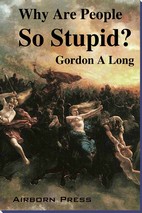
Social Commentary with a wry twist.
Biting analysis of:
The Stock Market, Committees, Corporate Cowboys, Bureaucracy, Communism, Capitalism, Bullies, and that idiot driving in front of you who slams on his brakes for no reason.
Revolutions, disasters, and office politics. The stock market,the war on drugs, zero tolerance for bullying and our justice system.
How can we possibly believe that our decisions are always logical? Why do we keep empowering people who have every reason to take advantage of us?
Actually, there are reasons. Even good ones. Partly human nature, partly natural selection, maybe even a bit of back luck.
And sometimes, we’re just really, really, stupid.
Excerpt
5. Cognitive Disasters
“Insanity: doing the same thing over and over again and expecting different results.”
- Albert Einstein
You know, you really don’t want to go messing around with Psychology. Psychologists are one of the worst groups of people for the “I Know Better Than You” syndrome (Chapter 6), and they never tire of telling us about all the stupid things that they know are going on in people’s heads.
This is very entertaining reading up until the point when one suddenly thinks, “Hey, wait a minute. Are they talking about me?” Psychologists call this reaction Cognitive Dissonance, and they probably get a real chuckle out of it. They write one of those fascinating books, and they stick in one of those stupid little details, and they call across to another Psychologist, “Hey, Sigmund, did I ever dump a handful of Cognitive Dissonance on those readers.” Then they fall about the lab roaring with laughter and throwing white rats at each other. Psychologists need to get a life.
Fortunately for the reader, the “Everyone Else but Me” reaction* takes over and we say, “Of course they’re not writing about me,” and immediately feel better. For a while.
*This term will not be on the End of the Unit Test. I just made it up.
We humans advertise ourselves as a logical species. If you believe the social anthropologists, we survive by observing our environment and adapting our behavior to what we learn. The logical learning pattern goes like this: you receive information, you predict a future outcome; it occurs, you continue your behavior; it fails to occur, you change your ideas accordingly.
Unfortunately for us, it doesn’t always work that way.
Beliefs
“Prejudices are what fools use for reason.”
- Voltaire
“Belief, intuition and prejudice are opposite sides of the same coin.”
- Me
Our logic tells us that we observe the world and make decisions based on facts that we observe to be true. However, after observing certain facts to be true a certain number of times, it seems that our minds make a switch. The charitable interpretation is that it is extremely stressful having to look out for a Sabre-tooth every time we go to the creek, and we just get tired of worrying about it. Or else we’re basically lazy. We come to think that these facts will now always be true, no matter that other facts come along which cast this possibility in doubt. We say, “I have it figured out. The Sabre-tooth only comes around on Tuesdays and the second Friday of the month, and if I wear this cabbage around my neck, he stays away completely.”
The human mind seems to have a limit to the number of impossible things it will believe before breakfast, and when it reaches that limit, it ossifies. The result of this freezeup is called belief. We cling to the memory that our belief was once based on logic, and thus use logic to try to persuade others to believe the same as we do.
As we all know, this is a practice doomed to failure. It’s the same with trying to deal with the logical facts that show up to negate our beliefs. We say things like,
“I’m sure that Sabre-tooth never comes on Sunday. Sabre-tooths (Sabre-teeth?) are religious.”
and,
“I’m on a roll. I’ll bet my house and car on the next hand.”
So, quite contrary to logic, the human race modifies the facts to suit its beliefs, rather than the other way around.
How stupid is that?
In fact, that is probably the source of our Big Question. It isn’t stupidity that bothers us; it’s a lack of logic. The outside observer sees someone doing something for no logical reason, and assumes that person is stupid.
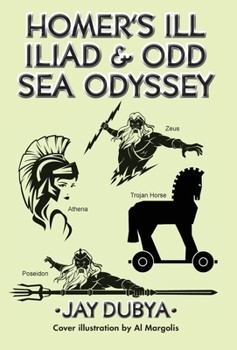
Homer's Ill Iliad & Odd Sea Odyssey (420 pages) is an adult satire/parody rewrite of the classic stories of the 10 year Trojan War and of the 10 year adventure of Odysseus trying to return home to his native Ithaca.
The Wholly Book of Doo-Doo-Rot-on-Me is adult satirical humor featuring adult language and adult content, and the work is a parody of the Old Testament Book of Deuteronomy.