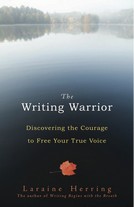
Learn to deepen your relationship with your writing by releasing your desire for results, practicing self-observation without judgment, and cultivating absolute vulnerability.
All writers are faced at some point with feelings of self-consciousness and self-doubt about their work. In this invaluable guide, Laraine Herring offers advice to writers who want to become more comfortable with their writing, face their inhibitions, and gain the confidence to release their true voice. Utilizing the breath, a vigorous movement practice designed to break up stagnation with the body and the mind, and writing exercises aimed both at self-exploration and developing works-in-progress, Herring offers a clear path to writing through illusion. Learn how to remove obstacles in your writing and develop techniques to help you relax into your own voice; discover ways to enter into a compassionate, non-judgmental relationship with yourself so that you can write safely and authentically from a place of absolute vulnerability; and discover the interconnectedness of your personal writing process and the community as a whole. The Writing Warrior will not only help you find ways to develop your writing, but also ways to develop yourself.
Professional Reviews
Seattle Post-Intelligencer
I just finished reading The Writing Warrior: Discovering the Courage to Free Your True Voice* and found it a wonderful companion book, reminding me at times of Anne Lamott's Bird by Bird in that it's good company on those bad writing days, and at other times of Natalie Goldberg's books on writing in its spiritual leanings. The Writing Warrior offers ways to bring deep breathing (as well as "shaking," which, even the author admits, sounds weird at first) and focus into your writing -- and points out that paying attention is always essential for writers, whether it's about the material, the goals, the practice of writing, or the relationship of writing to self.
Picture
Laraine Herring's advanced degrees in both creative writing and psychology give her just the right perspective for a book on motivating writers and making the most of one's writing life. She quotes wisdom from such sources from the Bhagavad Gita to William Faulkner to the Dalai Lama, and she uses these sources as starting points for areas of particular relevance for struggling writers: releasing results-oriented anxiety, letting go of writing "rules," and not equating money with writing success. Herring's insights, often based on stories from her own life or presented in simple, accessible metaphors, remind writers of basic writing truths that we tend to forget (by "writing is not like making a peanut butter sandwich," she means: "Every time you sit down to write, it will be a brand-new experience").
While The Writing Warrior isn't primarily a book of exercises, Herring does include a number of prompts that I found interesting and helpful (for example, "Place your character in a situation in which he or she is incapable of moving, either physically or psychologically"). And perhaps just as important are her sections called "Internal Conversations" (which bring to mind Julia Cameron's exercises in The Artist's Way), in which Herring prompts us to dissolve our illusions, from time to control to publication.
The Writing Warrior fulfills its promise in offering discovery and courage; it's a terrific writing companion for any writer facing self-doubt or blocks, or who simply wants a motivational boost. As a writer, I enjoyed its lessons and exercises; as a teacher of writing, I'll recommend it to students as a valuable accessory to the writing life.
The Vancouver Observer
All writers are faced at some point with feelings of self-consciousness and self-doubt about their work. In The Writing Warrior (in paperback from Shambhala) Laraine Herring offers advice to writers who want to become more comfortable with their writing, face their inhibitions, and gain the confidence to release their true voice. Utilizing the breath, a vigorous movement practice designed to break up stagnation with the body and the mind, and writing exercises aimed both at self-exploration and developing works-in-progress, Herring offers a clear path to writing through illusion.
“Your responsibility is to your writing. Write what is within you to write and release the rest.”
Learn how to remove obstacles in your writing and develop techniques to help you relax into your own voice; discover ways to enter into a compassionate, non-judgmental relationship with yourself so that you can write safely and authentically from a place of absolute vulnerability; and discover the interconnectedness of your personal writing process and the community as a whole. The Writing Warrior will not only help you find ways to develop your writing, but also ways to develop yourself.
“When you let go of what is no longer necessary, the authentic essence of yourself and your writing bubbles up. This is freedom. This is flexibility. This is being utterly, completely alive. Are you ready? Take a deep inhale. Expand your belly. Now, let it all go. Hold nothing back. Relax your jaw. Release your shoulders. Soften your gaze, and step into yourself, one warrior word at a time.”
ForeWord Reviews
Writer’s block, doubt, and shame are things of the past for Herring’s readers; this guide gives them the confidence to share their true voices with the world without hesitation. She encourages readers to employ “the breath,” a technique that she developed in an earlier work in which writers engage in physical activity to help them connect body to mind. These types of connections can also be seen between one’s thoughts in writing, she explains, and sensing such interrelatedness allows one to better understand his or her self. Herring is demanding of her readers, yet she maintains a personable, friendly ton
Democratic Dilemmas and Divine Inspiration examines the significance or relevance of the idea that the U.S. Constitution was, as many believe, divinely inspired. How much did that belief matter to founders of the nation and how much does it matter no
Democratic Dilemmas and Divine Inspiration examines the significance or relevance of the idea that the U.S. Constitution was, as many believe, divinely inspired. How much did that belief matter to founders of the nation and how much does it matter no