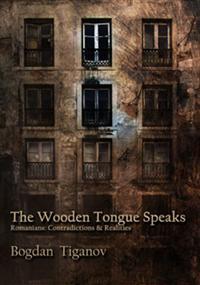
In The Wooden Tongue Speaks exiled Romanian author Bogdan Tiganov takes us on a journey to the interior of his home town of Braila in a collection of short stories and poetry. In this post cold-war collection, we discover the social, religious and political issues facing a people just now emerging into a world of contradictions and realities.
The Wooden Tongue Speaks deals with the ways in which communism affected the Romanians of today, the problems that migration causes to both the Romanians who leave and those who stay behind, the different attitudes of young people in Romania, childhood and what it means, the lives of Romanian street children and gypsies, mental health issues in Romania, old people battling their loneliness and their memories, friendship and careers in Romania, the lives of Romanian women, the importance of food in Romanian culture, doctors and their conscience, multicultural Romania and Romanian politics.
Excerpt
It bothers me to think that I was being listened to, that my phones were tapped, my walls too, and the neighbours had glasses up to theirs. In fact the walls were so thin there was no need for glasses. As a boy I could hear how my neighbours upstairs chased each other and the woman screamed: “Help!” But nobody stopped her husband.
I couldn’t whisper a joke about Ceauşescu without being told to “Shh.” I realised it even then. I knew I couldn’t say everything I wanted or everything that came to mouth, but that was fine. I now know not everything that comes to mouth is useful. Not everything, if anything, is worthwhile.
But there in my home, and in my grandparents’ home, what was there to listen to? Why would it interest anybody else? Do you want to hear how my parents are unbelievably tired and bad-tempered, shouting at each other because they can’t understand each other’s point of view? You don’t want to hear that. You can hear that in your own home. I certainly didn’t want to hear it. Do you want to hear what we’re screaming at our new colour television? We’re screaming: “Bullshit!” because we no longer believe what you’re showing us. You’re telling us how everything’s rosy and how we’re the best but I don’t see that on the table. My table’s empty and I’m hungry. The electricity’s gone off. We light some candles. The walls start shaking and so does the floor. Do you want to listen in to our panic as we hold on to what we have so it doesn’t smash on the floor and we lose it all? Nature tells us that we’re fragile.
At times, during our exile, we wanted to leave the problems of living in a foreign country as refugees and go back home to what we thought we knew. Would you swap isolation and loneliness for love? The love, we felt, would not come simply from our family, but from the very trees and the earth that uprooted them. The expressions on peoples’ faces would make us feel like we belonged. Be it poor, sad, heartbroken, happy, delirious. We had these fantasies. I still get flashes of fantastic euphoria though I know that they’re as much bullshit as what the Communists were feeding us.
I’ve learnt to mistrust the easy answer.
Maybe you’re so interested in my family because television’s not enough for you, your life is not enough, so you start listening and reporting, ratting and spreading lies about us because you are now a fully-grown unshakable demon of a pervert. You’re addicted to what we’re having for dinner, hooked on to our morning routine, how mama brushes my hair or how tata2 shaves, how many plops you hear in the toilet. You’re in love with our dreams and imagination, how innocent, naive and terrifying.
Most of all, it bothers me to think that some element of happiness or sadness or honesty was lost because we were hiding it from you. We didn’t want you to know how deeply scarred we were, our stomachs slashed inside and our hearts burning slowly on a spit, but all you heard was some hysterical laughter or howled cries. That’s all you heard. What we couldn’t hide. And mama realised we’re alive right now so why waste it? Why give so much and receive so little?
What does it matter now though? You must feel utterly satisfied sitting in your villa in the mountains with the eagles singing to you and a great big pitchfork impaled up through your anus and out of your mouth. Enjoy the horrifying silence you created and upheld.
Professional Reviews
Helena Drysdale (author of Looking for George)
These moving memories, stories and poems explore the mind-warping paranoia created by Romania’s notorious dictatorship, and are a brutally honest insight into the bleakness of its post-communist disillusion.
Exiled Writers INK (Esther Lipton)
The wonderful prose pictures that the exiled Romanian writer Bogdan Tiganov paints of everyday life under an oppressive regime are both vivid and revealing. The dialogues and arguments which punctuate many of his stories unmask the tensions and the feelings, both of profound love and intense hate, that arise within families and friendships. The ‘Wooden Tongue Speaks’ is a worthwhile and impressive addition to the literature of Romanian exiles.
Ilinca Bernea (author of Iubiri in Camasa de Forta)
A mature book from a young author, whose writing already carries the fingerprints of a personal style with powerful lyrical accents, that decants in a language crossed by a rough, uncensored sensibility contrasting images from a disintegrated universe recomposed in words from the substance of nostalgia.
London: Lashed, Lacerated, Lampooned and Lambasted satirizes 18 popular Jack London novellas with adult content and language and the work is author Jay Dubya's 37th published hardcover/paperback book.
My second book is about a boy who has Asperger's Syndrome and is bullied to the point to where he shoots up his school. I have divided the excerpts from it into three parts: Before, during and after the shooting.