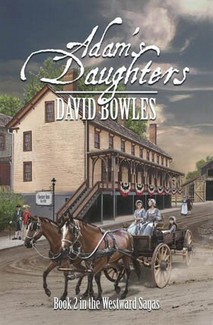
Category: Historical Fiction Publisher: Plum Creek Press, Inc.
ISBN-10: 097774843X
Pages: 264
Copyright: September 28, 2009
ISBN-13: 9780977748433
In the years following the Revolutionary War, the Mitchell siblings take on renegade Indians, highwaymen, and the hardships of an untamed land.
The Westward Sagas tell the story of the Mitchell family's 100-year odyssey west from Pennsylvania to Texas. In Adam's Daughters: Book 2, Peggy Mitchell, a survivor of the Battle of Guilford Courthouse, grows up in Jonesborough, Tennessee during the tumultuous first twenty years of the nation s existence. Though haunted by memories of war, she matures into strong, independent young woman who is courted by Andrew Jackson and who has a freed slave as her best friend. Her younger brothers and sisters become her surrogate children and students. Together the children of Adam and Elizabeth take on renegade Indians, highwaymen, and the hardships of an untamed land.
Excerpt
Chapter One
Under the Apple Tree
Six-year-old Rebeckah Mitchell sat cross-legged in the hayloft of the barn. Her older sisters, Peggy and Ibby, lay next to her, still fast asleep. From her vantage point looking out the loft door, she could see the sun rising. Its brilliant light rose ever so slowly behind the tall sycamore trees that lined the banks of the gently flowing Knob Creek, a short distance down the hill from the house and barn. The steam that rose from the spring-fed creek mesmerized the freckle-faced girl as she watched the vapors drift up into the sky and disappear into the faint rays of sunlight.
She heard the whinnies and clippity-clop of horses coming from the direction of Jonesborough. Where could they be going so early in the morning? Rebeckah hurried to the other side of the barn, trying not to wake her sisters. She found a knothole in one of the rough-hewn boards at just the right height to give her an unobstructed view of two wagons on the road from town.
Two men rode in a large freight wagon with a long wooden box in the back, and a man and woman followed in a carriage. Today isn’t Sunday, Rebeckah thought. Why are they dressed like they’re going to church? Both turned toward the Mitchell farm house. Lulubelle, the family’s yellow-haired dog, began to bark; Elvira, the donkey, brayed; and the white leghorn chickens started their barnyard chatter as the visitors approached.
The noise woke sixteen-year-old Peggy, who said, “What’s happening?”
“We’ve got visitors coming,” Rebeckah answered.
“Who is it?”
“Don’t know—two wagons coming from town.”
Ibby, who was eight, woke, yawned, and looked out the hayloft door from high up in the gable of the barn.
“It’s Uncle Samuel and Mr. Miller in the first wagon.” Ibby slowly stretched her arms up over her head as far as they would go.
Samuel Fain was married to Rosanna, their mother’s sister. Peter Miller was a neighbor. Both were elders of the Salem Presbyterian Church just on the other side of Jonesborough.
The girls watched through the loft door as their parents stepped out of the log house to greet the visitors. Their father, Adam, was holding two-year-old Samuel, and their mother, Elizabeth, was cradling baby David, who was just weeks old.
The sisters climbed down from the loft, brushed the hay off the clothes they had slept in, ran through Grandmother’s garden, and greeted their uncle with a hug.
Uncle Samuel asked their
father, “Where do you want us to unload your mother’s coffin?”
“For now just put it on the sawhorses in the barn.”
Reverend Samuel Doak and his wife, Sister Esther, pulled into the yard in their carriage. Reverend Doak was not only their pastor at the Salem Presbyterian Church, but he was also Adam Mitchell’s maternal second cousin and long-time friend, just four years younger than Adam.
Sister Esther said, “Adam, I am so sorry that you lost your mother.”
“Grandmother isn’t lost. She’s in the house in her bed. Isn’t that right, Father?” Rebeckah stood with a hand on her hip and her head tilted, looking to her father for an answer that didn’t come.
“Look, everyone,” Sister Esther said. “I’ve been up since way before daylight cooking. I have here in the back of our carriage fresh baked biscuits, eggs, ham steak, and red eye gravy for your grits. Come on now. My Dutch ovens can’t keep breakfast warm forever. It’s going to be a long day.”
Elizabeth asked Peggy to get the fresh boiled coffee that was warming on the fireplace hearth inside the house.
Peggy hesitated at the door for a moment, dreading to see her grandmother’s corpse. When her mother had asked her to take Ibby and Rebeckah to the barn last night, she had told Peggy the end was near for Grandmother Mitchell.
As soon as she entered the house, Peggy understood why her parents had needed them out of the way. The furniture had been rearranged, and the long wooden table board where the family ate every meal had been moved outside. The mirror over the oak chest was covered with black fabric that her mother had purchased from Deaderick’s, the new dry goods store in Jonesborough. Mother said it would remain up until a proper period of mourning had been observed. I wonder how long that will be, Peggy thought. How can I comb my hair without a mirror? Then she reminded herself why the mirror was covered.
Peggy heard her mother calling, “We need that coffee out here now. The men are waiting!”
Peggy rushed out and set the large pewter pot on the table board.
Elizabeth looked at the pot and brushed a tear from her eye. “Seeing this pot reminds me of being in the spring house with Mother Mitchell during the Battle of Guilford Courthouse.”
“So this is the pewter she hid from the British troops.” Peter Miller said.
“Your mother was a real hero, wasn’t she?” Sister Esther poured Adam his coffee.
He answered, “When that British officer asked her to remove herself from the trunk she was sitting on, she refused to budge. That’s just the way Mother was.”
“And the British didn’t get the pewter so they couldn’t turn it into musket balls and use it against us!” Rebeckah, now leaning against her father, finished the familiar story about her grandmother.
“That’s right,” her father said. “You weren’t born until the next year, but your mother, sisters, and brothers were with her in the spring house when Cornwallis’ soldiers found them.”
“And Robert was hidden behind Grandmother’s petticoats with your dueling pistol, and he would have fired if the soldier hadn’t given up and left,” Rebeckah said.
“Robert was just going on fourteen then, but he would have defended his family. Thankfully he didn’t have to. After my mother chastised the young officer for harassing an old woman, he just turned and walked away.”
“Speaking of your firstborn, where is Robert?” Mr. Miller asked.
“He and William rode out early this morning towards Little Limestone Creek, and then on to Greene County. They went to get my sister and brother-in-law, Mary and James Ross, and their children to escort them back for the burial.”
Mr. Miller said, “That’s a good idea. There’ll be less chance for an Indian attack with two armed horsemen escorting their wagon.”
Reverend Doak came out of the house rolling up his sleeves. He, along with Elizabeth and Sister Esther, had just finished last minute preparations for the viewing of Margaret’s body. “On the way here, I asked Elder Mathes to start tolling the church bell.”
Peter responded, “The congregation has been praying for Mrs. Mitchell as everyone knows she’s been ailing for weeks. When they hear the bell ring seventy-seven times, they’ll know it’s for her. There aren’t any other seventy-seven-year-olds in these parts.”
“Adam,” Reverend Doak asked, “where is the spot in your apple orchard that your mother wished to be buried?”
“This way, Pastor.”
Samuel and Peter, who already had shovels over their shoulders, followed Adam and the pastor to the gravesite.
Elizabeth came out of the house and handed Peggy a bundle of clothes. “Peggy, take the girls down to the creek and wash up. Then take them back to the hayloft to change.”
Peggy nodded and called her sisters.
The men made good time digging the grave in the fine sandy loam of the Mitchells’ apple orchard, but the sun was high when the last spade of red dirt was pitched out of the ground.
Back at the house, neighbors were arriving with the few fresh flowers blooming this early in the spring of 1788. These were added to dried flowers scented with pine tar, cinnamon, and vanilla to help cover the stench of death. All the doors and windows of the house were open wide, and the fireplace was snuffed to keep Grandmother Mitchell’s body as cool as possible until she was laid to rest.
Elizabeth’s brother, John Blair McMachen, rode up just as the elders returned from digging the grave. “I’m sorry I wasn’t here to help. I just got back from delivering the news of Mother Mitchell’s death to the people in Jonesborough.”
Elizabeth hurried to the group of men and spoke to John Blair, who was still in his saddle. “Please bring Father to the house. I want him to have some time alone with Mother Mitchell before the reverend starts the memorial service.”
John Blair nodded. “I’ll bring him right away.”
Rebeckah, who had been intently listening to every word the adults said, began to sob. “She isn’t dead! She’s just sleeping!”
Adam picked Rebeckah up and carried her to the family table. He asked Peggy to gather the children for a family talk. Peggy found twelve-year-old John and ten-year-old Adam at the swimming hole on the creek throwing flat stones, making them skip as they hit the water. She already had Ibby and Jennett, who was five, in tow as she approached the table. Samuel held one of his mother’s apron strings as she stood with baby David in one arm and the other arm holding Rebeckah close to her side.
Reverend Doak stood out of hearing range under the shade of a nearby chestnut tree. He nodded to Adam and Elizabeth, reassuring them of his support. Neighbors and friends recognized that the family needed to be alone together at this time and gave them the needed distance. The group of women talked about how they would miss Margaret’s fall apple-paring socials and her quilting parties. The men remembered the stories they had heard of her heroism during the Battle of Guilford Courthouse.
Adam spoke to his family. “Children, we have lost Grandmother Mitchell. I should have gathered you around me sooner for this talk. My heart was so sorrowful I just couldn’t talk to you before now.” He looked at the young girl clinging to her mother. "Rebeckah, I’m sorry I didn’t explain to you about her passing.”
Elizabeth hugged Rebeckah tighter. “I also.”
Rebeckah looked at her parents, her eyes filled with sadness and questions. “I just don’t understand—Sister Esther said we lost her; you just said she is passing; the last time I saw her, Peggy and Mother said she was sleeping. I want to see her now. Please?”
Adam looked at his wife. Elizabeth nodded her approval, took Rebeckah by the hand, and led the family to the back stoop of the house. She asked the rest of the family to wait until after Rebeckah had seen her grandmother.
Rebeckah looked at the body and then back to her mother. “Grandmother looks like she’s comfortable now.”
“She is, Rebeckah. Grandmother Mitchell is now in a better place.”
Elizabeth motioned for the other children to gather at the foot of the bed, which was now completely covered with flowers.
“A better place? Where?” asked Rebeckah.
“Heaven—where all good Presbyterians go,” Elizabeth answered.
“How did she get there?” Ibby asked. “It looks like she’s still on the bed.”
“Her spirit just floated up to heaven,” Elizabeth said.
“Like on a cloud?” asked Ibby.
“Yes, that’s right. She just floated up on a cloud.” Elizabeth motioned upward with her hand.
“I saw her leaving early this morning down by the creek,” Rebeckah said. “She just floated up into the sky.”
Adam and Elizabeth looked at each other but didn’t question her.
Ibby said, “I didn’t see her.”
“You couldn’t—you and Peggy was asleep. I watched her from the loft of the barn. She just floated up to Heaven, pretty as you please, just like Mother said.” Rebeckah nodded, making a gesture toward the sky with her palms up.
Ibby started to rebut her story but Peggy shushed her, halting the sibling rivalry.
Adam said, “I’m sorry we didn’t let you see Grandmother sooner. Your mother and I thought we were doing the right thing at the time. We should have just told you she had died and gone to Heaven.”
Peggy, who had been especially close to Grandmother Mitchell, broke down in tears and reached out to touch her grandmother’s hand. The family had lived with Mother Mitchell in Guilford County, and after the battle, her father had brought Peggy, her brothers William and John, and their grandmother to live with Aunt Mary and Uncle James Ross. Adam had returned to Guilford Courthouse, and more than a year passed before the rest of the family moved over the mountains to Knob Creek.
Throughout the day, the gathering of neighbors and church members continued to grow in front of the Mitchells’ log cabin. They were coming up the lane on horseback, on foot, and in carriages and farm wagons. Uncle Samuel and Mr. Miller stayed busy greeting the arrivals and letting them know that Reverend Doak would start the service as soon as the family had said their goodbyes to their loved one.
John Blair and his brother-in-law William Fain carried the frail John McMachen, known by family and friends as Mr. Mac, from his home on the hill overlooking the Mitchell farm. They crossed their strong arms to make a seat out of their extended arms and hands for Mr. Mac to sit upon for the trip down the steep hill and across the road and farm field.
The octogenarian had been one of the first settlers in the area, who with his only son John Blair, and free slave Samuel, had homesteaded thousands of acres in the Washington District. He built one of the first permanent homes at the head of Knob Creek. Mr. Mac offered his daughter Elizabeth and son-in-law Adam any of his lands to farm and build a home if they would just take up residence near him. Mr. Mac promised that he and Margaret would take good care of the older children until Adam could move the rest of the family.
The McMachens were so well-known that the community dropped the Machen part of the name all together. When people tried to recall the McMachen name, they sometimes came up with McMahon, McMackin, or some other McM. It didn’t matter—everyone knew Mr. Mac and his son John Blair.
The crowd cleared the way for Mr. Mac as he was carried to the deathbed of his dearest friend and confidant.
Mr. Mac and Mother Mitchell had first met more than a quarter century earlier when both their spouses were alive and their children were young. On the banks of the Opequon Creek near his home in Frederick County Virginia, he and Robert Mitchell had become instant friends and had decided that Mr. Mac’s daughter Elizabeth should marry Robert’s son Adam and bear them many grandchildren. The arrangement didn’t work as the fathers had planned—Adam chose to marry his childhood sweetheart Jennett instead. She died three days after giving birth to their son Robert. Eventually Elizabeth and Adam did get together without their fathers’ interference. They might not have ended up together if Mr. Mac hadn’t moved to Guilford County to be near the Mitchell family after his wife Isabella died.
When the men carried Mr. Mac into the crowded room, Elizabeth said, “Let’s leave your grandfather to be alone with Grandmother.”
“No, Elizabeth,” her father protested. “I think Margaret would have wanted all her family around her in this little time we have left before she is placed in her coffin.”
Reverend Doak stuck his head in the door. “It’s getting late, and we should proceed.”
“Would you please wait for Robert and William to have a few moments with her when they get here?”
“It’s all right, Mother. We’ve been here with you looking through the window.”
Robert’s voice took Elizabeth by surprise. The small cabin was so crowded she hadn’t seen her oldest sons or Adam’s sister Mary.
Mary said, “The pastor is right. We should start as many of her friends and neighbors have been here for a long time, waiting to see Mother and pay their respects. Even Governor Sevier and Judge McNairy are here.”
The family stepped outside after Adam asked Mr. Mac to stay seated and to do the honor of accepting the condolences of the mourners as they came through the cabin.
Reverend Doak called the crowd together around the small porch for prayer and a short eulogy. After the service, he announced the cabin was open for viewing the body, then he extended an invitation to the McMachen home for the customary Scots-Irish wake that evening.
The Mitchell family stood near the entrance as their family, friends, and neighbors worked their way to the front of the house. The Governor of Franklin, John Sevier, had ridden to Knob Creek from his home on the Nolichucky River.
“Thank you for coming, Governor,” Adam said. “I know that you are busy with the affairs of the state and trying to settle this Tipton matter.”
“Yes, I have been, but I had to pay my respects to your mother who did so much for the wounded after the Battle for Guilford Courthouse. I look forward to saying a few words about her at this evening’s wake, if I may.”
“Of course you can, Governor. It would be a great honor.”
“Where is Mr. Mac?”
“Inside next to Mother,” Adam answered.
“I should have known. Side by side till the end!”
“He’s taking it hard, Governor. He loved her very much.”
Next in line was newly appointed Judge John McNairy, whose family had lived near the Mitchells in Guilford County. He attended the log cabin school for boys taught by David and Rachel Caldwell. Adam’s oldest sons, Robert and William, were his classmates. The judge and twenty-one-year-old Robert had been getting reacquainted in the evenings at Murphy’s Tavern.
Judge McNairy had brought Andrew Jackson, a friend and fellow lawyer. Both had served their internships practicing law under attorney Spruce Macay in Salisbury. Judge McNairy and Andrew had recently rented the loft in Christopher Taylor’s cabin. With thirteen children in the family, the Taylor house was cramped. In the evenings, rather than dining with the family, the attorneys joined Robert and friends at Murphy’s Tavern for a meal, washed down with several tankards of ale. Mrs. Taylor, who didn’t need two more at her supper table, appreciated this arrangement.
However, when her boarders came home a little tipsy, they tripped over the children asleep on the floor and woke them, causing Mrs. Taylor anguish. She solved the problem by having Mr. Taylor build a crude ladder on the outside of the house leading up to the window of the loft.
By the time the last mourners had passed by Margaret’s flower-draped body, night was approaching, and the guests were hungry and ready to celebrate her life in the Celtic way. The family decided to bury her the next morning at daylight. The pall bearers assisted Reverend Doak in placing her in the coffin, which she had purchased along with her burial gown from Deaderick’s store some months before.
Adam had been perplexed that she purchased a store-bought coffin as he had always made the coffins for family members who died.
Elizabeth said, “Adam, this is just your mother’s way of letting you know how much she loves you. She knew you and I would be greatly bereaved and have much to do upon her death. I’m thankful she prepared for her burial, including choosing the site in the orchard where she wished to be buried.”
The pall bearers nailed the coffin securely shut and moved it back to the sawhorses in the barn. They left the large barn doors on each side wide open so the cool of the night air circulating around the coffin with the addition of fifty pounds of rock salt inside would preserve the body until morning. They would take turns staying with her coffin until burial while the others enjoyed the festivities.
Mr. Mac’s log house stood on a hill overlooking Knob Creek. The house was large by backwoods standards, and it had been the first home in the county to have a stone chimney and shake shingles shipped from Philadelphia. He had built the large home with the hope that the widowed Margaret would marry him and share his worldly possessions for the short time that remained of their lives.
Although she had rejected his marriage proposal, they had been inseparable during the six years Margaret had lived in the area. Margaret had her family’s blessing to marry him if she wished. He and Margaret were both grandparents to Adam and Elizabeth’s children. Adam thought of him as a father and sought his advice on major decisions, and Mr. Mac loved his son-in-law and treated him just like his own son John Blair. But in spite of all the good reasons for them to marry, Margaret told Mr. Mac that she loved him as the dearest friend she ever had, but she could never marry another after the loss of her beloved husband Robert.
They had traveled about Washington County together in Mr. Mac’s open carriage made of white limousine oak. Margaret had accompanied him to social events. They had become a popular couple and were the center of attention and life of any party they attended.
Confusion often ensued as Mr. Mac introduced Margaret as his friend Mrs. Mitchell and then spoke of their grandchildren. They sat with their children and grandchildren at church. The children of the Mitchell clan called the couple their grandparents, which they were, but not in the way people expected. The couple enjoyed explaining their relationship of so many years and laughing as they told their stories to the listener. Three of Mr. Mac’s daughters had married sons of friend and neighbor Nicholas Fain. At family gatherings and church socials, nearly fifty grandchildren circled around Mr. Mac, intently listening to his stories.
The wake was in full swing at the Quarters, so-called by the residents of the area because during the Revolution the local militia had stored its munitions and supplies inside. The Quarters were ideal for the purpose, high on a hill hidden in the woods. Mr. Mac would be able to see the British approaching from any direction and was prepared to blow up his own home should it look like the enemy would find the Patriots’ stores of war materials.
Mr. Mac had to be put into bed after the ordeal of the day’s activities. He instructed his daughters and son to carry on the tradition of a Scots-Irish wake in his absence.
Governor Sevier gave a moving eulogy describing Margaret’s efforts to comfort the wounded soldiers on her farm following the Battle of Guilford Courthouse.
John Blair embarrassed Adam and Elizabeth by telling of the first meeting of the two families at the McMachen home in Frederick County, Virginia, back in 1762. Both of them were so enchanted with each other they couldn’t keep their eyes off one another during dinner or at the next day’s church service at the Opequon Presbyterian Church. John Blair got very emotional when he elaborated on how Mother Mitchell had become a part of his family’s life and that he loved her as he had his own mother, Isabella.
After the eulogies, Adam announced, “Mother would have wanted us to carry on the Celtic tradition and sing and dance and rejoice in her life. She loved each and every one of you, so for her let’s sing, dance, and rejoice.”
Guests helped themselves to food from the heaping table and to the plentiful libations. The neighbors began to play dulcimers, fiddles, or whatever instruments they had brought.
Andrew bowed in front of Peggy, placing his best foot forward, and asked the surprised girl to dance.
Peggy still grieved, but she was determined not to let her tears mar the celebration of her grandmother’s life. She would enjoy the evening, laughing and dancing and having a good time—no matter how sad she felt inside.
Andrew was not the best-looking young man at the wake, but he was the best-dressed man she had ever seen. Most of the men of prominence wore their hair powdered; the powder made her sneeze uncontrollably. Andrew used no powder and wore his dark red hair pulled back from his face and cinched at the neck. He was taller than any man she had ever danced with. He could dance to whatever the informal ensemble was playing; it didn’t matter the song, for he could lead and she could follow. She gazed into his dark blue eyes; he intently gazed into hers. She had never experienced these feelings dancing with any other man. He was so graceful in every move that he made—whether it was a waltz or a Virginia reel.
Peggy began to feel a little woozy. Maybe it was the applejack. She had to sit down.
Andrew led her to a chair and asked, “Miss Mitchell, are you all right? Can I bring you something to eat?”
She realized that she hadn’t eaten since the early morning breakfast prepared by Sister Esther. “Oh, yes, please.”
While he was gone to get the food, she thought back over the evening. No one had ever called her Miss before; it sounded nice. Her cousins and brothers and the boys at Martin’s Academy just called her Peg. Mr. Jackson treated her like a lady, and she liked that.
Andrew returned with some pulled pork on a piece of toast. “You should eat this.”
Soon after she ate, she felt much better. “Thank you for your thoughtfulness.”
“It was my pleasure to be of service to such a lovely lady. Would you like to take a walk?”
“Yes, I would, Mr. Jackson.”
“Please call me Andy. That’s what my friends call me.”
She looked at the couples dancing. “May I call you Andrew?”
“Call me anything you wish, just not Mr. Jackson.”
“And you may call me Peggy.”
The couple walked down the hill toward the Mitchell home and Knob Creek.
Peggy said, “I’d like to show you my favorite place.”
The approach of Lulubelle, the family dog, startled Andrew. Peg knelt to pet the yellow-haired canine, whose tail was wagging rapidly after having missed the usual daily attention she demanded.
Peggy took Andrew’s hand and said, “This way,” as she ducked under the dangling branches of a weeping willow. She dropped his hand when they had to walk single file to follow a narrow path toward the creek—Peggy in the lead and Lulubelle at the rear, nosing Andrew in the seat of his britches every step he took until they reached the creek. At this late hour, the almost-full moon reflected on the smooth surface of the pond, and the stars glowed brightly on this clear night.
“I see why this is your favorite place.” Andrew took her hand again.
Peggy looked down at their clasped hands and pulled hers back. She’d only intended to guide him to the creek. “My father and older brothers made this pond. They built a dam out of limestone boulders; it was hard work and took most of a summer to finish.”
“I can tell it took a lot of work.”
“Father will start building a grist mill on this very spot, just as soon as he has enough timber cut and dried. I like the pond as it is. In the summer, it’s our swimming hole and where the family bathes. It’s not fair that the boys get to swim more than the girls.” Her frown turned to a smile. “But I sneak down alone more often than anyone knows.” She frowned again. “Once the mill is built, it will never be a place I can come and be alone.”
“Why is that?”
“My grandfather, Uncle John Blair, and the Fains and the Millers will all be using the new grist mill. It’s a joint effort to provide a mill near the farmers east of Jonesborough.” She sighed. “My poor father and the other farmers around here have to haul their grain all the way to Little Limestone Creek to be milled by Michael Bawn. Grain is lost on the road as well as their time.”
Andrew turned to face her and stepped closer. “Peggy Mitchell, I envy you.”
She looked at him in surprise. “Why, Andrew?”
“You have such a close family and so many friends.” He bent down to pet the dog.
“Don’t you have family?”
He looked up at her from his crouched position. “No, it’s just me. My father died before I was born, and the only thing I have to remember him by is his name, which my mother gave me. I had two older brothers, but they both died at the hands of the British. My mother died of cholera after her trips by foot to Camden to secure my release.”
“You were a prisoner of war?”
“Yes.”
She stepped closer to him. “But you’re so young.”
“I was only thirteen when I was captured.”
“Did they hurt you?”
“This scar on my face was from a British officer’s sword.”
“I noticed your scar but had no idea you received it in combat.”
“It wasn’t combat, Peggy. A British officer demanded that I clean his muddy boots after he had destroyed my aunt’s home. I refused, and he took a swing at me with his sword. I raised my left hand to deflect the blow, but was wounded on my left hand and face.” Andrew’s lips tightened to a grim line. “I shall hate the British forever for what they did to me and my family.”
“I’m sorry for your loss. I didn’t know.”
“Very few people know. John does; he’s my best friend and now my boss.”
“Your boss? I thought you were an attorney.”
“I am, but I have been appointed the prosecuting attorney for the state of North Carolina. John, uh, Judge McNairy and I will soon head for Nashville to set up one of the state’s three courts.”
“When will you be leaving?”
“As soon as we’ve recruited enough travelers to make a caravan large enough to discourage the Indians from attacking us.”
“Will you be coming back to Jonesborough?”
“Yes, I must, and so will the judge. Jonesborough is the county seat of Washington County. We’ll hold court here four times a year.”
“Where did you grow up?” Peg looked into his steel-blue eyes.
“On Twelve Mile Creek near Waxhaw where there are lots of pine trees. My father tried to clear 200 acres and eventually died of exhaustion.”
“Is that why you’ve chosen to enter the legal profession rather than farming?”
“I may someday have a farm of my own, but for now I see a great need for lawyers in the expansion of the West. I’ve acquired several clients already in Jonesborough since being admitted to the bar in Washington County.”
Lulubelle started to bark, and in one swift move, Andrew had drawn a small pistol Peg hadn’t seen concealed in his waistband.
A man’s voice called, “Andrew, where are you?”
“Over here by the creek.” Andrew returned the pistol to its hiding place.
Judge McNairy appeared and nodded at Peggy. “I apologize for interrupting.” He turned toward Andrew. “The Taylors left for home some time ago. Remember, Mrs. Taylor is still mad at us for the last time we came in so late. If we leave now, we can climb into the loft before they go to sleep and prevent our eviction.” He turned to Peggy. “I offer my sincere condolences.”
“I appreciate your coming and bringing Andrew.” She smiled, surprised to realize that she hadn’t thought of her grandmother or remembered her sorrow all the time she was with him.
Andrew asked, “Peggy, when might I have the pleasure of seeing you again?”
“You can find me this Sunday as every first Sunday of the month at Salem Church, southeast of Jonesborough. Just follow the Hominy Branch, and you’ll find it.” She flashed an impish smile. “They still allow attorneys to go to church in the State of Franklin, you know. They’re just forbidden from seeking public office.”
“I’m sure the State of Franklin won’t last forever, and then attorneys will have a say.”
The judge held out his arm to Peggy. “Come and let the two best attorneys in Washington County escort you home.”
As they approached the Mitchell home, Lulubelle realized something was amiss in the barn. She chased out Elder Alexander Mathes, who had been watching over Margaret’s coffin. Andrew and John said good night to Peggy and Elder Mathes and started toward home.
“Peggy, I know how close you and your grandmother were,” Elder Mathes said. “I realize that you are in pain. Is there anything I can do or get for you?”
The smile that had been on Peggy’s face all evening faded. “Yes, would you let me watch over her for the rest of the night?”
“I don’t know if I should leave you out here in the barn alone.”
Looking up at the star-studded sky she said, “Tonight I can’t think of anywhere else on this earth I’d rather be than alone with my grandmother and my dog.”
“If that is your desire, my dear Peg. Should I stay at a close distance in case some Indians come up the creek looking for trouble?”
“Don’t worry. If anyone comes near, they’ll have to contend with Lulubelle. She’ll wake the family.”
Mr. Mathes chuckled. “Yes, your Lulubelle can be heard barking for miles.”
After the elder took his leave, Peggy hugged the coffin tightly and said good night to her grandmother as she had every night for as long as she could remember. Sitting on the ground, her back against one of the legs of the sawhorse, with Lulubelle’s head on her lap, Peg fell into a deep sleep, dreaming of the wonderful times she’d had with her grandmother.
At daybreak the family placed Margaret Mitchell’s coffin gently in her grave under her favorite apple tree.
Professional Reviews
Not to be Missed
“Eye-opening and heart-rending, Adam’s Daughters is both a historical and literary jewel not to be missed.” ~ Renee Washburn, Apex Reviews (rated 5 stars)
Great Deal of Realism
“There was a great deal of realism in this book. What was most interesting to me was the issue of race. Peggy’s trail master was a Black man (Daniel).” ~ Bluestocking, The Bluestocking Guide (rated LI-Like it)
A Winning Formula
“I have so enjoyed Bowles’ two books. They combine genealogy with references to the History of the United States that is both easy to read and instructive. … The book is full of accounts of the daily routine of life in Jonesborough during the early years after statehood. It weaves historical characters like Andrew Jackson into the lives of ordinary residents. The combination is a winning formula.” ~ John L. Kiener, “Digging for Your Roots” from the Jonesborough Genealogical Society, Herald & Tribune
Dublin 1941. A brutal murder. Mistaken identity. And barman Eamon Foley is running for his life.
Nine months later Foley is in a crowded pub, and his brother-in-law is shot dead.
Fourth Book in the Southern Swallow Series finds the Academician Li K'ai-men in exile on Hai-nan Island. China has a new invasion threat. A showdown between ingenuity and technology explodes as the Sung Dynasty tries to preserve itself.