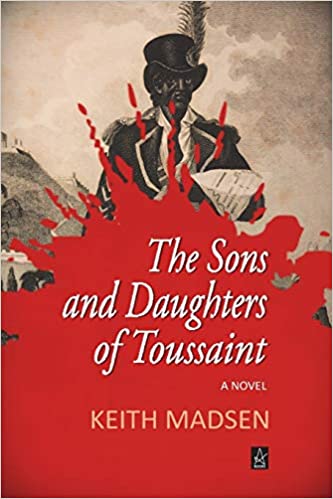
In this commercial fiction novel with an historical backdrop, The Sons and Daughters of Toussaint, Isaac Breda seeks to renew the revolution of his famous forefather, Toussaint Louverture.
Isaac Breda wants to renew the revolution of his famous forefather, Toussaint Louverture. He is depressed that a revolution which had so much potential, and which had cost so much, seemed to have so little to show for it. He resolves to start a non-violent revolution to make their freedom real. In the first half of the novel, the story is told by alternating chapters between historical sections, telling the story of Toussaint and his compatriots, and contemporary sections, where Isaac seeks to renew Toussaint’s spirit in his people.
Isaac’s story intersects with that of his best friend’s beautiful sister, Marie-Noëlle. At first she is mainly focused on moving to the United States and making her fame and fortune in modeling. But her character develops into a powerful agent of change herself when the revolution falls on her shoulders. The immense challenge transforms both her and her country.
Excerpt
Marie-Noëlle knew she was beautiful. She had long taken delight in the power of her eyes when she opened them wide, smiled and tilted her head just so at some defenseless male -- whether the male be 13 or 93, lying on his death bed, he would be ready to spend his last ounce of energy just to see that smile again. Then as she matured into womanhood, she learned to delight in the other weapons of her developing arsenal: her legs, slender and smooth, flowing from underneath a short dress, drew the eyes of every passer-by, male or female; her breasts, soft and firm, even with their partial veiling, were emblems of her goddess authority to command the world of men.
Her brother, Henri, was good-looking, but not even close to being in her league when it came to attracting the opposite sex. When US tourists came to Cap Haitian, he always looked for young women he could come on to, even propose marriage to, with the hope of getting into the United States. In contrast, when male US tourists came to their city, if they got one look at Marie-Noëlle, they were the ones begging for a chance to whisk her away to a better life.
Yes, Marie-Noëlle knew she was a stunning beauty. What she didn’t yet know was what else she was, and what to do about it. At first it was a lot of fun having all the young men make fools of themselves over her, but the fun was now ebbing. She wanted more.
Professional Reviews
Thought-Provoking Novel of Social Justice
Prior to picking up Keith Madsen’s debut novel, The Sons and Daughters of Toussaint, my view of the country of Haiti had been through the stereotypical lens of the news media. Haiti is typically portrayed as a third-world country in the Caribbean whose people live in grinding poverty, beset by periodic hurricanes, earthquakes, and outbreaks of disease. The Haitians’ lot in life is made even worse by violent crime and a history of intractable political corruption.
The Sons and Daughters of Toussaint served to change this view by first providing the story of Haiti’s break from enslavement by the French, as seen through the eyes of Toussaint Louverture--a principle leader of the Haitian Revolution--then picking up the spirit of revolution in one of his fictional twentieth-first-century descendants, Isaac Brede.
In addition to Isaac Brede, two other characters served to break the stereotype of the Haitian people as wallowing hopelessly in the gutter: Marie-Noelle and her brother Henri. Marie-Noelle is a beautiful young woman who leaves Haiti to take New York by storm as a fashion model. Her brother Henri also leaves Haiti to attend college in the US. Both are talented, smart, and ambitious
The first half of the novel alternates between the 19th and 21st century, opening with a chess game between Toussaint Louverture and none other than Napoleon Boneparte.
I was surprised by how bloody and violent the 19th century sections of the novel were, including the killing of women and children. Upon reflection, I came to realize similarities with the Nat Turner Rebellion, which William Styron imagined in The Confessions of Nat Turner. Both novels raise the question of the morality of violent resistance to slavery and oppression when it includes the slaughter of innocents.
Another noteworthy thematic element of The Sons and Daughters of Toussaint is the clothing company started by Marie-Noelle and one of her fellow models. They initially start the company to provide attractive and affordable clothing drawing on their Haitian heritage. As resistance to Isaac Brede’s peace work grows, Marie-Noelle’s company becomes the rallying cry for peaceful resistance to bring about social change, in particular the “Nou pas pe” t-shirts: We are not afraid.
In addition to the social justice theme, the novel features a love story between Marie-Noelle and Isaac Brede. It begins as immature flirting, is tempered by the hardship of time spend apart as Marie-Noelle pursues her modeling career in New York, deepens into marriage, and endures past death.
Towards the end of the novel, I was shocked by what happens to Marie-Noelle at a rally, then gratified to see how she comes to accept it, and, ultimately, to triumph over it to serve as a bastion of hope for the future of her fellow countrymen and women.
I particularly appreciated the message of hope in The Sons and Daughters of Toussaint--that even in a country as troubled as Haiti, all is not lost. I highly recommend this thought-provoking novel to readers who have an interest in questions of social justice and the men and women who grapple with these questions while still fulfilling the need to live their own lives.
A Violent Past Gives Rise to a Vision of Hope
Keith Madsen knows Haiti intimately and that knowledge and his obvious love for the country permeates this novel with details that could only have come from first hand experience. "Sons and Daughters of Toussaint Louverture" alternates between present day Haiti and the last days of Louverture, hero of Haiti's revolution, which ultimately released the country from the bonds of foreign control and slavery. Not without a bloody price. The present day story presents us with a vision of a fictional revitalized Haiti on the verge of reclaiming its place as the pride of the Caribbean.
I found myself fact-checking the historical narrative, wondering if Jean-Jacques Dessalines, Toussaint's successor was indeed the cold-blooded tyrant depicted in "Sons and Daughters", why is Dessalines Day still celebrated as a national holiday in Haiti? It turns out Madsen got his facts right, and Dessalines, along with much of Haiti's past, has been subject to a historical makeover. In a time where the US is reconsidering the status of "heroes" from our past, it's a part of Madsen's tale that hits home. Another compelling thread for me was the question of beauty – what it is and isn't, when one of the main characters in the novel, a Haitian model, famous for her good looks, is obliged to rediscover her own inner beauty.
There's a spoiler in the description of the novel on its back cover, so I'd advise diving in to the book itself, putting yourself in the good hands of a excellent storyteller.
A Remarkable Blend of History, Romance and the Struggle for Racial Justice
Love of all things Haitian shines through every word in Keith Madsen’s daring book. I use that adjective because to envision a future for a nation and its people takes courage. And it is Madsen’s vision that is the foundation for the dramatic story he has chosen to tell.
Isaac Breda is the modern protagonist of the novel and a descendent of Toussaint Louverture, the famous Haitian revolutionary and humanist who led the battle for his country’s freedom from France during Napoleon’s rule. We follow both of these men in alternating stories until the novel settles into the present and moves into what I found myself fervently hoping will be its future. A strong theme of courage in the face of overwhelming odds runs though this book, and the slogan “Nou pa pè!” - We are not afraid!” resounds from the pages.
Madsen has wonderful powers off description. Both the Haitian and New York settings come alive in this book and provide a strong sense of place. Combine that with the author’s sense of humor, his gift for painting heroes and villains equally well, and his inclusion of a love story of epic proportions and you get a book that is genuinely moving (in spite of a few pages that seem to belong in a philosophical treatise).
I now have a much better grasp of Haitian history and the tragedy of how, after achieving independence, Haiti has remain colonized on many levels and unable to make the progress that Toussaint dreamed about. What the book brings is a sense of possibilities, an affirmation that with wise and compassionate leadership Haiti could experience lasting change for the better.
I was touched and surprised by the ending.
Highly recommended for anyone with a true interest in Haitian history and culture, as well as vivid characters who embody the struggle for justice and economic well-being that continues to this day.
A delightfully rare Historical Novel. 85% a biography of a spy, musician, mother and her neice trapped behind German lines in World War I. This background led to a diplomatic post in World War II. Aged 92, Vera disclosed her past life one year before
Sometimes, vacations just don't turn out the way you hoped they would. An idyllic wilderness house boating get-a-way soon turns into a hellish nightmare...