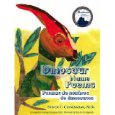
Category: Children Publisher: Three Conditions Press
ISBN-10: 0972124160
Pages: 72
Copyright: May 2009
ISBN-13: 9780972124164
Award-winning book of art, poetry and information about dinosaurs for children aged 4-12, but adults love it too!
30 poems that will encourage in any child love of language carefulness as well as language playfulness. The bilingual (English/Spanish) book received rare distinction as a Paleontological Research Institution (PRI)-approved book for its content and illustration accuracy, and received two 2009 Moonbeam Awards in the Children s Poetry and Spanish Language Book categories.
Tackling dinosaurs from A (Allosaurus) to V (Velociraptor), each poem plays on the meaning or etymology of the ancient animal's name. The richly hued watercolor collages delight with whimsy of their own, and the bilingual glossary of technical terms and prehistoric creatures rounding out the book is sure to satisfy the inquisitive nature so many children bring to learning about these beloved creatures.
This book is intended for a wide age range: children as young as 3 to 4 years old seem to love the pictures and the rhyme and rhythm, while 11- to 12-year-olds can appreciate the more subtle plays on words; adults who want to enjoy some fun reading or brush up on their Spanish will also profitably read this book.
Professional Reviews
The joys of poetry coupled with paleontology can painlessly be introduced to children
By Norman Goldman "Editor of Bookpleasures.com" (Montreal)
(TOP 1000 REVIEWER)
Thanks to the efforts of authors like Dr. Steven C. Cunningham, the joys of poetry coupled with paleontology can painlessly be introduced to children ages 4-12.
Dinosaur Name Poems (Poemas de nombres de dinosaurios) is just that kind of a bilingual English-Spanish children's picture book. Not only will kids learn about prehistoric creatures presented to them in the format of witty poems, but at the same time, they may also pick up a few Spanish or English words along the way, as each poem appears in both languages.
All of the poems have a great roll-along sound and bouncy rhythm, characterizing thirty dinosaurs from Allosaurus to Velociraptor as they play on the meaning of the etymology of the ancient animal's name. This will unquestionably engage kids and persuade them to sit still and listen. And if you are concerned about the pronunciations of these pre-historic animals, fear not, at the end of the book there is a complete listing of all of the creatures in alphabetical order with their phonetic pronunciations, name meaning, locomotion, diet, and some interesting tidbits such as how did it get its name. There is also a glossary of technical terms such as the meaning of carnivorous, herbivorous and several words used in various poems.
The title poem Ichthyornis (ik-thee-ORN-iss) is one of my favorites:
"Fish Bird," you are named
(but don't be ashamed)
for what you like to eat.
If I were you, loving as I do,
all treats that are sweet,
including this confection,
a morsel of chocolate perfection,
that down my throat just slid,
they would call me "candy kid."
Another titled Teratosaurus (teh-RAT-uh-sawr-us) is adorable and can be sung to the tune of "Happy Birthday."
You-re a "Monster Lizard."
You-re a "Monster Lizard."
You look like a monster,
and you eat like one too.
Perfect for reading out loud, Dinosaur Name Poems (Poemas de nombres de dinosaurios) will no doubt encourage adult and children participation, as it sparks the imagination of both to pose questions pertaining to these extinct animals as: "What if....these animals lived to day? Where would we find them? How did they become extinct? As an added plus, the study of paleontology, particularly in the format presented in this book, may also offer many avenues of exploration to a wide variety of sciences as biology, geology, chemistry, physics and astronomy.
Supporting the thirty poems are Valeska M. Populoh's laugh-out-loud animated illustrations with their brilliant texture and wonderful palette of colors, notably red, green and blue that are well matched to the text. These images greatly bolster the spirit of the poems as well as their sense of amusement. The many way-out details and somewhat zany appearances of these pre-historic animals will elicit smiles from kids, assuring that this title will be a repeat favorite with families.
The book received rare distinction as a Paleontological Research Institution (PRI)-approved book for its content and illustration accuracy. It also and received two 2009 Moonbeam Awards in the Children's Poetry and Spanish Language Book categories.
Dr. Steven Clark Cunningham was born in Denver, Colorado. After graduating from Creighton University with majors in chemistry and Spanish, he attended medical school at George Washington University in Washington, DC. Having finished his residency in general surgery at the University of Maryland in Baltimore, Maryland, he is currently doing a fellowship in surgery of the liver and pancreas at Johns Hopkins University.
He has served as a contributing editor of Maryland Poetry Review, and his poems have appeared in Maryland Poetry Review, The New Physician (winner of literary arts contest), Chimeras, WordHouse: Baltimore's Literary Calendar, the anthology Function At The Junction #2 (Electric Press, 1997), the cookbook Pasta Poetics (ed. Matt Hohner, 1997), and the anthology Poems for Chromosomes
Norm Goldman, Publisher & Editor of Bookpleasures
A great introduction to etymology
Of course all poets love words. In Dinosaur Name Poems author Steven Cunningham shows us how many different ways there are to love them. Along the way readers will learn about dinosaurs and the field of paleontology.
Mr. Cunningham clearly enjoys rhyme. Dinosaur Name Poems will appeal to any child who loves to come up with rhyming words. Though the author resorts to some awkward syntax in order to get his rhymes, the reader will understand that the fun is in the words themselves. In the poem, "Saurolophus," for example, Mr. Cunningham uses nine words that rhyme with "crested." What are they? Nested, congested, infested, requested, rested, ingested, suggested, arrested, and last but not least, protested.
Though Cunningham rhymes also in couplets, he is at his best with these long collections of rhyming words. In "Archaeopteryx," he has fun with the word "wing."
"Ancient Wing,"
could you bring
me on a fling?
We'll swing and we'll zing
way beyond T.king.
To the ground he'll cling,
with envy he'll sting
while sweet somgs of spring
to the warm air we'll sing.
What a beautiful thing
to ride your ancient wing.
Dinosaur Name Poems aims to please kids of varying ages and interests. Young children will love the vivid illustrations, which accurately depict the features of each dinosaur while at the same time being brightly colored, imaginative, and sometimes even funny.
As with the illustrations, the text of Dinosaur Name Poems is not all silliness. Each poem begins with a translation of the dinosaur's name. Older kids, and serious dinosaur enthusiasts, can discover more about these names in the Glossary, which is twenty additional illustrated pages. The glossary begins with a definition of "etymology" and then goes on to give the roots, and their definitions, for each name.
For many children this may be a first introduction to etymology-- and also a new way to have fun with words! The glossary section also provides a nice introduction to the field of paleontology. Through an "interesting note" on each dinosaur, the author outlines a brief history of our understanding about the species. It is fascinating to learn about the ways that paleontologist have changed their theories as they find new fossils. Kids will understand that our knowledge of dinosaurs is still growing and might even be inspired to become paleontologists themselves.
As if all this fun with words were not enough, the reader has the added treat of seeing the poems translated into Spanish on the same page. Dinosaur Name Poems would be great for a bilingual classroom. In short kids can learn some Latin, Greek, Spanish and perhaps even discover a love for language, all while having fun with colorful pictures and silly rhymes.
Quill says: A great introduction to etymology that will appeal to kids on several different levels.
An inspirational book about a unique world where trees hold intrinsic knowledge and powerful forces of energy. The group of students called the Planeteers demonstrate character building and not judge people base on their appearance, but judge them on