Category: Travel Publisher: Blue Sky Books
ISBN-10: 1456445393
Type: Non-Fiction
Pages: 250
Copyright: Dec 9, 2010
ISBN-13: 9781456445393
Snakes Alive collects together 56 of the author's best travel pieces, amounting to 71,000 words.
Mike Gerrard's travel writing has won awards in the UK and USA, and been published in The Times, Time Out, The Washington Post, Wanderlust, The Independent on Sunday, The Express, The Sydney Sun-Herald, The Guardian, and many other publications.
In this collection of his travel writing, his award-winning pieces about eating snake in China, taking a taxi ride through troubled Belfast, and walking the hair-raising levadas of Madeira are all included.Also here are other evocative accounts of his experiences:
* camel-trekking in the Sinai Desert
* helping to drink a bar dry in Guyana
* dodging orangutan dung in Sumatra
* canoeing in Venezuela's Orinoco Delta
* touring Paris at night on a bike
* discovering Viking toilet habits
* going to a country that doesn't exist
And capturing the atmosphere of Jamaica, the South Pacific, Armenia, Georgia, Guatemala, Mexico, and Athens in these 56 travel pieces, amounting to 71,000 words over 250 pages.
Excerpt
Magic Merida
'The hotel is not responsible for values left behind in your room.' The sign behind the reception desk at the elegant Colonial Hotel seemed to give carte blanche to enjoy ourselves in Merida, the capital of Mexico's Yucatan state. Whether I would or not I'd no idea, because all I knew was that it was where we'd be staying after visiting the Mayan ruins at Chichen Itza, and before moving on to more ruins at Palenque. Such places are often chosen for geographical convenience and handy hotels more than anything, so I left my values behind but went out to explore with an open mind and an open Rough Guide.
At the Artisan's Museum I disturbed the lone doorkeeper, slumbering to the sound of the radio. He switched on the lights, which somehow also connected his radio to the loudspeakers, so that I toured the rooms to the rasping horns of Mexico's Radio One. Perhaps he just thought I'd be lonely in there.
It was a bit eerie, gazing at the displays of devil masks and skeletons, those grinning, boney reminders of the Day of the Dead. There were red skeletons riding red dragons suspended from the ceiling, a yellow skeleton grimacing on the back of a giant green and yellow beetle, a skeleton clutching a skeleton baby, even a skeleton in a blue denim jacket. For light relief were the rows of masks: red-faced devils with staring eyes, jaguars, men that epitomised Latin evil, and some that looked just like the Mavericks. I half-expected the radio to burst into 'Dance the Night Away'.
If this was the people's culture - embroidery, farming implements, drums made from armadillo shells - then high culture resides in the Museum of Contemporary Art. I walked back towards the centre, taking lengthy detours where road junctions were submerged in several feet of water from that morning's torrential downpour. It was like negotiating your way round Venice. A long queue of people stretched along a block behind the Iglesia de Jesus. Queuing for church, or maybe for transport? Well, both in a way as I turned the corner and saw it was the afternoon show for Godzilla.
'Hey, good pussy,' a Mexican guy was shouting after two foreign female tourists who were for some strange reason leaving his shop. I can't think why. He directed me round the corner to the Contemporary Art Museum, where a narrow doorway opened up into one of Merida's hidden treasures. The city is laid out on a grid system, the streets spiking out straight from the huge Plaza Mayor, the heart of the heart of Merida. On one side is the imposing Cathedral, and opposite the Palacio Municipal, whose English translation of 'Town Hall' doesn't quite achieve the same effect. On the north side of the Plaza stands the Palacio de Gobierno, and on the south side the Casa de Montejo, the 16th-century mansion home of the Montejo family. In-between these splendid old buildings, people read their papers in the shade of the rows of laurel trees, or sit and have their shoes shined. Workers were tidying up the topiary, giving razor-sharp edges to razor-sharp hedges, and signs on the lawns smooth as snooker tables said: 'Respect the environment' and 'Take care of the flowers.' I'd expected mess in Mexico, and chaos, and while there was plenty of both there was also the delights of finding places like Merida, a city of Palaces, seemingly relaxed and at ease with itself.
The grid system means that you walk along a city block past shop fronts and offices, hotels and restaurants, past closed doorways and then past the occasional one that opens up to give a glimpse of the world inside - the courtyards and stairways and gardens and fountains that occupy the interiors of those large city blocks. So it was in the Contemporary Art Museum, along from the Cathedral in what was the Archbishop's Palace. The ticket office, no more than a few feet wide, leads through to a spacious garden, with well-tended bushes, and fountains flowing. At the far end a wide stone staircase leads up to the first-floor galleries, where attendants hold the doors open and smile as you enter. At first I feared the worst, that the splendour of the building would turn out to contain the usual motley provincial collection, especially as the first room contained nothing more exciting than photos and models of the world's greatest treasures, from Stonehenge and the pyramids through to copies of modern masters. At the far end of the room a group of schoolchildren were chattering like starlings as they took their art lesson. Up some stairs in a galleried recess a fake Mona Lisa was smiling. Downstairs a runaway boy was retrieved by his ear.
In other rooms, though, the museum showed its worth. There was the Gaugin-like work of Victor Arguez, with huge lumpy nudes. Beyond was the art of embroidery, with lovingly detailed floral designs round the hems and necks of white dresses. Beyond that a temporary exhibition, 'Exposicion Itinerante', of Cuban photography: stark images of stark poverty. Local artist Fermando Castro Pacheco has an exhibition, including a wonderful Torteadora, a woman making tortillas and having an expression of complete serenity on her face. A Mexican Mona Lisa. The Museum leaflet tells me that Pacheco was invited to paint the murals on the walls of the Government Palace, the Palacio de Gobierno, so I walk across the Plaza, past the armed guards, and into another wonderful interior, an open-topped tiled patio, with tropical plants in pots and surrounded by a double-decker row of graceful arcades. In one open office a few people are waiting to see the Mayor, clutching pieces of paper. On the walls are Pacheco's stunning huge murals, of Mayan Indian life, of Mexican history.
Next morning I visit two cathedrals. First is the vast 16th century Cathedral of San Idelfonso, where people kneel and pray to Christ of the Blisters, a statue said to have been carved from the wood of a single tree, which has twice burned but never done more than blackened a little and come out in blisters. After that I cross the Plaza again to the modern cathedral, the Banamex Bank, where I pray to a hole in the wall that by inserting my Switch card and magically pressing four digits here in the middle of Mexico, a hundred quid will be taken from my account in Leeds and put into my hand. It works, a modern miracle. I celebrate with a guanabana milkshake at the Jugos California juice bar, where the TV is showing the Mexican version of Candid Camera, featuring the one where the bank robber runs out of the bank, drops a bag on the pavement, and passers-by race after him to return it to him. He should have just used his Switch card.
Merida's the home of the hammock, and king-sized ones are 'heaven on a string' according to our tour leader. In Merida's market they hang from stalls, while spice smells hang in the air. A woman is frying tortillas, though without quite the beatific expression of the woman in Pacheco's painting. Nearby a man is playing and swaying his sax while his elderly partner, in a battered trilby, bongoes away.
Merida's a great place for meandering, and I decide to head north for the Anthropological Museum without worrying too much if I get there, but I've scarcely crossed the Plaza Mayor when the sky turns from blue to grey, and by the time I reach the Plaza Hidalgo it's black and so close it could tap me on the shoulder and say: are you serious about this walk? When the raindrops start I duck into the Restaurant Express for a bottle of beer as the light shower turns into the Victoria Falls. I move back a table as the rain bounces in from the pavement, and the owner pulls down the shutter half-way. Deprived of the pleasure of watching people race by with plastic bags on their head, or in the case of one woman amble by in just jeans and a t-shirt, soaked but smiling like a Yucatan Fred Astaire, I move across to the open side and gaze at the torrent. Thirty minutes later and the gutters are gushing, and it's almost time for lunch. Poc-chuc pollo, por favor, and a copa vino blanco. The wine is surprisingly dry and smooth, in fact slips down so fast it's gone before the chicken turns up. Otro? the waiter asks, one of the more useful words I've learned. Otro, I say, and he brings another, followed by the irresistible smell of roast chicken, served with the poc-chuc sauce, a mix of onions and bitter oranges, which sounds strange but tastes sublime.
Two hours later and it's no longer like sitting behind a waterfall. The rain stops, the sky clears, and I venture out. A man is walking along with a green plastic bag tied round each foot with string. There's a queue for one of the collectivo buses, and half-way along it is a man with a clown's make-up painted on his face, waiting mournfully.
That night I tuck into an avocado stuffed with peppery tuna, and down a dark beer, reflecting on two days well spent. At the next table are three British women, the talk dominated by one with a blaring Northern accent. 'Anyway,' she informs the world, 'my mum says I should go out with him, but I also know there's a very low side to him. His actions. But he's a very nice bloke.' Musing on this and wondering if he'd maybe just left his values behind in his room, I toddle down to the Plaza Mayor to watch the passing show and enjoy a tooth-tingling guanabana sorbet. An old Mexican man comes up to me, in shabby suit and with a wooden box in his hand. I'm about to say I don't want my shoes shined when he asks, 'Magic, senor?' Magic, I have to agree.
Travel to Guatemala with The Imaginative Traveller: www.imaginative-traveller.com
US State Journals, pages for you to fill in the blanks.
Nurture your creativity with My Indiana Journal, an interactive journal designed to spark your imagination and self-motivation
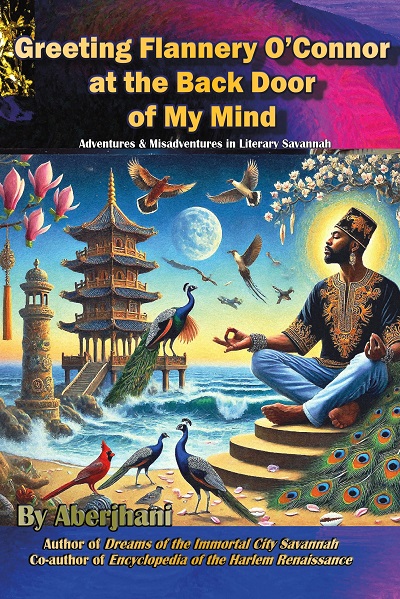
First Kindle eBook edition of the literary memoir Greeting Flannery O'Connor at the Back Door of My Mind. Explores a certain author's "Adventures and Misadventure of Literary Savannah" upon encountering, in one form or another, authors Flannery O'Con
Expands beyond the safety of pages bound by predictability to explore and often confirm exciting creative possibilities. A shimmering collage of memoir, creative nonfiction, literary journalism, and dizzying flights into poetic observation, this is t