|

Click here to buy this book!
Kindle Edition
Download to your Nook (eBook)
Download from Apple iTunes (eBook)
Download from Smashwords (eBook)
Amazon
Lulu
Barnes & Noble.com
Novels by William Walling
Novels by William Walling
Category:
Science Fiction
Publisher: Virtualbookworm.com, Inc.
ISBN-10: 1589397614
Type: Fiction
Pages: 283
Copyright: © 2005 by William Walling
ISBN-13: 9781589397613
Price: $7.95 (eBook)
An interstellar criminologist and planetary security director schooled in advanced empathic perception conducts an investigation into a royal assassination accompanied by two unwanted "assistants," the prince and prime minister of Kraan.
Klavik, Security Director of Kraan, a massive world governed by the only remaining monarchy in far-flung neohuman interstellar society, has been conditioned to acutely perceive the emotional state of others. After Kraan’s reigning monarch is assassinated while on holiday in parsecs-distant Eden, a terraformed pleasure world operated by a distant alien syndicate, a pair of companions force themselves upon Klavik during his investigative sojourn in Eden: Kraan’s crusty Prime Minister and adolescent Prince Royal. Employing his “sixth sense,” Klavik fastens on a nervous Eden official as the prime prospect for interrogation, but is frustrated at every turn because his energies must be channeled toward protecting his illustrious charges. Emil Shatterhand, Eden’s planetary director, ushers the threesome into a “hall of mirrors” where nothing is as it seems. After feints and ploys designed to distract or frighten away the trio, Klavik senses sly “nibblings” at the limbic fringes of his mind and gradually becomes aware that an alien exotic is present. Sly mental assaults and induced nightmares invoking sleeplessness persist. When his charges are taken hostage, Klavik is forced to accede to psychic “evaluation” by the exotic, and the ultimate confrontation erupts in a rapacious battle of wills.
Excerpt
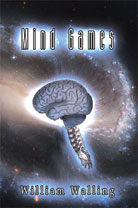
Mind Games
William Walling
Toil not to find a better Paradise,
If other Paradise indeed there be!
The Rubaiyat of Omar Khayyam,
a poet of Old Earth antiquity
Prologue
Venture there now if the exorbitant wherewithal is yours, and it will be impossible to imagine Eden’s raw, pristine state — a frigid, backwater planet smaller than Old Earth, the neohuman ancestral home. Selected from among hundreds of candidates because it best fit the prescribed template, the lonely planet featured large, ice-covered seas, a crust readily manipulable by advanced terraforming technology, and chanced to sustained no higher life forms per se, a fact totally immaterial to the founders. Had such been the case, the anonymous world would have been “cleansed.” Of almost equal importance, the isolated mote circled a G2V main sequence primary, Sol’s veritable twin, in a sector of the visited galaxy untrammeled by cultures in conflict.
The absentee owners, shadow masters of a far-flung commercial empire, inhabit a remote, enigmatic hydrosphere transliterated as Parvo in Lingua Stella, the interstellar trade patois. A species of exotics known only by hearsay due to its “otherness” and reputation for entrepreneurial brilliance, Parvons resemble neohumans in only one respect: intelligence.
Following a round of stiff competitive bidding, the Parvon Syndicate awarded lucrative contracts to a terraforming specialty conglomerate in Chalseanne, thirty parsecs distant along an in-galactic geodesic. Titanic mobile fusion cells were brought to bear powering teragauss generators that “seized” the raw world’s molten ferrous core in a magnetic vise. During the course of an entire standard decade, the barren planet was pulled into a stable orbit closer to its primary within Rasool’s Optimum, where exposure to radiation flux and the particulate “stellar wind” was deemed ideal for neohuman tenancy. Dual moons were orbited to silver the night skies. Minor adjustments were made to the system dynamics of two inner planets, and four outlying gas giants orbiting broods of natural satellites. The obscure stellar system’s lesser bodies were left to seek equilibrium on their own.
Terraforming then began in earnest. An atmosphere enrichment program began concurrently with extensive mountain-building projects. Conclusions derived from the multiple, exhaustive studies of neohuman consultants led to “cleansing” inimical life forms from the seas, continents and islands — life forms inimical to profit in the Parvon sense — after benign, ecologically compatible substitutes were procured, or cloned, and readied for transport.
Architects and ecologists, engineers, agronomists, marine biologists, artists, designers, social scientists — legions of professionals boasting expertise in a host of disciplines —descended on the gestating world in droves along with a huge, multi-ethnic construction crew. The Parvon Syndicate’s directors worked reflexively, weighing from afar the economic versus aesthetic aspect of each prospective venture. Trade-offs involving trillions of stellars and millions of labor manhours were debated at length, and reconciled.
More than eighty planetary systems populated by unmutated and lightly mutated neohuman stock were screened for their most inordinately attractive male and female specimens. Thousands of cloning contracts were signed. As living quarters became available, cloned infants and toddlers were transported to newly established crèches in Eden, the resort world’s chosen name. Reared in accordance with Syndicate precepts, their maturation rates paralleled final constructions.
The Parvon Syndicate’s investment of time, energy and valuta was immense. The predicated long-range return on the investment was estimated to be astronomical.
Toward the end of the sixth standard decade, a pair of senior Syndicate directors — iridescent, vermiculate exotics encased in bioregenerative null-grav capsules to interdict them from the poisonous, oxygen-rich atmosphere — roamed Eden on a final inspection tour. They found the cloned android population enjoying its teens and early twenties.
The Parvon Syndicate looked upon its handiwork, and was pleased.
During the seventh standard decade, it rested.
Paradise Found
Gessim Ahmed Kallas
Terranova, 3427 C.E.
ONE
The weapons technician was nervous. He looked away to avert the inquisitor’s chill, steady gaze.
“You did work that night,” said Klavik.
“Yessir.” The technician licked his lips. “Not much got done. We spent the wee hours crowded in the test lab while His Omnipotence was on site.”
A rippling burble of anxiety mixed with corollary twinges of foreboding impinged upon Klavik’s consciousness, reactions common in subjects under interrogation. State Security Director by appointment to the Crown, the absence of hoped-for intimidation — his secondary stock in trade —disappointed Klavik. Intimidating a subject under questioning was something his impassive features and fixed, unblinking stare usually brought into full flower. If told, few would have believed his primary weapon, enhanced empathic perception, a cultivated “sixth sense” that enabled him to perceive gross emotional patterns in others. Schooled in the psychic discipline, he had previously interviewed a parade of so-called witnesses, and recently resumed questioning arsenal personnel at random, trolling with folded hands and searching mind for stray slips, scraps of hitherto unrevealed information, while remaining alert for any hint of elevated emotional disquiet that might prompt more intensive questioning.
Where the weapons technician was concerned, he knew that once again he was pumping at a dry well. Other than general anxiety over being questioned by someone in authority, the middle-aged technician’s emotional tenor fell within nominal parameters.
“Who instructed you to leave the arsenal proper?”
“The supe . . . Our, uh, supervisor told us to clear out. We cooled our heels in the lab till His Omnipotence and those with him went back aboveground.”
“I see,” said Klavik, who saw nothing revelatory. During the wee hours, Kraan’s semi-deified monarch had dismissed his escort of Royal Elite Guardsmen and paid an unannounced visit to the underground nuclear arsenal. None of the scientists, engineers, technicians or administrative staffers grilled to date could imagine why the ruler had put in an impromptu, unheralded appearance.
Wearied by sessions of fruitless interrogation, Klavik felt it futile to voice the familiar concluding mantra, but did so anyhow on general principles. “You noticed nothing unusual that night, no untoward incidents, no strangers on the premises?”
A blink of surprise. “Strangers down here? Security’s tight as a bung in the complex, sir.” The technician tapped the badge clipped to the pocket of his dun-colored jumpsuit. “Iris eye patterns and a fancy hologram are digitized on our rad badges. Doors stay shut if the computer doesn’t like what it reads. Can’t begin to guess how a stranger’d get inside.”
Nor I, thought Klavik darkly. “You saw no one you failed to recognize?”
The technician’s brow creased. “Scuttlebutt says a half-dozen priests came down with His Omnipotence. Didn’t see ‘em myself.”
Having interviewed the prelates in question, Klavik had found their accounts in total agreement. His Omnipotence had ordered the clergymen to wait for him in the blockhouse below the arsenal’s sealed, guarded entrance. As in all prior interviews, questioning the technician was leading nowhere. “Wouldn’t you think it highly unlikely,” he asked “for our gracious sovereign to arrange for the theft of costly, weapons grade thorium isotope?” Hoping the off-the-wall query would nudge loose an emotional spike, he was not surprised when it failed to do so. “His Omnipotence,” he added, knowing the added bait useless even before dangling it, “would have no reason to steal anything that was already Crown property.”
The middle-aged technician puffed his cheeks. “Never thought about it that way. Me and the others, we kicked the whole crazy business around amongst ourselves. What happened to the thorium is . . . No one has a glimmer.”
His enhanced sense of esthesis reconfirmed the technician’s innocence. The puzzle had deepened another notch.
Ultra-sophisticated surveillance systems had recorded nothing unusual, nor had equally complex alarm systems been triggered, on the night a lethal, extremely valuable quantity of weapons-grade thorium isotope vanished from the subterranean arsenal. As security director, it was Klavik’s prerogative to work alone on those rare cases with global security implications. Having chased a number of skimpy leads, all of which had proved to be either hearsay, or confusion attributable to mildly contradictory eyewitness accounts. The current interview had once again led him into a blind cul-de-sac. Yet a nagging suspicion remained that some higher-up within Kraan’s fractionated government had engineered the outrageous theft, and then heaped over it a tangled skein of incidentalia no amount of sleuthing could unravel.
|