|

Click here to buy this book!
Kindle Edition
Download to your Nook (eBook)
Download from Apple iTunes (eBook)
Download from Smashwords (eBook)
Amazon
Lulu
Barnes & Noble.com
Novels by William Walling
Novels by William Walling
Category:
Science Fiction
Publisher: Virtualbookworm.com, Inc. Publishing, Inc.
ISBN-10: 1589398181
Type: Fiction
Pages: 259
Copyright: Copyright 2005 William Walling
ISBN-13: 9781589398184
Price: $7.95 (eBook)
Could the course of World War II, particularly its outcome, be changed? Sure, all you need is time travel -- and practice. But it still may not be quite that simple. So even when you think you've got the hang of it, you'd best be very, very careful . . .
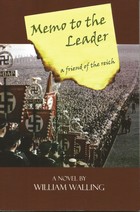
It is year 142 of Deutsches Weltreich, the German World Empire as reckoned from 1933. when Adolph Hitler became German Chancellor and the vilified Nazi regime was born. Dr. Jame Silverthorne, a tenured history professor at Goebbels Institut in Greater Denver Gauleitung, Colorade Province, is a seasoned time traveller as well, vetted more than once by Reichskounzel to conduct retrotemporal research in selective epochs of the past. James plays the key role in a desperate conspiracy designed to obliterate Deutschesweltanreich in retrospect via a clandestine return to wartime Berlin in order to locate and hopefully thwart the efforts of Nazi hero of heroes Erich Lustmann, a former SS officer sent back to 1939 decades after the war by Odessa SS exiles in Argentina. A postwar “secret weapon” unknown to the Allies, the Lebe Technique developed by a Nazi theoretical physicist permits Lustmann’s successful dispatch into the past armed with prescient knowledge of wartime events, who somehow manages to influence and begin to rectify the action-decisions of the Nazi hierarchy, hoping to enable the Third Reich to become the World War II victor, not the vanquished. Fearing his ‘mission impossible” is precisely that, Silverthorne nevertheless pursues his world-changing crusade in an exciting time travel adventure both grand in scope and purpose.
Excerpt
Memo to the Leader
William Walling
“The future ain’t what it used to be.”
Yogi Berra
Prologue
Solitude was the most maddening aspect of perpetual confinement. His faceless keepers treated him with neither respect nor disrespect, neither kindness nor unkindness. Their Olympian detachment made his existence inhumane, as if he were already dead; and in a sense he was dead, though living burial was a lame substitute for oblivion. After an endless period of sleep deprivation and deftly applied psychological pressure,, interspersed with exhausting, medication-enhanced interrogations, exquisite pains were taken to deny him the solace of nonexistence.
Stolid guards with opaque Sinic features never acknowledged his presence when food trays were deposited or retrieved from a slot in the steel-barred door. Infrequently, at what might be noon, midnight, or any hour in between, he was marched from the suppurating, jackhammer-scored walls of his limestone cell to a natural gallery in the caverns, where indistinct voices and muffled cries of anguish were occasionally heard. Encouraged with gestures to shuffle to and fro, he performed lethargic calisthenics, his every move scrutinized by silent, taser-armed guards
He saw no other prisoners, ever.
The invisible, vacuous days dragged past in sunless isolation, strung together like evil beads lacking demarcation into anonymous weeks, empty months. He had ample time — all the time there was, perhaps all that remained as well — to examine, re-examine, reflect upon, evaluate and re-evaluate the confluence of circumstances and situations which had culminated in The Great Mistake. Everlastingly, elliptically, his thoughts went back to the complex jumble of schemes, personalities, actions, encounters and endeavors that had fleshed out the world-changing drama in which he’d played a pivotal role.
Take care what you ask for! The caveat reverberated in his mind like a shrill clarion call, and circled there, spinning round and round until he could not stop second-guessing his part in the triumph or the tragedy, and then second-guessing his second-guesses until the riddle had neither beginning nor end and reflexive hindsight crowded his mind into shadowy labyrinths. Panic invariably ensued, searing him with a realization that if his meaningless existence lasted much longer he might find himself not himself, but some stranger bent upon trying to pick shadows off the chiseled walls of his cell.
Perhaps if he’d firmly declined to accept the mission, had adamantly refused to go on the fateful night Omsley put in an impromptu appearance at the chalet, events might have taken a different, more laudable course. That, however, was wishful thinking, the essence of futility. Omsley’s surprise visit had made a beginning of sorts, but there had been more.
So much, much more . . .
ONE Colorado-Provinz, Mai, Deutsches Weltreich-jahr 142
Intrigued by the potential evident in a Genetik-Brett haploid chart, a nameless Aculturazation Ministerium bureaucrat had decided the subject’s first language should be German, thus endowing the newborn with prospective fluency garnished by the arsence of a provincial Amerikanischer Akzent. Nearly four decades later, Dr. James Silverthorne leaned forward in the leather armchair and began earnestly describing the historical imperatives he hoped to establish if permitted to engage in retrotemporal, on-site research of the events and circumstances surrounding a renowned twenty-century-old battle.
Kanzler von Colorado-Provinz Ernst Kästner lifted an imperious hand, silencing his visitor in mid-sentence. “Your command of our language is commendable, but would you mind helping me brush up on my nodding acquaintance with English?”
“Natürlich, Herr Kanz . . . Certainly, sir.” James recognized the other’s “nodding acquaintance” for what it was — pure sham. Ever mindful of his lofty post in the Deutsches Weltreich hierarchy, it was second nature for the erudite official to disarm lesser mortals with false modesty. His true reason for wanting to abandon the mother tongue had to be the black-uniformed SS-Untersturmführer in the high-ceilinged, austerely decorated chamber. A political attaché assigned to shadow the chancellor wherever he went, and report any act or word that might be construed as contrary to Nationaler Sozialist doctrine, he sat stiffly erect beside the obligatory oil portrait of Hitler, his body language denying Silverthorne’s very existence.
James reclaimed his train of thought and began anew. “Opinions differ, sir. Many of my colleagues believe the annihilation of three Roman legions was a turning point in one barbarian segment of ancient Europe, while others view Varusschlacht, while important in itself, was no major milestone, merely another of the great battles peppering antiquity.”
“And your view . . ?” At ease behind his massive rosewood desk, Dr. Kästner toyed with the Ancient Order of Teutonic Knights signet ring on his finger.
Viscerally certain of his interpretation, James said he was convinced the epic battle had catalyzed an eventual change in ancient Europe’s populace. “At that moment in time, Rome had barely finished putting down a massive, drawn-out uprising in what are now the Balkans —”
“Please, Professor,” interrupted Kästner. “I’ve no wish to be inundated with historical expertise. What is your, um . . . gut feeling? Is that an appropriate Americanism?”
“My conviction,” responded Silverthorne, “is based on established fact. Neither Caesar Augustus nor any of his successors resumed the aborted conquest of Germania Magnus, thus allowing the so-called barbarian tribes in the region the freedom to avert total Roman rule and develop their own language and culture. If the tribal chieftain Roman historians record as Arminius had failed to organize and lead a huge army of barbarian warriors, or the battle had gone the other way, I seriously doubt if the outcome would have —”
“Hermann!” declared the chancellor, a disagreeable burr sharpening his diction. “You meant to say Hermann der Cherusker, did you not, rather than ‘Arminius’?”
James feigned chagrin over his purposeful gaffe. “Forgive me, sir. Yet either name is equally suspect. The hero’s indigenous name is a historical sidelight I hope to resolve.”
Outwardly mollified, his host nodded. “Do go on.”
“Historical conjecture,” pursued Silverthorne, “has been rife for generations. Various historical quandaries are rooted in what Rome termed the Varian Disaster. Had the vanquished become the victors, for example, would future Emperor Tiberius have resumed the conquest, and perhaps extended Roman hegemony east to the Elbe? If so, would the western empire have later fallen into eclipse with the Gallic and Germanic peoples under Caesar’s thumb? Or later still, would a coalition of tribes, the Goths, have successfully marched on Rome? Again if so, how would revised European conditions have affected Charlemagne’s attempt to resurrect the empire, or of greater significance to us what of the modern German empire?”
“Provocative questions indeed,” remarked the chancellor, a refractory glint invading his dark eyes. “Yet referring to Tausendjahr Deutches Weltreich as an ‘empire’ strikes me as tactless. Should anyone in the presence of our noble Reichsführer or Reichsleiter dare call die Neue Weltordnung an ‘empire’ I daresay both leaders would take umbrage.”
Pretending to humbly accept chastisement, James dsif,“Sorry, sir. A slip of the tongue.”
Kästner glanced down at Silverthorne’s thick dossier on his desk beside a leather-bound folio edition of MEIN KAMPF, and his manner softened. “Ah, well! No one would dream of belittling your accomplishments, or your qualifications to undertake the junket. Your most recent book electrified historians and literati everywhere, including the intelligentsia in Welthauptstadt Germania.” He paused, his manner thoughtful. “Refresh my memory if you will. What was the nickname his subjects bestowed on their beloved monarch?”
“Der Alte Fritz,” supplied James, trying to imagine a reason for the change of subject.
A dry chuckle. “Der Alte Fritz, ja, ja. Ignoring his self-serving notion to “brush up” on American English, Kästner continued in German. “One glaring omission in your narrative piqued my curiosity, an explanation of how you, a friendless stranger in Prussia, managed to infiltrate Schloss Sanssouci and actually stand in the presence of Friederich der Grosse. Everyone I spoke with expressed fascination over your word picture of the era’s preeminent ruler leaning on a silver-handled walking stick, shuffling about the palace in his faded military uniform.”
“An accomplished flutist and composer, Frederick devoted his declining years and waning energies more to music than statesmanship or command of the Prussian military.”
“Umm, yes. Quite right,” the chancellor said, reverting to English. “I must say you’ve been enormously privileged, Dr. Silverthorne. I confess to having enjoyed your Potsdam book equally during a second reading. Yet an explanation is still owed. How in the world did you, a friendless stranger, manage to worm your way into serving on the palace staff?”
James forced a self-effacing smile. “Looking through servants, not directly at them, was a practice ingrained in the era’s Prussian elite. As a provincial from southern Germany, a pose my, er . . . peculiar modern accent probably reinforced, I first talked my way into a position as footman. Weeks later, a friendly equerry helped me obtain posting as a bewigged usher. The only glitch in the entire junket occurred when my locket and snuff box were —”
“Glitch . . ?” Kästner’s brows contracted. “I fear you’ve lost me.”
“A colloquialism, sir, for a problem. Dean Omsley had the locket fashioned in the institute’s nanotechnology lab. Outwardly a trinket on a tarnished silver chain any servant might own, it enclosed a micro-recorder. The snuff box held all the unprocessed digital images I had snapped in secret, salted with snatches of eavesdropped conversations. I’ve often wondered what the thief, another servant surely, thought when he or she pried open the locket and tried to make sense of the molecular device. I’m sure both items were simply discarded.”
“A dreadful loss.” The chancellor clicked his tongue. “Capturing spoken words and tangible glimpses into that rich era of our past would have added enormously to your book.”
James readily agreed.
“As for daring a visit to distant antiquity, there are reasons why it might be . . . um, shall we say overzealous? No, foolhardy might be much more accurate. Retrotemporal Forschungs-Agentur copied Dr. Omsley’s prospectus your proposed junket to my office. It mentions the battle site near Osnabrück, and your intention to be present during the actual conflict.”
“Learning every possible detail prior to the days of engagement,” said James, “as well as the immediate aftermath, will be crucial to establishing historical integrity.”
“Umm-m-m, yes. One would suppose so, but I fear another type of harsh reality also underscores the inordinate degree of risk associated with your proposed junket.”
|