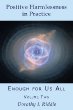
"Positive Harmlessness in Practice" documents that we have no collective experience of harmlessness because our habits of harm are so pervasive and provides a Butterfly Shift approach to build our “harmlessness muscle.” Lots of practical exercises and a Harmlessness Scale™ help us make the shift to harmlessness in all that we think, say, and do.
All spiritual traditions mandate harmlessness, yet the twentieth century was the most violent period in human history. How is this possible? "Positive Harmlessness in Practice" documents that we have no collective experience of harmlessness because our habits of harm are so pervasive. To build our "harmlessness muscle," Dr. Riddle details a pragmatic three-step daily practice—a Butterfly Shift. Such mini-immersion experiences of harmlessness help us develop the skills and habits that make it possible for us to embed Harmlessness as our core value.
"Positive Harmlessness" invites us to embrace an ethic of harmlessness, individually and as a human family. Practical exercises and a Harmlessness Scale™ help us learn to model harmlessness in all that we think, say, and do. In closing, Dr. Riddle challenges us, as a human family, to demonstrate our commitment to an ethic of harmlessness by eliminating the rampant violence against women that currently constitutes, worldwide, the greatest single human rights violation.
Excerpt
All religious traditions share a commitment to harmlessness, however defined. So do professional codes of conduct, which include phrases like that attributed to the Hippocratic Oath: "First, do no harm."
Why do we tolerate harm? Why is there so much violence? It is clear that we cannot rely on spiritual beliefs to prevent it. Part of the answer lies in our distorted view of who we are and how our universe operates, which encourages us to focus on self-interest and to live from a fear-based myth of scarcity.
The first volume in this Enough for Us All series, titled Principles of Abundance for the Cosmic Citizen, explored the meaning of “enough,” the benefits and responsibilities of being a cosmic citizen, and seven principles by which our cosmos operates (which are listed in the Preface of this volume). We will review those principles in the next chapter as they relate to harmlessness. In exploring the concept of harm, the principles that concern us most are that we are indeed all part of the same cosmic energy field (the Principle of Interconnectivity) and that we have evolved primarily through cooperation and networking (the Principle of Cooperation).
We have been shaped over the past 300 years by the mechanistic, deterministic worldview that emerged from Newtonian physics as well as by a belief that our evolutionary history was grounded in violence and competition (“survival of the fittest”). The findings of quantum physics reveal quite a different picture and one that can help us shed our mistaken identities as violent beings. But first, if we are to shift from harmfulness to harmlessness, we need to understand harm and why we indulge in it.
Professional Reviews
Positive Harmlessness in Practice
The three volumes in Dr. Dorothy I. Riddle’s series, Enough for Us All, are designed to awaken awareness to the joy and abundance that are the birthright of all cosmic citizens. The first volume, Principles of Abundance for the Cosmic Citizen, brought science and metaphysics together in an engaging discussion of our interconnectedness in a vast cosmos that evolves through a process of symbiosis and cooperation, and how our ability to thrive as a species and as individuals depends upon moving beyond competitive self-interest to collaboration with others in a dance of give-and-take that assures that there will be enough for all to live and prosper.
Recognizing the need to develop attitudes that foster this cooperation and defuse the violence that threatens us all, Riddle offers her second volume, Positive Harmlessness in Practice, a thoughtful, wise, and mind-opening exploration of ways to help make harmlessness experiential in a culture in which habits of harm are so pervasive that they are felt to be “normal.”
Riddle traces the ubiquitous habits of harm to their root causes—fear of loss and scarcity, a belief in entitlement, ignorance of alternatives to violence, and an “us-them” mentality that objectifies other individuals or groups. Her call to eliminate violence against women —easily the most pervasive form of violence worldwide—exposes the ways in which men use violence as a way to prove their potency. Besides addressing this egregious harm with her characteristic passion and clarity, she also provides a unique Harmlessness Scale™ that gives readers the vocabulary and understanding necessary to recognize attitudes and characteristics that range from brutality to advocacy, making it possible to evaluate one’s own standing with regard to habits of harm and the hidden attitudes that may give rise to them.
Riddle courageously confronts centuries of worldwide religious belief and practice in pointing out that the “ethics of reciprocity” (the “Golden Rule” that is espoused by most world religions) is mostly motivated by self-interest, and stresses the urgent need to move beyond it to a “positive harmlessness” motivated by kindness and goodwill. While she makes it clear that “harmlessness is not simply a more extreme version of reciprocity, (but) a qualitatively different dynamic,” she is aware that it is difficult, if not impossible, to implement a way of being that one has not experienced.
To facilitate the embedding of a new ethic of harmlessness, Riddle offers the “Butterfly Shift mini-immersion”—an active, experiential harmlessness practice named for the chaos theory dynamic that accounts for the ripple effect that spreads out from a small and seemingly insignificant action. This simple daily practice disrupts familiar but harmful patterns, inspires feelings of hopefulness, and has a high probability of creating lasting behavioral change as it touches first one, then many, with kindness and compassion.
Riddle is a psychologist and economic development specialist who has worked in more than seventy-five developing countries, seeking to build understanding between different cultural, socioeconomic, and faith communities so that all may experience justice and equity.
-ForeWord Review
Positive Harmlessness
“A thoughtful, wise, and mind-opening exploration of ways to help make harmlessness experiential in a culture in which habits of harm are so pervasive that they are felt to be ‘normal’…Besides addressing harm with her characteristic passion and clarity, she also provides a unique Harmlessness Scale that gives readers the vocabulary and understanding necessary to recognize attitudes and characteristics that range from brutality to advocacy, making it possible to evaluate one’s own standing with regard to habits of harm and the hidden attitudes that may give rise to them.” [five stars]
Positive Harmlessness
“Riddle … reveals how fully awash we are in a culture that values the individual over the group to the point where we have come to conceive of human development as a solitary experience rather than a lifetime of interactions with others. Written in unfailingly clear and concise prose, this challenge to basic assumptions about human nature points the way toward a kinder, gentler world.”
Through insightful and thought-provoking writing, the author encourages readers to embark on a journey of self-reflection, guiding them to access inner wisdom and cultivate a mindset conducive to a better understanding of our world.