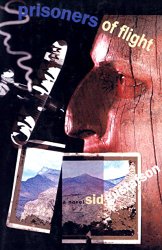
Two former Vietnam Prisoners of War take flight in a small plane. Freed from the surly bonds of earth, they soar until engine trouble forces them to land in the wilderness of Montana.in the wilderness, where they encounter the wild nature of themselves. themselves.
In Prisoners of Flight, Sid Gustafson’s veterinarian protagonist refers often to angels: “We haven’t heard from our angels in a long time. But they’re out there . . . waiting somewhere in the sky.”
Two ex-military pilots, Gustafson’s protagonist and his comrade, Henson, crash their plane into wilderness alongside Montana’s Flathead River. Former Vietnam POWs, they have wrestled with life’s trials ever since, holding to a single constant: a fierce longing for an idealized sky. Says Gustafson’s protagonist: “The flying rule is: When in doubt, do nothing. But I’m not flying anymore.” For indeed, Gustafson’s characters are themselves fallen forms of the angels they seek.
Gustafson (B.S., D.V.M. ’77) manages both an economy of words and a compelling lyricism. There’s a rhythm here that makes for a read difficult to interrupt. And he’s not afraid to toss the rules. Single-word sentences. Pop phraseology. Recurring metaphors. The result is a harrowing adventure part magical realism (with a hint of psychedelia), part paean to the deep forest, part redemption chronicle, and part cryptogram.
Gustafson strands his characters with only a river shack for shelter. Soon, twin sisters—“two breathless earth cookies”—searching for their dog (named Hope—“lost Hope”) emerge from the forest cold and bewildered.
The protagonist recalls how he and Henson communicated cell-to-cell as POWs—through tapping out a simple alphabetic code. They repeatedly refer to this “old dance,” often lapsing into it. Acutely aware of their frailties and failures, they call often on God. And while longing to be back in the sky, they fool themselves like lost boys whistling in the dark that happiness can be found on the ground: “Our earthbound angels can’t stop smiling. And we thought they only lived in the constellations of our skyblown minds.”
The narrative dealing with Henson’s fate is both mythic and sad. (I’m not giving away much here, since the first two words of Gustafson’s novel are, “Henson’s dead.”) Finally, the protagonist’s escape and redemption are pulse-pounding.
There is much that is satisfying about Prisoners of Flight. Best is that it ends, as all good prayers do, with a single word, tapped out in code:
“Amen.”
— Brian Ames ’85, author of Smoke Follows Beauty (Pocol Press, 2002), Head Full of Traffic, (Pocol Press, 2004),and Eighty-Sixed (Word Riot Press, 2004).
Excerpt
Chapter 1
Resurrection
Henson’s dead. I’m having trouble coming to grips with his passing. He’s up here somewhere. We led risky lives and his luck just plain ran out. He wouldn’t view it as bad luck, though. He’s an Indian, a truly native American. Luck doesn’t have anything to do with life, or death. Not in his view, which by now must be omniscient.
The mist I’m flying his plane through comes and goes. It stays. Suddenly my cocoon of clouds opens to a carapace of earth that dashes toward me. I pull up, skimming over the back wall of death, passing close enough to kiss the top of the world. I hang on to flight and catch a Chinook wind down the eastslope. Darkness envelops the atmosphere as I descend below the Continental Divide. All kinds of weather. This afternoon it was snow when I took off in a clearing of clouds. And now rain, coming and going, mostly coming. Winds of all sorts.
Little light remains to the west. Clouds bleed up the setting sun, an aura for Henson’s repose. An unfortunate wilderness death, my close friend dead. Dead, and I’m not yet in touch with his departure. A part of me has perished with him, a big twisted part of me. It’s quite a story, been quite a life; a rugged week and I have my hands full with this crippled plane. That, and I’m into rougher air. Rain runnels my windshield. I’m hoping to make it back to his ranch to inform his mother—his mother and children. And wife, his ex-wife. I need to land. Soon. I’m pretty sure I’m above his ranch. The weather breaks into a deepening darkness.
It’s tough to locate below. My loss of luck may not be far behind my partner’s. This is a shearing squall. A pilot’s nightmare. Weightless and eyeless. My fuel is low. I have two sets of skis on the plane; jerry-rigged skis on broken landing gear. Well, at least I had the skis when I took off. I topped some trees on the takeoff out of the riverbottom. I think I might have torn off the right set, snow skis Henson and I carefully strapped and riveted to the landing gear, landing gear crippled when we were forced to land on a river bank well over a week ago. And then there was the blizzard—the snow and bitterness that led to my friend’s doom—and now this.
At last I make out the faint prairie below—a dusky, dimming windswept expanse. The rain blows away. No lights in sight. Wind and silhouette, a contourless earth. No snow for a smooth landing. Blackfeet Indian Reservation nothingness. Henson’s ancestral homeland. I cringe as I imagine a runway bottomed by thick clumps of native bunchgrass, nothing quite as soft as snow. The blow sweeps me down the fall of mountains. I let it take me eastward, before I nose back around into the Chinook. I lose altitude, careening into wind, until I spot the vague elevation of a hogback ridge running out of the Rocky Mountain Front. I line up and bring my craft earthbound, hoping not to auger in. I stuff some blankets and a pillow in front of my chest and check my seat belt, tightening it as snug as I can. Could be touchy coming down. I heave my craft against the howling. I nose straight into her, throttle full open, and hold tight, easing down a bit closer. The dark earth rises toward me. When I visualize dimlit prairie, I realize I’m stationary to the ground, flying into such fierce wind. This may be good. I’ve brought a lot of crippled planes down in my time, but this ices my cake—wind, skis, no airfield, no runway lights. No instruments, no radar, no snow. This ain’t Vietnam. And I ain’t so young and cocky anymore. Scared, scared and old.
Fear.
Darkness thickens. Flight thins. New spirits of rain break cross my windshield. Earth mesmerizes me. My ground speed reels backwards, then surges sidelong. I pitch and yaw, yaw and dip, dip and dive. I pray. Pilots do pray, you know. Jesus, do we pray. A brief smoothness in the flow descends me. Everything shifts to slo-mo and I drop in on a nimble ridge of grass when I have half a chance. I touch the left landing gear’s skis to grass. They grab and hop, grab and hop. Whoa. I reef on the flaps, get the tail down. So far, so good, until the skiless landing gear drops in and spikes its gaff into the earth. It all twists away. My world tips. I cartwheel. Slow enough at first, then everything tumbles akimbo—off I roll into the last feign of twilight… .
I awaken to darkness. Blood and darkness and fuel fuming. Mind whirling. A gash of midnight suffused by a gassed upsidedownness. My mouth bleeds. I spit out teeth and align my senses as best I can. I decide it’s probably too late for an explosion. My head throbs. My ear aches. I touch it and feel an eerie splay of cartilage. My fingers come back bloody. In the darkness I cannot see the redness, but tell by touch, the lubricant feel of life.
I wait. My central nervous system calms to a whir.
The flying rule is: when in doubt, do nothing. But I’m not flying anymore. I think I’m not.
Wind blows. The plane creaks and whistles, nudged shrill in its cramped angle of repose. Oh, my. My oh my. Gravity disturbs me. Blood sludges through my head. I decide to unstrap. Click. I crumple to the ceiling. I right myself and wrestle up the door. Wind fills the fuselage, turbocharging me with oxygen. I struggle into the night. Once outside I’m blown apart from my plane. My face stings. My bones bend, tendons simper. I fold to the land and hug the earth. The Chinook wind is warm, almost hot. I curl into the soft bunchgrass fescue. My body quivers in aftershock.
I wait for the sun to light my newfound world. Or maybe the moon. And in my wait I sleep. In this coma I dream vacuous dreams, their memory shucked away by the howl of the Chinook wind, until a dream comes along that I can hold onto. A dream of cleanliness. A dream of bathing. With a woman. I cannot hold the dream in place, so I pocket the memory and roll to my back and gaze upward.
The darkness of night mingles with the darkness inside me.
The darkness is not perfect. I focus my senses—a clock in my heart—and realize this night is not permanent.
Under the scrutiny of stars I bear my melancholy. Out of the deepest cavern of night a calloused moon rears into the starched sky. A calloused and waning gibbous moon, blood-red. Its light is not perfect or permanent, but it caresses me to sleep again. Sleep in which I dream in a halo of happiness. I am finally getting in touch with my dreams. I am six, maybe seven days sober—that after six, maybe seven years drunk; perpetually cottoned against the pain of living. And despite the wrecked plane, my wrecked life, my dead flying mate, and my imperfect but impermanent darkness, I have a new outlook. I can’t tell you why—not here, not now—flight has ravaged me… .
Chapter 1
… a week earlier
Henson is a fine pilot and an even better man. We’ve been occasional close friends since we were 17 years old. That’s when we entered the United States Air Force Academy. You don’t need the brainwashed details. It was a long twisted time ago when we thought we wanted to fly. Funny thing is, we’ve been flying ever since. Could b
Professional Reviews
The Independent: Hamptons Review
Prisoners of Flight Book Review The Independent, July 2, 2003,
the Hamptons, Long Island, New York
By Joan Baum
We wince, we keep reading. This first novel by a Montana doctor of veterinary medicine moves with compelling, sometimes beautiful, and sometimes brutal, imagery. Shelley is famously blunt for opening his elegiac tribute to Keats, “I weep for Adonais -- he is dead.”
But here’s Gustafson, starting off this strange tale of bonding in the Northwest wilderness with “Henson’s dead.” Hen Son, part Blackfeet Indian, part Cree, had his name anglicized by the military. Later on, what Vietnam did not destroy, Captain Henson lost to a freak fishing accident and an inability to reconnect with the world of civilization -- an eye, his wife, his ranching business, though not his love of nature or a capacity for deep friendship with the narrator, Dr. Sling Roop, a veterinarian.
Their lives go back to training days in the Air Force Academy and then, after being shot down over the China Sea, to time spent at the Hanoi “Hilton,” where they were tortured. Prisoners of flight, they become prisoners of those memories. Ironically, they also find escape from the past in flying.
Prisoners of Flight begins with a brief present-tense prologue by Sling, who is airborne, but as he recalls Henson’s recent death, and “clouds bleed up the setting sun,” his judgment falters and the plane goes down. Injured, stunned, memories invade, and the stream of consciousness that ensues constitutes the actual story that will eventually connect with the prologue and explain how Henson died. The memories are many-layered but center on the recent weeks when Sling and Henson lived together in the wilderness after they flew blind and crashed in a desolate part of northern Montana. Within minutes of that crash, two college-age girls appeared, having seen the plane fall. They are twins, running away from an unhappy home and searching for their dog, who bounded into the forest. The situation is bizarre, but Gustafson avoids the expected and with great skill pulls their stories together, showing how they are all prisoners of flight. Essentially, however, the novel is a kind of love story between Sling and Hen, two maimed souls whose intimacy allows them to communicate with subtle gestures and code taps, and whose fierce need to escape into a pure, albeit dangerous sky, speaks volumes about the psychological and physical damage wrought by the Vietnam war, the addictions it bred, and the irreparable social discontent it generated.
It’s amazing what Gustafson packs in, including lore about veterinary medicine, some of it as discomforting as it is true, about what even the most compassionate animal lover has to undergo interning and then in practice. War made Sling “an animal” and drove him to drugs, but another war drew him to alcohol -- the losing battle against “stupid heartless people” who insisted he put their healthy pets to sleep. He loses wife, son, daughter, and home. Nonetheless, he is an admirable, decent human being, and readers will lament the passing of his kind: Machines? Not for him. They don’t know “the tone, the surge of capillaries, the pulsing blood.” People today “insist on machines—numeric proof, undeniable proof. They don’t trust a doctor’s touch, not anymore. I’m on my way out.”
In the wilderness, with Henson, Sling finds the insecurity he needs to slow him down and allow him to be a fully sensate being. “Living here is a ceremony, replete with sacrifice and rapture.” Together, in nurturing mode, Sling and Henson teach the girls what it means to live and face death. Yet, for all his instinctive and intuitive smarts, Sling knows he is not an animal, that man cannot live in the wilderness, that flight has limits. This is a haunting book. As summer deepens and city folk look to nature, to the outback, to so-called roughing it, it is refreshing to come across a literary account of The Real Thing -- so graphic, so poetically rendered.
Prisoners of Flight, a novel by Sid Gustafson, The Permanent Press, 176 pp. $18
Assistant County Attorney Ken Anderson spends his weekends drinking and running around. After waking up with another hangover, Ken decides not to drink so much anymore. Ken and his buddy, Tony, go out to eat and see Mia Correa and Faye Kincaid at the
Fast Track is a Mystery/Suspense novel about a young, strong-minded woman's quest to find purpose in life as she unravels the mystery of her parents' deaths 25 years earlier when she was an infant. The setting is Southern Wisconsin; the backdrop is j
What if you were named as heir to a Will that you knew nothing about and members of your family were being kidnapped and tortured for information they didn't have? What if you went to the police only to find out the Russian Mafia and your own govern