|
Lost Humanity at Amazon.com
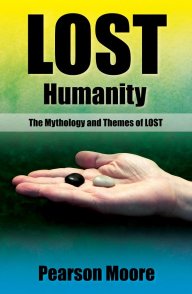
Lost Humanity
Category:
Arts/Entertainment
Publisher: Amazon.com
ISBN-10: 1613640935
Type: Non-Fiction
Pages: 350
Copyright: March 11, 2011
ISBN-13: 9781613640937
In-depth analysis of the television program LOST.
LOST as you've never experienced it before--
Announcing "LOST Humanity"
The new book by Pearson Moore
This is no ordinary companion book. No filler. No fluff. No weird theories. Just cover-to-cover, hard-driving analysis by one of the Internet's most heavily-cited authorities on LOST.
According to Pearson, "I've been working on this book since last June. I wanted to write something useful for all of us, now, a year after the LOST journey ended. I thought a book that delved into new ideas, that uncovered the deepest and most difficult themes, could serve all of us, whether we enjoyed the series, or hated it. My intention wasn't so much to explain things as it was to provide food for thought. All of us have to come to our own conclusions about LOST. In fact, the book does not present a conclusion per se."
Pearson approaches LOST from four "nonlinear" points of view: Disorientation, Metadrama, Literary Analysis, and from scientific chaos theory, using the idea of Lorenz Attractors or "Strange Attractors." Pearson uses these high-level analytical tools to make sense of character relationships, major themes, mythological references, and symbolic actions. For instance, Pearson explains the deeply relational nature of the two "odd couple" pairings inside the cave during the finale. Many interpreted these two scenes, in which Jack was coupled with the Man in Black and Hurley was coupled with Ben, as being symbolic, or ironic. Pearson disagrees.
He explains it this way: "The strange scenes where opposing characters worked together to lower Desmond and then Jack into the cave were not intended as irony for the sake of irony. In fact, these were not statements of irony at all, but rather they were statements of necessity. In these two scenes, LOST stated that conflict is necessary to human life."
Pearson explains the exact nature of the Constant relationship, the Strange Attractor relationship, and the conflicts between good and evil as well as free will and destiny. And he takes on possibly the most difficult challenge of all: identifying the true nature of Christian Shephard and his on-Island apparitions.
Excerpt
Blue and yellow make green.
LOST is about the human need to belong, and the personal need to struggle. To achieve these conflicting ends, to find ourselves, we face disorientation, paradox, impossibility, and triumph, and all of these in the context of deep relationships, hurtful and healing, with those who make us into the people we become. The core of who we are—struggle and surrender, integrity and iniquity—is expressed in our relationship with others.
The contradictions are unrelenting. An intelligent, evil entity—immortal, impervious to bullets and missiles, invulnerable to rock and spear—could not be destroyed. Yet Jack and Kate killed the Smoke Monster. Juliet used her last bit of strength to smash Jughead’s nuclear core, but there was no explosion, no return to pre-Island lives. We ought to account the Incident a failure, yet the Candidates were catapulted thirty years into the future to fight the battle that would destroy all time loops. Faraday’s plan succeeded in ways unpredicted.
Forces and furies unrelated converged to explode into events unforeseen. Blue had no relation to yellow, but working together, they made green.
LOST presents a bewildering array of complex ideas, dense mythologies, interconnected events, and layers of thought and imagination woven into the most baffling and entertaining series ever produced for television. With so many characters and plot threads we feel overwhelmed, perhaps even convinced that the series made no sense, that it left too many questions unresolved. Our confusion is real, inevitable, and necessary. But it is not the final stage in our understanding. Hundreds of questions outstanding are resolved into a few major ideas. The major ideas meld into a single core, which is the thesis of LOST. The colours of the rainbow, the complexities of LOST, are all driven into light of a single wavelength, the kernel of an idea, that is the central tenet of the series.
The book you hold in your hands combines light and dark, blue and yellow, fate and freewill, good and evil, into a sure means of distilling coherence from ambiguity, confusion, and paradox. These were some of the guiding dramatic methods used in telling the story of LOST. The storytelling techniques were more advanced than any ever before applied to television, and with good reason. The creators of LOST were attempting to generate a work of enduring significance, an audacious statement about the condition of our humanity and the value of human civilisation.
This book is for anyone who has enjoyed LOST but wishes to gain fresh appreciation for the interrelated nature of its rich ideas. This book is for all of you who followed the series faithfully through most or all of the six years, but found yourselves disenchanted or confused or frustrated. You were not alone in your bewilderment and vexation—I was there, too. With several thousands of hours of research dedicated to the task, I found my way through the confusion and into a new state of understanding. In less than ten or twenty hours, having read this book, you will find a deeper and more rewarding sense of the Island, without having to read advanced texts in differential equations, literary theory, or quantum physics. You may find yourself at times annoyed or amused. You may concur with my analyses or disagree with my interpretations, but you will not complete this book without becoming exposed to new ways of thinking about and exploring LOST.
|