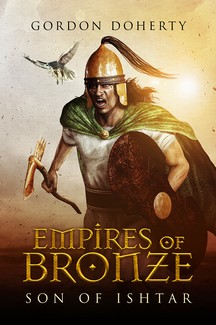
Four sons. One throne. A world on the precipice...
Four sons. One throne. A world on the precipice.
1315 BC: Tensions soar between the great powers of the Late Bronze Age. The Hittites stand toe-to-toe with Egypt, Assyria and Mycenaean Ahhiyawa, and war seems inevitable. More, the fierce Kaskan tribes – age-old enemies of the Hittites – amass at the northern borders.
When Prince Hattu is born, it should be a rare joyous moment for all the Hittite people. But when the Goddess Ishtar comes to King Mursili in a dream, she warns that the boy is no blessing, telling of a dark future where he will stain Mursili’s throne with blood and bring destruction upon the world.
Thus, Hattu endures a solitary boyhood in the shadow of his siblings, spurned by his father and shunned by the Hittite people. But when the Kaskans invade, Hattu is drawn into the fray. It is a savage journey in which he strives to show his worth and valour. Yet with his every step, the shadow of Ishtar’s prophecy darkens…
Praise for Empires of Bronze: Son of Ishtar: "A meticulously researched and vivid reimagining of an almost forgotten civilisation" - Douglas Jackson, bestselling author of the celebrated Gaius Valerius Verrens series "Vivid, immersive...wondrous!" - SJA Turney, bestselling author of Marius' Mules and The Damned Emperors. "An action-packed epic" - Matthew Harffy, bestselling author of the acclaimed Bernicia Chronicles.
About the Hittites & the Bronze Age: Over three thousand years ago, before iron had been tamed, before Rome had risen, before the ashes from which Classical Greece would emerge had even been scattered, the world was forged in bronze. It was an age when Great Kings ruled, when vast armies clashed for glory, riches and the favour of their strange gods.
Until the late 19th century, historians thought that they had identified the major powers who held sway in the last stretch of the Bronze Age: Egypt, Assyria… Ahhiyawa (Homer’s Achaean Greece) even. But there was another – a fourth great power, all but lost to the dust of history: the Hittites.
Hardy, fierce masters of Anatolia, utterly devout to their myriad gods, the scale and wonder of their world is only now shedding its dusty cloak thanks to the tireless work of archaeologists. The Hittites ruled from the high, rugged plateau at the heart of modern-day Turkey, commanding a ring of vassal states (most notably Troy) and boasting a dauntless army that struck fear into the hearts of their rivals. Their Great King, titled Labarna and revered as the Sun itself, was every bit the equal of Egypt’s Pharaoh, of the trade-rich King of Assyria, and of the brash lords of Ahhiyawa.
The Hittites were there when the Bronze Age collapsed. They bore the brunt of the cataclysmic events that destroyed the great powers, threw the Near East into a centuries-long dark age and changed the world forever.
This is their story…
Excerpt
Hattu set off down the less-severe northern side of the ridge and was soon making his way through the shady alder woods, the dry bracken crunching under his bare feet. He came to the chalky banks of the River Ambar, a vivid turquoise ribbon that ran through Hattusa and all the way out here. More a series of falls, pools and gentle rapids than a true river, its waters were sacred. He waded across, the thigh-deep water as chilly as the day was hot, and up onto the far banks. There, he froze, his breath held captive.
A whisper of movement nearby?
His head turned like an owl’s, but all was still and silent. Yet when he faced forwards again, something snagged the edge of his vision once more. Something had moved. A glint of bronze, he was sure. Only warriors wore bronze. Warriors… and bandits, or worse, Kaskans! Those rugged brigands from the Soaring Mountains who took delight in defiling and toppling Hittite temples… who took Hittite heads as trophies.
Another crunch of bracken. Closer.
His heart thundered faster even than that weightless moment when he had fallen from the ridge. ‘Who’s there?’ he called out, feeling afraid and foolish at the same time.
Silence.
He took a step towards the forest path, timid as a fawn.
Whoosh… twang.
Suddenly, Hattu was still. He stared at the reed arrow shaft quivering in the dirt before him. His limbs almost buckled under him until he saw the fletchings: silver and white striped feathers from a greylag goose. Instantly, his fear evaporated and a broad smile split his face. ‘Muwa?’ he cried, looking this way and that.
With a crunch of bracken, Prince Muwatalli, Hattu’s eldest brother, emerged from the shade of a nearby oak.
Professional Reviews
Douglas Jackson, bestselling author of the celebrated Gaius Valerius Verrens series
"A meticulously researched and vivid reimagining of an almost forgotten civilisation"
SJA Turney, bestselling author of Marius' Mules and The Damned Emperors.
"Vivid, immersive...wondrous!"
Matthew Harffy, bestselling author of the acclaimed Bernicia Chronicles.
"An action-packed epic"
Want to review or comment on this book?
Need a FREE Reader Membership?
Reviews for "Empires of Bronze: Son of Ishtar (Empires of Bronze 1)"
I like historical fiction. And it looks like you have been writing about a period that has been generally overlooked as a source of good storytelling. Unfortunately, I'm a poor reader and will be able to read your book and review it like others have given your books good ratings. Keep up the good writing true to history.
The Six Bells of Madame Lin is the first book in The Witch of Marigold Hall Trilogy, a fictionalized account of the struggles of Lin Mang, a blind woman who manages to navigate the world during the Mongol conquest of China in the 13th Century. Withou
Shanghai Escapist grabs the faint-of-heart right from the get-go and serves up an ultimatum: What would you do if caught in the same circumstances? From the opening scene, the reader is tossed into the maze of daily intrigue as it existed in 1960s-70
Shanghai Escapist grabs the faint-of-heart right from the get-go and serves up an ultimatum: What would you do if caught in the same circumstances? From the opening scene, the reader is tossed into the maze of daily intrigue as it existed in 1960s-70