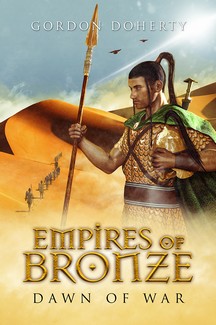
A tale of far-flung desert adventure set in the distant Bronze Age
Two great empires on the brink of war, one last hope for peace…
1294 BC: The fragile accord between the Hittite and Egyptian empires is crumbling. The ancient world braces itself for war on an unprecedented scale. Prince Hattu, the greatest of the Hittite generals, suffers dreams of terrible consequences – conjured by the Goddess Ishtar. But Hattu refuses to accept her prophecies, adamant that there is one last chance for peace.
This fragile hope lies in the borderlands of the east, where the two rival empires touch. Hattu gathers a chosen band and sets out for this distant, blistering desert land, determined and defiant. Yet the further he ventures, the darker and more twisted his mission becomes. Old ghosts rise around him and Ishtar haunts his every move.
The Goddess' divinations cannot be avoided, men say. Hattu will walk through fire to prove them wrong.
Excerpt
Prologue
The City of Ra, Egypt
Spring 1294 BC
An Egyptian vulture sped low across the eastern desert, coasting on the white heat of the dune sea, its frill of pale feathers shuddering and its yellow head and purple-beak sweeping in search of prey.
‘See how the carrion bird flies,’ whispered Pharaoh Seti, his kohl-lined eyes tracking the creature.
‘The sacred hunter,’ said Ramesses, his youngest son, beside him on the temple balcony. ‘It is coming this way.’
Indeed, the bird sped over the last dune and onto the green, fertile stripes of land hugging the mighty River Iteru. It rose to soar over the palm-fringed banks, swaying rushes and crop fields, its head switching this way and that, captivated by the myriad fawn-skinned people at work there. Finally, it tilted towards the sculpted, burnt-gold jewel on the river’s eastern banks: The City of Ra, a vast complex of mud-brick pylon gates, temples, towering pillars and statues of gods and ancient kings. Young Ramesses stretched on his toes for a better look as the vulture sped closer to the temple,
gripping the marble edge of the balcony and leaning out a little too far.
Seti felt a weakness in his veins – a need to protect the lad as a father should, to pull him back from the precipice. But when the vulture shrieked, Seti’s eyes snapped up, seeing the bird banking around the head of one mighty statue – a likeness of Pharaoh Thutmosis, unforgotten despite the passing of many generations. A warrior-king, a conqueror, a victor, a god. The great statue’s shadow stretched across the city, blanketing half of the balcony too. Seti forgot about his son’s welfare in that moment. He stepped clear of the shadow, a shaft of sunlight falling across his axe-sharp cheekbones and lantern jaw. I will match and outshine your legendary achievements, he mouthed, staring at Thutmosis’ stony eyes.
A strange noise sounded behind the pair. The creaking of a bow. Seti swung on his heel, tearing a dagger from his belt and bringing it round on the assailant.
‘Chaset?’ he raged at his eldest, the adolescent prince who would one day succeed him.
Prince Chaset did not even notice his father’s dagger, halted just a hand’s-width from his heart. The young man was too busy training his arrow-tip on the vulture. ‘I will teach the bird its final lesson.’
With a swish of one hand, Seti snatched the bow from the prince and threw it across the room behind the balcony, where it clattered, knocking over a wicker stool and a vase of wine. ‘Choose your enemies more carefully, you fool.’
Chaset’s hooded eyes flared open for a moment. ‘You told me to be the greatest warrior I could be: with the sword, the spear… the bow!’
Seti stood his full height and glared at Chaset – and Ramesses too for good measure. Snapping his fingers, he strode past them both. The two princes followed, obedient and afraid. ‘You train not so you can shoot sacred birds and offend the Gods, boy, but so you might share my destiny.’
He led them into a grand chamber at the far side of the temple. White, sweet-smelling ribbons of frankincense and myrrh smoke rose from the sconces affixed to the chamber’s pillars, the stone floor was polished to a sheen, and the high walls were adorned with reliefs of bird and snake gods. Most striking of all, however, was the set of stairs at the chamber’s far end – as wide as the hall, streaked with sunlight and guarded by black-wigged, white-kilted spearmen on the edge of each and every step, leading up to the temple’s roof terrace. Seti halted in the middle of the floor, lifting his arms while a pair of slaves helped strap to his chest a cuirass of crossed bronze-wings, gleaming even in the cool shade of the room. Another placed a coruscant and bulbous sapphire war-helm on his bare scalp. Two more handed him each a sceptre and a fanged flail, and another tied a lion’s tail to his belt. Armed and armoured, he strode on and up the steps, shafts of sunlight passing over him as he ascended.
‘It is to the north we will find our destiny. Conquest and glory, just as mighty Thutmosis once knew.’
‘The north,’ Ramesses muttered. ‘Retenu, the vassal lands?’
Seti looked down at his youngest. Ramesses had a keen mind. Sometimes he wished for Chaset to have such a thirst to learn. But his eldest was a fine warrior, at least. ‘The vassal lands, at first,’ he said as they emerged onto the rooftop and into the full power of the sun. The savage heat bent and warped the air around them, giving life to the statues of jackal, falcon and baboon-headed deities lining the roof’s edges. ‘There, I will press my foot on the throat of the tin routes. None will have that precious metal, none but I. Yet that is only the beginning, for the world stretches beyond those parts, and much greater rewards wait beyond.’
He stepped over to the semi-circular platform jutting from the front edge of the temple roof and threw out his arms, his sapphire helm sparkling like a dark sun. At once, a wall of noise hit him from below, and the sight down there set his heart alight with pride.
The Army of Ra cheered on and on in adoration: ten thousand voices, guttural and strong, rising from the huge, white-flagged square. The bare-chested, white-kilted menfyt stood in countless blocks of two hundred and fifty – each unit of these veterans known as a Sa. They pumped their gleaming, sickle-like khopesh swords and tall spears skywards, pale blue and white linen headdresses fluttering in the hot wind. The thousand-strong, bronze-coated crack corps known as the Strongarms simply fell to one knee – devoted, invincible, shimmering like treasure behind their zebra-hide shields. A huge host of coal-skinned Medjay archers, clad in leopardskin kilts and armed with stave-bows and twin quivers lined the left of the square and another swarm of bowmen stood on the right – paler-skinned Libyans, naked but for giraffe skin capes and dangling penis-sheathes, crying out to the skies in veneration. To the rear, a five-hundred strong wing of bright and majestic chariots glittered, the warrior and driver aboard each encased in armour and draped with weaponry, the feather-crested horses snorting and pawing at the ground. From the rooftops around the palm-lined square, trumpets keened and drums rumbled.
Chaset and Ramesses came to stand by Seti’s sides at the roof’s edge and another wave of adulation rose.
‘Army of Ra,’ Seti boomed.
The clamour of adulation fell silent instantly. Even the masses in the city streets beyond the square and all around the city’s hinterland seemed to halt and look up. All quivered and trembled with awe, entranced by their God-king.
‘It has been a long winter of preparation,’ said Seti. ‘Of whetting blades and fashioning armour.’ He let a moment pass to reinforce his authority and to choose carefully his next words. Oddly, they seemed to be stuck in his throat. Was it the presence of his two boys at his sides distracting him, directing his thoughts elsewhere, to weaker places, to thoughts of being a mere father?
Just before the silence stretched a little too long, a voice whispered, behind him: ‘Now it is time. Time to march north to the lands of Gubla at the edge of our realm.’
Once more, Seti felt his dagger arm stiffen and his body tense, ready to swing round on the other, until he realised who had crept up behind him and his boys. His alarm faded as fast as it had risen. ‘Now it is time,’ he repeated to the crowd. ‘Time to march north to Gubla at the edge of our realm.’
The voice whispered to him again and Seti repeated this next line: ‘Then we will march beyond Gubla, and smash the petty kingdoms who do not bend their knee to Egypt.’
The army was rapt.
‘At the last, we will come to face… them,’ the voice said in a strained hiss, Seti repeating the words and the hesitation.
He heard some men down below murmur to one another: ‘The Hittites,’ said one. ‘The Wretched Fallen Ones,’ agreed another. ‘They grow their hair long like women, scrape the beards from their chins and they live on windswept crags – like animals,’ said a third.
‘We will dash their armies,’ Seti continued, prompted by the voice, ‘topple their crude cities, their wretched capital high on the hills of their cursed heartlands… all will fall, all will be razed to dust. When it is done, the Hittites will be no more.’
The army seemed set to erupt with fervour, barely containing their hubris, a few yelps of zeal escaping mouths here and there. Now they just needed their Pharaoh to give the command that would begin it all. They took to drumming their swords and spears against their pale hide shields in a frantic rumble, knowing the moment was almost upon them.
But Seti was again plagued by that irritating doubt. He felt his hands slide up and over the shoulders of his boys, a mewling sense of concern for them once more pricking and jabbing at the golden promise of conquest. Next, he turned his head from the massed army and to the man who had helped choose his words: Volca.
The pale-eyed, fair-skinned Sherden islander had come to his lands six years ago from the Hittite court, pleading for shelter, telling his story – of how he had devoted himself to the service of their old king, Mursili, only to be turned upon by the ailing Hittite leader’s sons. Volca had been pathetic that day, snivelling at Seti’s feet. Not so now. Tall and lean, with collar-length, flaxen hair and plate-sized copper rings dangling from his ears to frame his handsome, narrow face. He wore a red cloak and a green-painted, armless scale corselet with a wide gold band clinging to his right bicep, and a trident strapped across his back. His horned-helm was remarkable, adding to his already considerable height. But the most striking aspect of the man was the part that the eye could not see, thought Seti – the thorny vines of hatred coiled around his heart. Volca despised the Hittites even more than most Egyptians did. On the day news had arrived of King Mursili’s death, the Sherden had shed tears of delight. Most crucially, he knew almost everything about those strange, northern people: how they lived, how they traded, how they made war. As such, he was more vital to the coming campaign than any champion down on the square.
‘The Hittites may be hardy, but they are weak in numbers,’ Volca said calmly – the words intended for Seti alone. ‘More, the two brothers who chased me from their lands are weak leaders: King Muwa is but a shadow of his father; and as for Prince Hattu,’ he spat the name and paused for a moment, his lips twitching, face sliding into a look of pure malice, ‘every night I dream of his death. It will be slow and it will hurt like the fires of the Gods.’
Disquiet crept across Seti’s shoulders, seeing the Sherden’s right fist coil and uncoil as if flexing around the hilt of an invisible knife. His eyes were like coals, blazing into the ether. Such intense hatred…
‘This is your time,’ Volca continued, snapping from his trance, ‘Lord of the Two Lands, Son of Ra, Horus of Gold,’ he gestured to the square and the crescendo of rumbling weapons on shields. ‘This is the moment for you to rage like a panther… to etch your name,’ he leaned towards Seti, clenching and shaking a fist, his face pinching into a rictus, spittle flying from his gritted teeth, ‘into eternity.’
Seti’s skin shivered with fervour. Charged with belief and a rampant sense of entitlement, he barely noticed his hands sliding from his boys’ shoulders. He turned his gaze back to the army, lifting his sceptre overhead like a sword, drinking in the sight of his forces. ‘It is time to march.’
The Army of Ra roared until the city itself shook.
‘To the north,’ Seti cried as the drums boomed and the trumpets blared, ‘to war!’
Want to review or comment on this book?
Need a FREE Reader Membership?
Reviews for "Empires of Bronze: Dawn of War (Empires of Bronze 2)"
Thanks for your comment. I'm highly envious that you've had the chance to set your eyes upon the remains of Seti and his boy. Could it simply be atmospheric conditions/bad luck that have rendered the mighty Ramesses to dust?
That's a very neat premise for your novel - that mankind effectively creates its own monsters (e.g. bringing mummies to life). I'm intrigued to find out what the regenerated Ramesses is like!
The Copper Age story sounds great too - I'm going to check it out.
I love historical fiction. From your excerpt, I see you writing about Ramses (II?) and Seti I, two of the most well-known and documented pharaohs of Egypt. and from the many five-star reviews you have, your war stories have been very well received.
After I peered into the face of Seti II in the mummy room in the national museum in Cairo and found that Ramses II's face was gone in a pile of rubble, I wondered why the lesser pharaoh was preserved better than the greater one of so much accomplishment and renown?
Using the coincidence between SETI (search for extraterrestrial intelligence) and the name of the Pharaoh, I included Seti II in the second chapter of my novel, Alone? His mummy is used to clone a new, 21st-century version of this Bronze Age pharaoh/god.
I'm currently writing a Copper Age story and posting it here, chapter by chapter.
Ireland 1944.. A young man’s body is pulled from the River Lee. He’s wearing a distinctive silver ring that belonged to Paudy Daly, the eldest son of the notorious Mixer Daly. Why?