This masterpiece altogether took a total of 10 years to complete. My words are deep and profound and you just might shed some joyful tears. It's been known to happen.
Excerpt
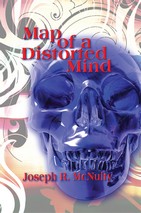
Map of a Distorted Mind begins with the emerging of the Phoenix - a re-birth. Departing from upstate New York and continuing on through Idaho to Oregon, this chronological collection of poetry invites its readers to escort the author, Joseph R. McNulty, on a transformational journey to chase a western dream. Prepare to travel a wandering path as each mile traveled leads to the measured discovery of the author's emerging manhood. As you follow the author on his restorative journey, you will encounter the sometimes overwhelming and life-threatening obstacles that he encountered along the way. You will see how he overcame them and what he learned from them. This book is an emotional depiction of purpose and service as the author reveals the reason behind his rare survival and his new definition for the meaning of life.
Professional Reviews
Mind Fog Reviews
In Map of a Distorted Mind by Joseph R. McNulty is a man expression of grief of a love lost. It talks about the day he fell in love with her and the day she died. I felt every emotion that this man felt in every poem in this book. Mr. McNulty showed the world exactly how he felt and at times did. I applaud him in being so open honest.
Every poem had a flow and consistency to it. At parts I thought it would make a great song because the way it flowed. I must admit my personal favorite is The Great Sardine Ride where he moves to be closer to the one he loves. I have done that and know firsthand how the pull of love will make you do anything. Those of us that love poetry that comes straight from the heart will love this book.
4.5 bookmarks (out of 5)
Carol A. Langstroth, Manager,
Mind Fog Reviews
Gloom Cupboard
MAP OF A DISTORTED MIND by J.R. McNulty reviewed by Alan Garvey
I’m loath to knock the idea of self-publishing, or self-published poets, especially as I went down that route for my first three chapbooks, but there are many worthwhile lessons to be learned by submitting to and publishing in literary magazines, establishing a track record of publication before seeing one’s first full collection go into print. One of the first lessons one learns is that not everyone will like your poetry – no matter how momentous or full of personal importance it may be – nor should they. Poetry is very much a matter of taste and many of the greats are reviled in different corners. This collection, ‘Map of a Distorted Mind’, exemplifies many of the attributes of writing and writers in the burgeoning world of self-publication, inconsistency being chief among them.
‘Past Life’, a long poem, is written (mostly) in rhyming couplets – I find myself wondering, why not all?. More continuity and flow across the lines, more intuitive/creative line-breaking, rather than ending on a full stop, as is the case throughout the collection, would improve the work – for example, a fine line amputated by the impulsive period: “Let’s face this redundant, adolescent gore./ Once more on the cutting-room floor.” There are numerous instances of superfluous adjectives, lapses into cliché: ‘frantic plea’, ‘safe haven’ etc. ‘Past Life’ seems to be driven by the impulse to say something rather than to show or just allow the reader to arrive at their own meaning.
In the ‘Upstate Poems’ the language isn’t concrete enough for me or the writer to handle, there is much fumbling around abstractions – “Repetitious crying with continuous laughter”, from ‘Sneak Preview’. I find myself chiding the author with the old, old adage of ‘Show, not tell’ as I find myself forlorn over this particular quatrain:
“Through the dusty eyes of a cross country bus trip
my eyes are shown the strangest of places.
To see what the world has to offer
outside of an overlooked farm town.”
I want to see the strangest of places through a poet’s eyes, feel the parched heat of that farm town. I want to know why it is overlooked and breathe in deep of the various scents of the fellow passengers on that bus and to get an idea of what they’re escaping to or from. This is not to say that I have no interest in this poem, merely that my interest was piqued and I feel cheated – I want the author’s vivid stories and recollections to be shared with me and anyone else who may read this book.
As I plough further and deeper into this collection, to the next series of poems, ‘The City of Trees’, I begin to feel doubts, a little guilt for what may be perceived as some erstwhile critic dropping canister upon canister of Agent Orange into a forest of poetry. But then I read a first stanza like this one, from ‘Lost Art of Human Decency’:
“Shuttered to the ground, these priceless artefacts.
Ignored feelings heed our development over time.
Hurt speaks open wide to spread choice words.
Care-free; Birdshot bullets lack consideration.”
And I think about how these poems have so much consideration and thought given to the situations and people within them – but little consideration to the reader who was not there, who lacks the memories and personal experiences of the poet, the reader who relies upon the devices and craft of poetry where the experiences that prompt the poetry are made as real as possible (involving the senses) and is open for the reader to draw their own interpretations. I have to wonder just how much poetry the author actually reads, if it began with the Romantics (for the many gratuitous exclamation marks) and stops at Jim Morrison (for the licence to write in free verse).
There are poems such as ‘Autumn Memories’ – it sets out to be no more than it is and it is wonderful (in the truest sense of the word) for just that. From that poem on the latter part of this series improves immeasurably, with many strong lines and poems. I quite like the oxymoronic notion of a ‘harmless rapist’ in ‘Lust’, a well-crafted personification of the deadly sin, notable in this collection for its brevity. The poem works well because an abstract concept is well-grounded in appropriate image and simile. ‘Sleepy Continual’, another ‘little’ poem indicates that the author is at his best where he does not appear to feel the impulse to impart a moment of tremendous import; letting the poem speak for itself is one of the hardest things a writer must learn, but they must learn to do so for the poem to grow out of the shadow of the author’s hand. In fairness to the author, an editorial eye would have caught a number of very simple mistakes, such as the tautology of the repeated phrase ‘merely just’ in “Streams of Our Lives”.
Many turn to verse, reading and writing pieces like “In Loving Memory” for the reasons D.J. Enright meant when he wrote “…when religion has materialised itself into thin air and creeds are shaken and traditions dissolved…people turn to paper and pen for consolation and sustenance.” Understandably so. But poets must be able to recognise when such pieces are suitable for public consumption and when they are not. Doggerel might seem like an unnecessarily cruel term – sometimes it’s the most apposite.
“A heavenly couple they both are.
I just couldn’t get over it in the car.
Bree was an inspiration without a doubt.
Valentine’s Day was something worth boasting about.
“You are my Pamela Susan, the Muse to my poetry”.
Inscribed was this, in a poem written for our chemistry”.
Some lines later there is a break in the poem, with the following:
(A note to the reader –
I ask you for a moment of silence
before you continue reading, please.)
I don’t know how many read in riotous abandon but I certainly don’t. And I don’t appreciate the blatant instruction, no matter how well-intentioned or personally important – the skill or craft of the writer is in guiding the reader along a particular path without being made too aware of the authorial hand.
The author clearly has a sense of what in our lives may form the substance of poetry, the raw material, but is not consistently able to offer us the visions he saw in ‘Map of a Distorted Mind’. There are moments when he does, in ‘Sunday Morning’, for instance, “The Idaho mountains circled us in/ like a starving pack of wolves.” I can catch the sleek-backed brilliance of silver and shadow and black lurking under his words, crowding high and looming over me. ‘Paris’ shows me what I want him to do most:
“I want to indulge all five senses.
I want to stroll down golden cobblestones.
I want to watch the sun set from a café rooftop.
I want to see those textbook photographs generate life.”
I want those same things, Mr. McNulty, but it’s up to you to give them to me, just like you did in those lines.
Mary Angela Nangini's poems celebrate the richness of life and love. From the city to cottage-country and the roads in between, Nangini explores the changing seasons of her varied region. (This book will soon be reprinted in hard cover.)