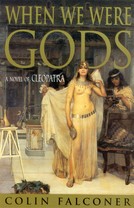
The story of one of history's most intriguing women, from the moment she ascended to the throne to her death in 30 AD.
Arrestingly beautiful and fiercely intelligent, Cleopatra VII of Egypt was barely more than a teenager when she inherited the richest empire in the world—one that stretched from the scorching deserts of lower Egypt to the shining Mediterranean metropolis of Alexandria. Imperiled at every turn by court conspiracies and Roman treachery, Cleopatra brazenly sought a partnership with the only man who could secure Egypt’s safety: Julius Caesar, a wily politician and battle-hardened general with a weakness for women. The result was a passionate love affair that scandalized Rome and thrust Cleopatra into the glittering but deadly world of imperial intrigue and warfare—a world that she would mesmerize and manipulate even after Caesar was gone. Colin Falconer takes the reader inside the walls of Alexandria’s great palaces and into Cleopatra’s very heart, creating a vivid portrait of an unforgettable woman who thrived and triumphed in a world ruled by men. This is the glorious story of a legendary woman, a story that blazes through thousands of years of history to capture the imagination of readers today
Excerpt
First there was this ...
Darkness, cold stone under her fingertips, torches flickering in the down draught of the tunnels. She heard their cold and sinuous coilings as they retreated from the torchlight. There were hundreds of them, countless deaths sliding upon and under, eyes glinting like garnet chips. The executioner's storehouse.
An asp flicked its tongue in agitation. Its bite caused agonising pain. The affected limb swelled to twice its size, and the victim would retch uncontrollably, then lose control of bladder and bowels. An ugly death, reserved for criminals.
And there, its slender body banded with yellow and brown, was a hooded cobra; the divine symbol of Upper Egypt, the royal emblem of pharaoh and Ptolemy alike. The Greeks called it basilisk, or little king. In the Book of the Dead she was the symbol for everlasting life.
Its bite was just as deadly but painless. Its victim fell quickly into a deep sleep and departed in a sigh of breath. Its fangs left two small marks, but that was all, death and dignity were granted together. It was the way her father had chosen for her older sister, Berenice.
He put his mouth to her ear; she felt the wiry hairs of his beard tickle her face. "This is the world you have inherited," he whispered. "Every palace is filled with snakes, twice as deadly as these. You will live among vipers all your life so you must learn to use your venom as wisely but strike without hesitation when you must. Do you understand?"
"I understand," Cleopatra answered.
She was ten years old.
One
the Brucheion Palace
Alexandria-by-Egypt
the Egyptian month of Phamenoth, 51 BC
Her father; Ptolemy XII, the Piper, the Bastard.
With his final breath she heard the slithering of cold bodies and the baring of fangs.
She stood by the bed, transfixed. Help me, she wanted to say. I am not ready for this.
His eyes were closed, his lips composed in a beatific smile; the parting with life had been gentle. Her father, yet not him. Without the tension of life, he looked only vaguely like himself.
He had called himself the New Dionysius, the Saviour who would rescue the East from the tyranny of Rome. He had the Bacchic ivy leaf tattooed on his body and was initiated into the secrets of wine and music and abandon. They had laughed at him behind his back, called him The Piper because of his fondness for the Rites of Pan, others just called him The Bastard and sneered at his efforts to stall the Romans.
I am on my own now, she thought. For the last few months I have ruled as his co-regent, but now, with his passing, the knives will be out.
From this day on and to all the world I am Cleopatra the Seventh, Queen of the Two Lands, Upper and Lower Egypt, Philopater Philomatris, Father-Loving Nation-Loving God. But that is just words. The truth is, I am eighteen years old, just a girl, without experience, without help, and without friends. And everyone around me wants me dead.
She kissed the Piper's hand for the last time, laid it cold on his chest. I promise you this father. I will save Egypt, as you had designed, and I will avenge you for every little joke they enjoyed at your expense.
*
"I have given orders for him to be borne to the Monument," someone said. "He will lie there along with his ancestors and Alexander."
She turned around, was confronted with a great slab of Macedonian lard with oiled ringlets and too many lapis and carnelian rings on his fat fingers. He wore that unctuous expression all Greek secretaries seemed to acquire with their robes of office. He was Privy Councillor to the House of Adoration, one of her father's closest advisers. She imagined his ambitions did not end there.
"That is for me to command, Pothinus."
"It is proper. I seek only to lighten your burden at this hour of grief."
"Of course. I did not doubt your intention."
The serpents had already slithered from their hibernation. They will give orders which they know I will not rescind, and so already they chip away at my power, even before my father's body is cold.
Don’t expect time to grieve. There will not be any.
*
The Regency Council filed in, her younger brother Ptolemy shoved ahead of them, like a prisoner. Look at him; arms no thicker than spear shafts, and a face like spanked child. They had dressed him in the chlamys of a man, although he was yet to sprout a beard.
What am I to do with him? Pothinus has filled his head with mischief, no doubt. She indicated a gilded chair on the dais and Ptolemy sat down beside her.
The Regency Council were at a gilded bench below her. There was Pothinus, of course, head of the Council and officially Ptolemy's tropheus, his Foster-Father; beside him Theodotos, Ptolemy's tutor, another functionary she would trust only after he was dead and his head thrown to the fish; and Achillas, an Egyptian and Captain of the Royal Guard, still loyal to her - for the present.
Look at them; a dusty scholar, a bully two generations out of the field and a shrill-voiced fat man with nothing between his legs but scallops of fat.
Her dioiketes, Hephaestion, her prime minister of the moment, was also there, she could smell his perfume. He was almost as lovely as her sister, Arsinoë. And last of all Antiochus, still a child in a short white tunic, a look of pale apprehension on his face.
Not a soul in the room she trusted.
She looked up at the fretted gold ceiling, at the fresco of the god Dionysus surrounded by his adoring maenads. She imagined her father's face behind the flowing beard and she asked him: did you really love me more than my brothers and sisters or was this yet another game you played?
She returned her attention to the court; all of them, even the few Egyptians among them, dressed in Greek chlamys, loose-fitting gowns fitted at the shoulder with a gold clasp; only the chief priests of Isis and Serapis with their shaved heads and white linen robes did not follow the custom. Further away, clustered in knots around the Great Hall of Pillars were her officers from her Household Guard, a few Gauls and Germans of the Roman contingent and a handful of wealthy Syrians, Jews and Egyptians. Immensely tall Nubians from her private bodyguard, naked and gleaming, were posted around the perimeter of the court, clutching ceremonial spears.
All of them waited to see what she would do. Her first big test.
The formalities were dispensed with. Pothinus was eager to be down to business. "We must move quickly to arrange your marriage to your brother, Ptolemy," he said. "It will allay the fears of the population. And we must have an orderly succession so that we do not arouse the interest of the Romans."
"You think the succession has not been orderly, Brother?" she said, using the honorific that was his due his lofty position at court.
"Indeed it has, Majesty. I merely point out the wishes of the people. It is imperative you uphold the tradition without delay."
The tradition; the pharoanic practice that had been adopted by the Ptolemies of royal brother marrying royal sister, a sop to the priests and the fellahin - the masses. Her father had married his own sister and Cleopatra's two older sisters, now dead, had issued from that union. Such barbarity was supposed to ensure the purity of the royal line. But this was not the Council's purpose here today. What they wanted to do was emasculate the new queen.
"When our father became ill," she began, the royal prerogative of speech sitting uncomfortably with her, " he arranged for our coronation as his co-regent to ensure an orderly line of succession. In our view the wishes of the people and the needs of state have already been served."
The smile did not leave Pothinus' face. "You do not intend to rule without a king, surely?"
"Ptolemy is not a foreign prince come courting. You are not hoping for issue from our loins, are you Brother?"
Even Ptolemy blanched at this. She felt a little better for having asserted herself.
"Pothinus said I should be king," Ptolemy blurted out.
Did he, indeed? "You are still a boy," she snapped at him. "That is why these men have appointed themselves your Council."
He scowled, his eyes on the floor.
The argument went back and forth, couched in the polite language of the court. She had no intention of giving ground and they could not force her to do so, outside of outright rebellion. They would not risk that with the Romans waiting any opportunity to intervene.
"It was your father's wish," Theodotus was saying.
She smiled to cover her anger, something her father had taught her to do. "He did not express such a wish to us." It is your wish, Theodotus, she thought. If I were to marry Ptolemy, I would become his queen and subordinate to him, and therefore subordinate to you and the rest of the Regency Council. Do you think me just a green girl you can bully into giving up the power to which I was born?
"Surely your accession was but a temporary measure?" Theodotus said.
"Do you presume to question your queen?"
To her relief, Theodotus subsided like the lamb he was, head bobbing.
A long silence followed, as she stared them down; all but Pothinus, who glared back at her from beneath heavy-lidded eyes.
It was Hephaestion who broke the tension. "There is another matter," he said.
She felt herself relax. To her own astonishment she had won this first encounter.
"Rome is on the brink of war, once more,” Haephaestion said. “Julius Caesar vies with Magnus Pompey for power. He has defied his own Senate and thrown Pompey and his armies out of Italy. Pompey has sent to us for our help in the conflict."
This was no real surprise. Pompey had been her father's ally and The Piper owed his throne to him. Now the Roman was calling in his markers.
"We must ignore this request," Pothinus said.
"Ignore it?" she said. "And how will that benefit us?"
"We are not slaves to the Romans. Should this Caesar gain victory we will only provoke him by supporting his enemy."
"And if Magnus Pompey should prevail?"
Pothinus did not answer her.
Already, her first decision on foreign policy. But this was not a difficult one to make. She already knew her own mind on this, and for years she had been impatient to have her say. Her father had called her opinions unschooled; she had thought him too timid.
"My father owes this Julius Caesar nine talents of gold," she said to them. "If he wins he will be here to claim it. You still wish to see Magnus Pompey defeated, Brother?"
"Pompey asks for sixty ships and three hundred soldiers."
"Then we shall give them to him."
"The people will say you are a slave to the Romans!"
Cleopatra stared at him. So, that is the rumour you intend to spread about me. At least you did me the honour of letting me hear it first. "They will say many things about me before I am dead."
Pothinus gave her a look: it said, oh, you really think it will be that long before you join your father in Alexander's Monument?
"Do as we command," she said.
She stood up and swept from the room.
*
Alone at last in her private apartments, she sat down, her limbs trembling with anger and nervous exhaustion. She was as lonely as she had ever felt in her life. She would pray to Isis for strength.
Despite all the training her father had given her, she did not feel like a queen. She was an impostor, impossibly young, impossibly green. She ruled Egypt but nothing was really hers; not even this room. The thick Capaddocian carpets and the carnelian encrusted chairs were her father’s choice.
She heard a noise behind her and she started. But it was just Mardian, her tropheus, her tutor since childhood. The closest thing she had to a friend. He was fat, as many eunuchs were, his blue chlamys as voluminous as the royal pavilion and his face as crumpled as a discarded gown.
"That Pothinus," he said. "He has the intelligence of a roof lintel."
"Will they stand against me, Mardian?"
"While Achillas is on your side they cannot move against you."
She brooded on this.
"You have little support here in the city. The people disapproved of your father's policies towards Rome. They will not like yours any better. Nothing short of war will please the mob."
"How can we stand against the Romans unless we have an army to match theirs? I am just being practical."
"Pothinus and the rest are out to line their pockets. Every merchant and middleman in the bazaar would rather have a milksop like Ptolemy on the throne and under the thumb."
She closed her eyes. "I have no support, I run a nation of shopkeepers and slaves who riot in the streets if the sun goes behind a cloud, The Romans are breathing down our necks looking for just one excuse to ransack our Treasury. What am I to do?"
Why had her father died so soon? A few more years as his co-regent and she might have consolidated her hold on the throne. But that was not quite true; while her brothers lived she would never be queen in her own right, her claims would always be subordinate to theirs.
She stared out of the window.
Such a beautiful nest for vipers, this glorious white city, the Brilliant City as the Romans called it. Gypsum-plastered palaces glittered in the spring sunshine all along the sumptuous curves of the Lochias peninsula, right down to the Royal Harbour. An arched causeway divided it from the Harbour of Good Return to the west. Behind the forests of masts, the warehouses creaked with the wealth of Egypt; ivory trunks piled up like cypress logs, pearls tossed in jute sacks like pine nuts, tottering bales of silks and muslins, great mountains of henna and cardamom and cinnamon. The world’s treasure chest right there.
A fresh salt breeze whipped the silk hangings, ghosts dancing her father's last revel.
But we are more than money; our capital is the foremost city in the world for learning. The famous Library contains more than seven hundred thousand volumen, cylindrical scrolls with treatises on mathematics and philosophy, medicine and astronomy, anatomy and geography. Our Museion boasts some of the finest scholars in the world, salaried by the state, their knowledge at our royal disposal. Our own Eratosthenes calculated the circumference of the earth, by comparing the length of shadows at midday in Alexandria and at Aswan. Aristarchos demonstrated that the earth went round the sun, and Euclid created the first school of mathematic.
Even Alexander would be astonished that this city had brought his name such glory. But there were no more Alexanders left to defend her now, her architecture or her culture; just the rabble of pirates, escaped slaves and outlaws Achillas called an army, ruled by a clique of Greeks, Syrians and Jews whose idea of a good dinner was to poison all their guests. The metropolis consisted of excitable Greeks and Egyptians whose only loyalty was to their purses and whose first reaction to any crisis was to storm the palace. They were all utterly indifferent to that other Egypt that brought them all their wealth, a hinterland of peasants who prayed to crocodiles and still believed their overlords were pharaohs.
And yet, and yet, she loved this country and this city; it was her birthright and her destiny. She would not shrink from it. I will show you Pothinus, I will show you father, I will show you Alexander, how a true queen acts and lives and breathes.
Two
Isis: Goddess of Ten Thousand Names, Shelter and Heaven to Mankind, Protector of Women, Word of God, Great Mother of all Nature. Her temple stood on the promontory of Lochias, facing the sea. It was a private sanctuary, reserved only for members of the royal house.
The salt wind whispered through the fluted columns, sand filtered along the marble tiles. Isis gazed unblinking at the ocean, the sacred knot tied between her bare breasts, her left hand holding a jug containing the waters of the Nile, a snake entwined around her right harm, a crocodile docile beneath her left foot. On her head she wore a golden band with the two feathers of justice, above her brow a round disc that shone like a mirror, the silver face of the moon.
Cleopatra fell to her knees. From somewhere in the temple she heard a priest singing a hymn to her in a high-pitched voice. She laid the offerings of fruit and flowers at the goddess’s feet and asked the Great Mother for her help.
Afterwards she walked back through the palace gardens, now brilliant with the white flowers of spring, to the news that the Apis bull had died.
*
Cleopatra lay naked, face down on a smooth bench of alabaster, while Iras, her Nubian, massaged balsamic oil into her back and shoulders. Another slave rubbed her hands with almond cream while yet another massaged her feet with mint water. Charmion brushed through her long dark hair with a tortoiseshell comb.
She sent for Mardian, but did not draw the fretted cedar wood screen for the interview. She never minded him seeing her immodestly. He was practically her mother. There was no one who knew her better and besides, all masculine feeling in him had been razored away when he was ten years old.
His fleshy jowls danced as he walked, like dewlaps on a bull. A poignant image, in the circumstances.
"Majesty," he said and fell heavily to his knees and touched his head to the floor.
"You have doubtless heard the news. The sacred Apis bull has died." The bull was thought to be the incarnate of Ptah, the god of Memphis. It was chosen for its characteristic markings; black, with a white diamond on its forehead, a crescent moon on its right flank, and the mark of the of scarab on its tongue. During life it was pampered as no other animal on earth and when it died it was mummified and placed in a special tomb with its forebears, like a pharaoh.
It was thought to be a bad omen that the bull had died so soon after her father, and all Alexandria was abuzz with the news. In the bazaars they were saying it was a sign that the gods were unhappy that a queen now ruled Egypt without a king at her side. She had no doubts where that rumour had started.
I will turn this omen around to my own advantage, she thought. I will cultivate a power base of my own, away from Alexandria and these scheming Greeks and Jews.
"I have decided to attend the funeral service myself."
Mardian blinked in surprise. For once she had her tutor at a disadvantage. "At Memphis?" he said. "No Ptolemy has ever paid court to the Egyptian gods."
"Then this will be the first time.”
"I see," he said but his face was a hieroglyph for bewilderment.
She settled her chin on her hands. Perhaps I can do this, she thought. If I can outwit my own tutor I can outwit the Council too. "Ask the dioiketes to prepare the state barge. We are going to pay our last respects to the Apis bull and welcome the next."
"Is it wise, Majesty?"
"They do not love me in Alexandria, Mardian. But I am not queen of just this one city. I am Mistress of the Two Lands. I shall show the Council that I will not be besieged in my own palace. How do you think the priests and the people of the chora - the peasant fields - will react when they see their queen, in the body of Isis, the Great Mother, greeting a fellow god in his own temple? Will they not love us then?"
She smiled, closed her eyes and surrendered herself to the ministrations of Iras.
*
Before he left, Mardian spared a glance at the hard, brown body on the alabaster table. Such a slight girl for such fierce determination. They have all underestimated her. From a child he had seen that she was very different to her brothers and sisters. Pothinus, Theodotus, and the rest of that crowd did not understand what they were dealing with. She was stubborn and wilful, yes, but she also had a fierce intelligence. No other Ptolemy had taken the time to learn the language of the people they ruled. To his knowledge, she was the first to speak anything other than Greek. If Isis had decided to reincarnate, she might well have chosen to re-invent herself in Cleopatra.
*
And so, to the boon docks.
This was an Egypt unknown to the Greeks and Jews of Alexandria; mud villages clustered under dom-palms and donkeys pulling creaking sakkiehs, water wheels. In Alexandria the colours were the blue of the sea and the white of the buildings and there were so many different nationalities that the whole city looked like a bazaar; here every face was the same, hooked nosed and nut-brown.
They had left the capital in the middle of a rainstorm, but down here the Nile was fat and sluggish, the skies clear.
It was only the second time she had come to the chora. The first time was with her father on the occasion of her coronation as co-regent, just a few months before. Every king since the very first Ptolemy had been crowned first in Alexandria and then a second time at Memphis, where the ancient Pharaohs had been crowned.
A shaven-headed priest had handed her the royal crook, sceptre and flail and crowned her with the double pharaonic crown, the cobra diadem of Lower Egypt and the white bulbous-tipped vulture headdress of Upper Egypt.
It had struck her then as vaguely ridiculous. But the Piper had admonished her. Life is a pageant, he said. The people do not wish to know of you, the girl with the lustrous dark hair and olive Macedonian skin, of her fear of snakes and the darkness, or of her fondness for olives; they wish for a queen and a goddess, with none of the faults of Nature that were given to them. You must seem out of reach for them to love you. This ceremony enshrines your person as a goddess. Now you must live like one.
So now she reclined on a couch on the deck of the royal barge, shaded by a golden fringed canopy of pure silk, surrounded by Nubian slaves with long-handled jewelled fans. Her hair fell round her shoulders in tapering ringlets and on her head she wore a golden band with the two feathers of justice, above her brow was a round disc that shone like a mirror, the silver face of the moon. Her pure white linen gown was knotted at the centre with the sacred knot, and her bare breasts were painted blue. There was a golden snake coiled around the flesh of her right arm.
The silver-tipped oars sparkled as they dipped and rose. With every mile small children ran from the mud-brick houses to stare and farmers with sun-browned skins and white loin cloths gaped at the goddess queen returned.
Is it really our queen, here in the chora? Is it really our Isis?
Cleopatra raised a languid hand to the faces packed on the riverbank. Even the slight movement of the boat on the river made her nauseous.
But she forced herself to ignore her discomfort. This theatre was intrinsic to her destiny, and the uncertainties that had plagued her after her father’s death sloughed away the further they sailed up the great Nile. I can do this, she told herself. I can prevail in my father's palace of serpents.
Saqqara
The priests poured from the temple of Apis to greet her, dressed in the blue of mourning. She heard dismal music coming from inside. She was borne on a litter past the sacred pool, where Pshereniptah, the High Priest of Memphis, was waiting for her. Clouds of incense hung in the still air.
"Dread Queen," he murmured, "you do us great honour."
"On the contrary, I am here to honour Ptah," she said, and she saw from his reaction that she had chosen her words well.
A ramp plunged into the bowels of the desert, dark and breathlessly hot. She followed the priests down a long underground gallery. On either side were the enormous black sarcophagi of Apis bulls from a thousand years past.
The mummified bull was borne on a litter by a sweating phalanx of slaves. The bull was huge in death, wrapped in white bandages so that only the horns protruded. Other slaves followed, bringing the canopic jars that contained its viscera and vital organs. The bull litter was lowered onto sarcophagus of pink granite and then the great stone lid was levered into position.
The sacred Apis was at rest, ready for his next incarnation.
That night, at the feast held inside the temple to commemorate the passing of the Apis, Pshereniptah leaned towards her and whispered: "Your presence here today will never be forgotten. To the priests and the people here, you are no longer just Cleopatra. Now you are truly Isis herself."
Three
To be an effective ruler, she quickly learned, everything must be delegated, but no one should be trusted.
Every morning, with her prime minister – her dioiketes - beside her, she sent directives to the functionaries, the strategioi, who were responsible for each nome, or district. This was among her duties, as queen. But as pharaoh she must also be accessible to the common people, so afterwards she held court in the Audience Hall, receiving petitions and requests in her own hands, dispensing justice in person. And she never failed to enquire after the health of the divine bull, Apis, from the chief priest.
There then followed an endless round of council meetings to discuss every minor and major detail of governance; from the dredging of irrigation canals, to the administration of import taxes and the appointment of minor officials.
The problems she had inherited were far graver than she had realised. The country was paralysed by its vast bureaucracy, nationalism was rampant in the chora, many fellahin had fled their fields, unwilling or unable to pay the increased taxes raised by her father, and the onset of another famine had even led to uprisings in Upper Egypt.
This last problem she addressed immediately; more princes were unseated by hungry mobs than invading armies. She astonished Pothinus and the rest of the Council by announcing she would devalue the currency by one third, thus increasing exports and making more money available to the Treasury to buy grain from abroad, while at the same time instituting a strict program of rationing throughout the country.
For the time being the prospect of mass starvation was allayed.
Meanwhile she waited for news from Greece on the outcome of the conflict between Caesar and Pompey. Everyone in Alexandria believed Pompey would defeat the upstart general. She was sure her decision to send Pompey soldiers and supplies would be vindicated. That would teach Pothinus a thing or two about diplomacy.
She no longer felt like an imposter on the throne.
But then two Roman envoys were murdered by some drunken legionaries in a camp outside the city and her new-found confidence evaporated like the mists over Lake Mareotis in the morning sun.
*
The whole of Alexandria was celebrating. You would think we had just defeated the crack Mars legion and sacked the Forum, Cleopatra thought. It wasn't even Egyptians who had killed them.
The two men were sons of the Roman governor of Syria, Marcus Bibulus. They had been killed by Roman legionaries stationed outside the city, troops lent to her father by Pompey, eight years before. Well, hardly Roman; these soldiers were mostly Germans and Gauls with foul breath and lank beards who drank too much and looted the bazaars in the city from time to time. Many of them had found wives of equal ugliness in Rhakotis and fathered hordes of brats.
The Syrian governor wanted this ragged and unruly bunch back, to help him fight the Parthians, and sent his two sons to get them. But the mercenaries were by now overfond of life in Alexandria and did not want to be soldiers again. A few of them got drunk and decided, in their dense and provincial way, that the answer to the problem was to murder the messengers.
And now the problem of what to do about this affair is mine.
The court, as usual, was a colourful and elaborate affair. Her prime minister was there, with his oeconomi, the officers of the Royal Guard distinctive in wide-brimmed felt hats and high-laced boots. The Chief Huntsman, the Chief Physician, and the Chief Cupbearer were also in attendance, resplendent in their diadems and gold brooches.
A hush fell over the Great Hall of Pillars as she entered. She was dressed in the formal robes of state, pectorals of lapis and ivory and a thick belt of heavy gold. She held the crook and flail of the Great House of Egypt and on her head was the vulture headdress and golden uraeus of the Two Lands.
Charmion had spent long hours applying her cosmetic, paying special attention to her eyes, which were accentuated with black kohl and green malachite. Her mouth had been reddened with a special ointment made from ram's fat mixed with red ochre, and her hair gleamed with a special ointment of oil and juniper juice.
A scribe in a kilt sat at her feet beside a scholar from the Museion, ready to record the proceedings in both Egyptian and Greek.
Finally she spoke: "Would someone like to explain what happened in the city yesterday?"
A fidgeting silence. Pothinus finally spoke up: "Majesty, the Roman soldiers were ordered by two envoys to accompany them to Syria to assist the governor there in his petty wars. They refused to go."
"And so they murdered two defenceless men?"
"They were Romans!" Pothinus almost spat the words.
"These troops have settled here now," Theodotus said, more soothingly. "They are simple barbarians from Gaul or Germany and have taken wives and mistresses for themselves. Many have families from local women. They have no love of Rome."
"They are Roman soldiers nevertheless."
Pothinus seemed to glow with pleasure when she said this. Perhaps he was the one who engineered this crisis, she thought. It has his hallmark on it. He would make me choose between antagonising the Romans and fomenting the disgust of my own people. How like him. "Well, it is done now, Majesty," he said.
She looked around the court for the third member of the council, the Captain of the Guard. "Brother," she said, addressing him according to formal etiquette. “you have not given us your opinion."
"Dread Majesty, as Pothinus says, they are just Romans."
Oh, just kiss his fat backside and be done with it, she thought irritably. Does he own all of you?
She turned finally to her prime minister, standing beside her throne; one Protarchus who had replaced Hephaestion when he completed his year's tenure of the post. Not as pretty, but a good deal more sensible. "What do you think of this matter?"
"Majesty, they are Romans, as the Captain of the Guard says. And they have broken Roman law. Therefore it is my opinion that they should answer for their actions to Rome."
She turned back to the court. "That is our opinion also. Therefore we command that the murderers be found and handed over in chains to the Roman governor in Syria for judgment."
Achillas took a step forward. "Majesty! Is this just? Should we grovel to the Romans? We might as well lie down at their feet and let them march into Alexandria!"
"Well if they wished to, you and your army could not stop them!"
He stared at her, white-faced. I believe I have just lost my last ally in the palace, she thought, appalled at her own impetuosity.
"Majesty, will you humiliate us before the Romans?" Pothinus said.
"If Egyptian soldiers murdered your sons in Rome would you not expect them to be handed back to you for justice? Though I admit it is not a likely event, in the circumstances."
Another point scored. But Pothinus persisted. "The people will ask if we are ruled from Alexandria or from Rome."
"We have no authority over peoples' questions only their actions, Brother. Find the men who murdered the envoys. Bring them here."
Pothinus dared for a moment to glance around the room at Ptolemy. The boy still would not raise his sulky eyes from the floor. It will not be long, she thought. I believe he will decide to challenge me, soon enough. But not today.
"Do as we command," she said.
Four
Egypt was known as the Black Land because of the ribbon of fecund black soil left behind by the Nile after the annual floods. It was this rich sediment the people of the chora depended on each year to nourish their crops.
All along the river were domed mud brick buildings called Nilometers. They housed deep underground chambers built expressly to measure the height of the annual floods. There were gauges on the walls to calibrate the level of the river; if the Nile rose too high she washed away the dykes and the fields were flooded and ruined; but if she did not rise enough the fields were not watered and the soil was too thin for next year's crops. Every year they flirted with famine or flood and death, it was said, could be measured on the walls in cubits.
For the second year in succession the Nile fell below the Cubits of Death and this time she was powerless to prevent the oncoming disaster. In the chora, the children died first, and then the sick. There were riots in Alexandria, uprisings in the Upper Nile. Thousands of fellahin abandoned their villages. It was the perfect season for treachery.
*
Cleopatra worked at her desk long into the night. The desk was one of her most treasured possessions, it was made from a solid slab of lapus lazuli and was supported at each corner by basalt sphinxes inlaid with gold and coral. They said it had once belonged to Alexander himself.
She was working with wax tablet and stylus, her scrolls spread across the pale blue bench. A crisp sea breeze, scented with jasmine from the garden, stirred the curtains.
Again and again she went through the figures supplied her by her strategioi. The grain reserves in the warehouses were dangerously low. Most years they had enough to feed not only Egypt but half the Mediterranean. But this year countless thousands of her own people would starve, no matter how many times she stared at the figures in the ledgers and how many different ways she tried to calculate the numbers.
Suddenly Mardian burst in, his long gown flapping around his ankles. He did not wait for permission to speak. "Majesty," he gasped, "you are in danger."
She laid down the stylus. She heard her father's voice and the susurration of reptiles in the long-ago cell below the palace. Every palace is filled with snakes, twice as deadly as these.
"Pothinus?"
He nodded. "Achillas has been persuaded to support him."
She went to the doorway. The two Macedonian Guards who stood sentry outside her apartments each night were gone. The empty corridors mocked her.
"You have no friends left in Alexandria, Majesty. Except myself and Olympos, your physician. And I am afraid neither of us would know which end of a sword to hold."
They had prepared for this moment for months. Mardian had smuggled most of her money and jewels down the Nile to Thebes and Philae. The priests had helped her; not all Egypt was against her, only Alexandria. Her visit to Saqqara and her dedication to the sacred bull had provided a lifeline.
Well, it would not be the first time a Ptolemy must fight for the throne. Her father had spent time in exile and Pompey had helped him win back power. While I breathe, she thought, nothing is ever lost.
"We must leave now, ," Mardian said, his voice shrill with agitation. "Your executioners may already be on their way."
She felt like a gambler who has lost all his money, fumbling inside his purse for the one gold coin that might yet keep him in the game.
"A boat waits for you at the landing," Mardian said.
She nodded and hurried past him, her throat so tight she could scarce breathe. No time to think of tomorrow. Just stay alive. Keep one step ahead of the serpents and their venom.
A small boat was moored at the foot of the palace steps. She clambered in, Charmian and Iras after her. Mardian summoned slaves and had two chests of clothes loaded on board. He was last into the boat.
They slipped silently through the Heptastadion into the Harbour of Good Return, then through the canal into Lake Mareotis. There they transferred to the dhow that would carry them up the Nile to Thebes and safety.
The last time she had visited the chora it was as a goddess, in a royal barge, shaded by silk canopies and fanned with peacock feathers. Now she would return as a frightened young girl, with the stench of the bilges in her nostrils, a veil thrown across her face, hunched in the hold like a criminal.
Five
the month of Septembris, on the Roman calendar, 48BC.
Caesar watched the galley leave the dark and dangerous shore. A short time later it drew alongside his flagship and a great barrel of pork was helped out of the galley and onto the deck. The creature was painted and perfumed in the manner of a Damascan tart, and now awaited his pleasure, grinning like a slave hoping for betterment. Two Nubian servants stood behind him, almost naked, their black skins glistening with sweat.
The emissary's name was Theodotus, apparently.
The soldiers gathered on the deck were nervous, alert for treachery, their faces cast in shadow by their helmets. Waves slapped against the ship and a strong offshore breeze guttered the torches.
"Greetings noble Julius Caesar," the emissary said, in a shrill voice that grated on his nerves. "On behalf of the Regency Council I welcome you to Egypt as a guest of the great Ptolemy the Thirteenth, King of Egypt, Master of the Two Lands."
Caesar kept his hand on his sword hilt and said nothing. His eyes went to the wicker basket one of the Nubians held in his arms.
"We bring you a gift, noble general."
Caesar nodded. One of the Nubians placed the basket on the floor at his feet and took out an object, wrapped in cloth. The fabric was white but had a brownish stain.
His fellow spread a small carpet on the deck beside it. They placed the object on the carpet and began to unwrap it. There was another cloth under the first, this darkly stained also. They peeled it away to reveal a human head.
The head had been separated from its owner some time ago and was quite unrecognisable. The flesh had turned black and it stank like a barrel of squid in the sun. This treat was presented to him on a silver platter. Theodotus, holding a scented handkerchief to his nose, came forward and held out a signet ring. Caesar recognised it. It was Pompey's.
"What have you done, you fat pansy?" Caesar growled.
Theodotus took a step back, as if he had been struck. "He offended all lovers of peace," he squeaked. "Our King's sister had set herself up against you, had sent him ships and soldiers. We did it for you."
"For me?"
"Dead men don't bite," Theodotus said.
This gyppo thinks I will commend him for butchering a fellow Roman?. He took a step forward and grabbed him by the throat. Only the intervention of his own officers prevented him throttling the man then and there.
Six
Mount Kasios, east of Pelousium.
A hot wind shifted across the desert. Two months they had waited by the wells, her army sprawled in ragged tents under the palm trees. If army it might be called; a core of enthusiastic but ill-trained Egyptian fellahin recruited from Middle and Upper Egypt, augmented by a few hundred Nabataean mercenaries she had enrolled into her army at Ashkelon.
Achillas, meanwhile, was secure in his fortress at Pelousium, blocking the way to the capital, his own ragged army of purse snatchers and brothel guards bolstered by veteran legionaries, the Gauls and Germans who had refused to go to Syria.
A stalemate. She could not go on, and they would not come out.
Everything she had feared for Egypt had come to pass in the year she had been away from Alexandria. The Roman general, Julius Caesar, was now invested in her palace on the Lochias promontory. Against the odds, he had defeated the great Magnus Pompey in Greece, and had pursued him all the way to Egypt. The Regency Council had thought to placate him by offering him Pompey's head.
It seemed the ruse had not worked.
A shameful episode, in her opinion. Her father owed his throne to Pompey. If that proud Roman had expected loyalty or gratitude from the Piper’s family and advisers, he had badly miscalculated. Pothinus had instead decided to play the Roman and set a trap for him. As he waded ashore Achillas stabbed him and then hacked off his head. They had left his body to rot on the beach.
Caesar had shown his gratitude for their perfidy by installing himself in the royal palace and taking Pothinus and Ptolemy hostage. He had Theodotus banished for his part in Pompey's murder and now claimed the right to arbitrate in the civil war.
The mob had behaved predictably; there had been riots in the streets and some of Caesar's soldiers had been killed. Caesar was now himself besieged in the palace, beset by the populace and Achillas' soldiers.
And so the months passed. Perhaps I will die here in this white and empty wilderness, she thought.
And then Caesar's freedman rode out of the desert.
*
"My name is Rufus Cornelius," he said. "I bring a message from Imperator Julius Caesar."
He removed his Roman helmet with its decorative brush and placed it under his left arm. He was resplendent in red cloak and enamelled breastplate. He had about him that air of confidence all Romans possessed, not quite the snot-nosed arrogance of her own Greek ministers but air of absolute assurance that came with membership of the most feared army in the world.
And here I am, a brigand girl queen with a ragbag army, sharing my silk pavilion with snakes and lizards, the sweet sandalwood incense barely disguising the stink of the camels and sand in everything? What must he think of me?
But she would not show him what she was thinking. She assumed an air of condescension. "What does your Lord have to say to Queen Cleopatra?" she asked him.
"He is much grieved by the situation he finds here in Egypt, Your Majesty. Rome enjoyed friendly relations with your father and he is most concerned to find the nation racked by war."
"This war was not of my doing. I was deposed unlawfully by the Regency Council."
"Indeed. For as you know, your father made a will which he vested in Rome, and in it he states that you and your brother are to rule jointly."
Really? If there is such a will, she thought, this is the first I have heard of it. But I suppose my father might have signed anything to squeeze more money out of the Romans and get his throne back.
"Imperator Caesar is aggrieved to find your brother in contravention of his father's will and has taken it upon himself to decide the matter. It is Caesar's wish that you come to Alexandria so that he might broker a solution to these problems."
"If I could come to Alexandria, I should not need Caesar."
The Roman had the temerity to smile at that. "The offer stands."
"And I thank him for it. Tell him I shall consider it."
Seven
Well.
I put on a good show, I think. If they knew how weak and afraid I really feel I would not have a friend left in the world.
Mardian watched her, his doughy, hairless face blank. He must be as frightened as I am, she thought. If I win, his future is assured. If I lose, he is dead too.
"What do you think of this Rufus Cornelius, Mardian?"
"Trust a Roman and you deserve whatever misfortunes result. Those bastards would penetrate their own grandmothers if there was profit in it."
"Yet what choice do I have?"
"None. It is impossible to get into Alexandria anyway."
"Perhaps that is the point of his summons. It is a test."
"A foolhardy one."
"I win nothing here. We cannot mount a siege of Pelousium. Achillas is content to let us camp here until I run out of money or our Arab mercenaries lose heart and go home."
"But even if there was a way of getting you into the city, you would only become Caesar's prisoner."
She closed her eyes. Yes, but I cannot just sit here in the desert, day after day. I would rather die. I have to do something.
"What do you know about this Julius Caesar, Mardian?"
The eunuch puffed out his cheeks. "I know that he is a great soldier. He routed Pompey at Pharsalis and that mean-tempered bastard was considered Rome's best general. I know he is married to a woman called Calpurnia, a political union of course. I know also that he is a renowned lecher. They say he has bedded every one of his friend's wives and that not a divorce takes place in Rome without his name is mentioned."
Such a summation depressed her. She might pretend to the throne of Egypt but she could not compete with such a man. She was a virgin in bed and in the battlefield.
"Is he very handsome?"
"Not particularly. My spies say he is he has a problem with baldness, about which he is particularily sensitive."
"We shall have to find a way to impress him," she said.
"It would seem very little impresses Caesar."
"Oh, there must be something."
Me, perhaps.
It was an impertinent thought. But to test it, she would first have to gain entry to Alexandria. But how? Not even Caesar could guarantee safe conduct through the battle lines. At this moment, he was as much a prisoner as Ptolemy and Pothinus. Cleopatra doubted that even Rufus Cornelius and his escort could find their way back into the city now.
But it had to be done.
"Does Caesar favour Ptolemy against me, Mardian?"
"If he is a Roman he favours whoever suits his purposes best at the moment."
"Then why should he love my little brother when his prime minister and his general both make war on him and want him out of Alexandria?"
"You would invite the Romans to stay in Alexandria, in place of your brother? It is like inviting a crocodile into your house because he promises only to eat the mice."
"What other choice is there? Before I can re-order our country's destiny, and my own, I must be Queen of Egypt again. He is the only one who can bring that about."
She heard the camels cough outside the tent, and the hot desert wind whipped the silk. "You are right, of course," he said, finally. "But it is a gamble. I fear for you."
"This invitation is a challenge."
"Or a trap. Even should you find a way into the city, you may just join Pothinus and your brother as his hostages.”
Mardian was right. What if he only wanted her to force Pothinus to make a deal; you give me nine talents of gold and I will give you Cleopatra? "What do I have to lose?"
"Your life, Majesty."
"A life as a renegade living in the wilderness?"
Mardian gave a shrug, his mouth twisted downwards in a bow.
"You disagree?"
"The Romans are all bastards. I would rather place my buttocks in a vat of boiling pitch as trust any of them."
"I do not intend to place my trust in this Julius Caesar. I put my trust in my own ingenuity. And yours." Brave words, she thought, if only I believed them. What has my ingenuity won me so far?
"To get inside the city, your disguise will have to be absolute. For everyone in the palace knows your face as well as they know their own mothers."
"Perhaps I can hide inside something. A crate of figs perhaps."
"That will only get you as far as the kitchen, Majesty."
Mardian suggested she might get inside the palace through the sewer. She imagined standing in front of the greatest and most powerful Roman in the world, stinking of Alexandrian turds, and asking him to make her Queen of Egypt.
" There must be some other way,” she said.
"Every gateway is bristling with soldiers. Pothinus has even thrown underwater chains across the harbour."
"Yet you have that look in your eye. I see you have thought of something."
Mardian sighed. "You are committed to this course of action, Majesty?"
"Have you ever known me to change my mind?"
"If you must throw your life away in this reckless manner then as your friend and adviser I suppose it is my duty to help you." A final sigh of forbearance. "There may be someone who can get you in. A spy who moves freely in and out of the city."
"I wondered how you knew so much of Caesar's affairs."
"He is a Sicilian, a merchant. It was his ship that took us to Thebes the night we fled the palace."
"Is he trustworthy?"
"I would trust him with my life."
"It is not your life that is at risk, it is mine."
"He will not fail you, Majesty. He is my brother-in-law, my sister's husband. His name is Apollodorus."
Eight
"Apollodorus," she said.
"Majesty."
He bowed but there was something almost insolent about him. He had the air of a man more accustomed to giving orders than receiving them. His face had been burned by salt and sun, like rock weathered over time into something formidable rather than pleasing. Dark eyes, thick lashes. Mardian said he was thirty years old.
He was dressed in the Greek style, his chlamys fastened at the shoulder by a large emerald. There was a golden ring in his left ear, which gave him a rakish look..
"It seems you have been in my service for some time and I did not know it," she said to him.
"Mardian pays me well."
"Not too well, I hope."
"I am worth it."
"He also says that you move in and out of Alexandria with ease."
"I own a score of ships, perhaps twice as many barges. If I wish to go into the city, I go. If I wish to leave, I leave."
"Your boats are never searched?"
"I have a safe conduct pass," he said and reached into his purse and took out a gold coin. "It is signed by the God of Greed and is good for all cities everywhere."
"I have many such passes, but they have done me no good at all."
"Borders are for princes and soldiers, Majesty. Not for merchants."
"Has Mardian told you what I want you to do?"
"He has."
"And you will do it?"
"My part is easy. If I may speak freely, Majesty?" he said.
She nodded.
"I shall sail into Alexandria with a hold full of Syrian carpets, as I have done a hundred times before. My role requires no courage. It is you who must be brave."
She admired his boldness in saying so. But after all, it was boldness she was paying for. And he is right. Do I have the courage to do this?
But how much courage do I need? This last year of exile I have grown bone weary and even fear loses its hold over the soul when it is such a constant companion. I have lain awake every night dreaming of Pothinus in chains and feeling the cool breeze of the Royal Harbour on my face again, instead of the fetid stink of camels. I am too tired, and too full of anger and hate to feel dread any more.
"All I need to know is how you intend to fulfil your role."
Apollodorus shrugged his broad shoulders. "Caesar has made his headquarters in the palace on the northern tip of the Lochias promontory, near the Temple of Isis." My former residence, Cleopatra thought bitterly. "To get there we must sail into the Royal Harbour and make a landing at the palace steps. However, as your brother Ptolemy and his minister Pothinus are also in residence the situation inside the palace is confused. There are Macedonian guards inside the grounds as well as Roman legionaries so you will not truly be safe until you are in Caesar's apartments."
"My apartments, Apollodorus, but let us not quibble over terms."
He bowed his head in graceful acknowledgment. "My safe conduct pass will see me to the palace, but should any of Ptolemy's Macedonian guard see you, I fear that will not be enough."
"So what do you plan to do?"
He smiled. "That, Majesty, is what you pay me for."
*
She had her women prepare her as best they could for the interview with Caesar. It would be the most important audience of her life and she would not go to Caesar looking as if she had just crawled out of a well.
Iras massaged her with oils of almonds and then rubbed balsam into the skin of her face and neck as protection against the desert wind. Charmion worked her hair into thin plaits crowned with a high chignon. She applied antimony to her eyebrows and eyelids, brushed ochre onto her lips and then dyed the soles of her feet and the palms of her hands with henna.
As they worked she studied her reflection in a bronze mirror. She knew there were some who called her beautiful and others who found her features too strong and commanding for a woman. She did not have the cherubic beauty of her sister. How could she? Her grandmother was a Syrian concubine. But she had wit and charm to burn, as well as the tight little body of an Asian princess. It would have to do.
"Charmion, have you ever laid with a man?"
Charmion seemed startled by such a question. She was, after all, just a slave. "No, Majesty."
"The truth? I am not trying to trick you."
"It is not that I should not like to," Charmion said. "But there has seldom been the opportunity and I do not have the courage to make one."
Cleopatra sighed. Surely she would not have to ask Mardian about this? "I wish to know more about such things and I do not want to talk to any of camp followers. Do you know someone who might help me?"
Charmion glanced up and their eyes met in the metal mirror. "There is a woman. She lives in Ashkelon, she has retired there. She was well known at the court, among the men. A heterai. In her day she was very expensive."
"Send for her. Pay whatever she asks. I leave in two days. I must see her before then."
Charmion hurried away. Cleopatra closed her eyes, listened to the wind whip the silk of her tent. It carried with it the stale breath of the camp, overcoming the perfumes of the Arabian incense. She took comfort that she would soon be away from this dreary place and her future would be decided for better or for ill. She would die or she would prevail; either way she would know her destiny.
“Caesar,” she murmured and stared at the stars, and wondered whether he would prove her saviour or her nemesis.
Nine
She was a Jewess, which was unusual for a professional courtesan - a heterai. She looked much younger than the forty years she admitted to, with jet hair and fine bones and pampered dusky skin. She wore a tunic of fine rose silk that seemed to shimmer as she walked, fastened by a brooch of pure gold. There were gold bangles on her bare brown arms and a small gold ring in her hooked nose. Her fingernails had been powdered with mother of pearl and there was a jewelled diadem in her hair.
Her dark eyes glittered with amusement.
She looked around the royal pavilion, at the diaphonous curtains sewn with silver thread, the thick woollen carpets in gold and peacock blue.
Cleopatra lounged on cushions while a slave - a deaf mute, and the only other person present - fanned her with a large ostrich feather to cool her and keep away the desert insects. She tried to appear at ease.
"They tell me your name is Rachel,” Cleopatra said, “and that you were a heterai for many years.”
"The best there is. I am retired now, in Ashkelon."
"In some luxury, I believe. You must have done well. Did Charmion tell you why I asked you to attend me?"
"She only said that my services were required. She was very generous or I would not have come."
The woman cupped her hands in front of her, one knee bent, a courtesan by nature as well as by training, Cleopatra thought.
"How many men have you lain with?"
"I never counted them. One man is much like another."
"Hundreds?"
"Certainly that many."
"Charmion says that you once commanded a high price in Alexandria. That you have a reputation."
“As you say, Majesty.”
"For myself I have never known a man in that way." She waited, but Rachel's expression was unfathomable. "I should like to know your secrets."
"I can tell them to you in an hour, Majesty. But ..."
"But?"
"Their application requires more than simply learning. If you understand."
"Yes, I do understand. That is why I allowed Charmion to be so generous. And I will be more generous still. “You have not retired entirely from your activities?"
"I am a married woman, now. I perform my duties much less frequently."
"Could you be persuaded to return to your previous occupation for an hour?"
"Two hours, Majesty," Rachel corrected her gently, "and that would depend on the amount of persuasion I was offered."
Cleopatra held out a set of ear rings. Red Sea pearls and fearfully expensive.
"Is this man so displeasing to the eye?" Rachel asked.
"No, he is not. If I was any other woman I might wish him to teach me what I want to learn himself. But that is not possible."
Rachel took the ear rings and cupped them in her palm. "Very well. Who is this fortunate man?”
*
The oil lamp flickered, throwing shadows on the silk roof. A blind slave crouched in the corner of the tent, working a fringed canopy that stirred the air, which was hot and thick as molasses. It rippled the diaphanous curtains that divided the room.
Cleopatra sat on a high-backed chair behind the curtains, her presence concealed by the shadows. The lighting had been so arranged that she could see into the tent but still remain an anonymous observer. A stylus and wax tablet was poised on her lap. She was determined to learn how to please a man as surely as she had learned oratory from Mardian and geometry and mathematic from her tutors at the Museion.
She saw the tent flaps part. Apollodorus. A bonus for him, he had been told. A gift from the queen.
She felt her stomach muscles tighten. I shall gain no vicarious pleasure from this, she told herself. It is purely a matter of instruction. I cannot go to Caesar completely unarmed.
Rachel lay on a simple bed. She wore a short, fringed tunic that revealed the long line of her thigh. She had darkened her lips with a blueish powder to make them appear fuller and heavier, and accentuated the corners of her eyes with touches of vivid vermillion. Her breasts were covered only with a transparent gauze veil. Her nipples had been brushed with carmine, and were swollen blood-red.
She rose slowly from the bed. He reached for her but she slid away from him. A pitcher of wine and two silver goblets had been set out on a folding cedar wood table. Beside them was an hourglass. Rachel turned it over to set the sand filtering to the bottom chamber and then poured wine into one of the cups. Then she took the Sicilian by the hand and led him to the bed, She sat him down, and held the cup to his lips.
Apollodorus tried to grapple her onto the bed but she pulled away. Instead she knelt between his legs and told him to take off his clothes.
Cleopatra felt her fingers tighten around the stylus. A bead of sweat made its way down her spine between her shoulder blades.
Apollodorus removed his tunic. His chest and belly were covered in a pelt of dark hair. Cleopatra leaned forward, her face brushed the silk of the curtain, as she strained for a better view.
Rachel moved to the side, so that Cleopatra could see every move. The perfect tutor! What was she doing?
Cleopatra dropped the wax tablet on the floor, where it fell soundlessly on the thick carpet. That a woman could do that with her tongue and her mouth! Apollodorus was thrashing wildly about, as if he was being whipped. His face contorted like a man under extreme torture.
I can see why she could not teach me this just by telling it, she thought. Her hands and her tongue seem to be everywhere at once.
Suddenly Rachel stood up and walked slowly back to the table. Apollodorus groaned in frustration. She took another draught of wine and looked directly into the shadows, where she knew Cleopatra was watching. She smiled. The little witch is enjoying this, Cleopatra thought. Rachel went back to the bed, where Apollodorus lay sprawled like a sacrifice. She leaned over him and kissed him again, dribbling ruby red wine into his mouth. Then she stripped naked.
She rubbed fragrant oil into her body. The buttery glow of the oil lamps emphasised the sinuous curve of her spine, the rounded swell of her hips. She let her Sicilian kiss her belly and small breasts. He took a hard brown nipple between his lips and she uttered a little cry like a wounded bird.
Cleopatra swallowed hard. Her hands were shaking. She felt as if she was watching something both sacred and profane. It was not as she had imagined at all, something that could be learned by instruction, as men went to the Gymnasium to learn to wrestle or throw javelins. She had seen the mating of horses and cattle and had imagined it was simply a matter of technique. But this was so much more.
She was aware of an an urgent warmth in her belly and a wetness between her legs. The Sicilian had pinned the heterai beneath him on the bed, and Rachel writhed her hips in rhythm with him, her hoarse cries punctuating each thrust. Her scarlet fingernails raked the skin of his broad back.
But then she turned her head to the side and smiled into the shadows. Rachel, for all her feigned submission, was still in control.
Perfect love, perfect theatre.
Cleopatra felt suddenly sick with her own desire.
Rachel now sat astride her lover, riding him, letting his hands roam across her oiled body. But then suddenly and without warning she lifted herself away and held him in her hands as the seed spilled out onto his belly. He lay gasping, his mouth open, his fists clenched.
She rose from the bed and went to the table to fetch more wine. She tapped the great hourglass beside the wine flask. The sand had only run half through. It seemed there was yet more of the performance to come.
But Cleopatra knew she could watch no more. She stood up and rushed from the pavilion.
Ten
A fine-grained and violet dusk settled over the coast as they rowed out to the galley. The ship was one of the Sicilian's merchantmen, on its way down from Syria. To the west, in the quickening haze, she could make out the great fort of Pelousium and the campfires of Achillas's soldiers.
When they reached the galley, their tiny craft wallowed in the chop. Rough hands hauled her onboard as if she was some castaway found at sea rather than Queen of Egypt.
They weighed anchor and made their way out to sea for the short journey down to the Delta and Alexandria. Apollodorus stood with her at the prow. She could not look at him. Remembering what she had seen that previous night overwhelmed her with shame. She could have chosen any other man for her lesson with the Jewish hetarai. Choosing the Sicilian had been an unpardonable indulgence.
Her master spy had himself been revealed to his depths.
"Mardian tells me you are married to his sister," she said, keeping her eyes on the coastline, which was quickly fading to black.
"These ten years, Majesty.”
"Where is your wife?"
"I do not see her very often. The demands of my business take me away much of the time."
"She is not in Alexandria, then?"
"No, Majesty."
His sullen demeanour angered her. Did he think because she no longer occupied the Lochias palace that he was free to be so insolent? "How did you enjoy your whore?" she said.
He was silent for a long time and she thought he had not heard her. Finally, he said: "You are very generous. I thought I had already been well paid."
"A little bonus. You are away from home so much of the time.”
"I would rather it had been my wife."
"Of course. But if there is a bargain to be had ..."
“I love my wife.”
His protests of fidelity did not surprise her. All men are liars, her father had told her in one of his more lucid moments. That men took other women did not shock her, it was the way of their sex. But it galled her that this Sicilian should say he loved his wife when he still had the scent of another woman on him.
"Of course you love her. When you are with her, anyway."
"Do not dare to judge me! You may be a queen, but you are yet just a girl and you do not know everything there is to know about life!" He turned away and went to stand on his own at the stern.
Cleopatra huddled inside her cloak, her cheeks burning with humiliation. If I prevail tonight, I shall have you whipped, Mardian or no! she thought. I will not be spoken to like a servant! I have been abandoned and betrayed and exiled but I am still a queen, and I shall be till the day I die!
Cleopatra spent the night hunched over the stern, paying her respects to Neptune, as Apollodorus would have it. She learned that even the proudest will and the noblest blood is prey to the motion of a small boat. When there was not even bile enough left to vomit over the stern, the Queen of Egypt lay huddled in the scuppers like the poorest beggar in Rhakotis.
*
A few hours later, Apollodorus roused her from where she lay, squatting miserably at the stern. They were approaching the harbour. She had never seen her city as most Alexandrians had seen it, from the sea. Its white palaces appeared ghostly against the star-chipped night sky. Zeus stood astride their marvellous tower, above a vast beacon of flame, while waves broke like phosphorus on the rocks below.
She held on to the rail, her knuckles white, too miserable to appreciate this spectacle. She felt so wretched she would have been just as pleased to see the Land of the Dead.
After she had retched yet again, she kept her gaze fixed on the dark shore, too ashamed to look at the sailors or at Apollodorus, knowing they had all seen her at her worst. Her limbs shook uncontrollably from the violence of the nausea. I hope they do not think I am afraid.
Lamps twinkled in the Brucheion. It was the palace where she had been born, had spent her entire life. Now it seemed as dread as any enemy fortress.
A carpet was brought out, and laid on the deck. It was a gift fit for an emperor, not just a Roman magistrate. It had been woven in Cappadocia, of the finest wool, the pattern a rich scarlet and blue of Tyrian dye.
"You must get into the rug now," Apollodorus said.
Cleopatra took a breath. Few of us have the privilege of being mummified while we are yet alive, she thought. She felt the sailors’ eyes on her.
"Hurry," Apollodorus said.
Steeling herself, she lay down and folded her arms over her chest. Even before she gave the signal that she was ready, three men had darted forward. They rolled her inside the carpet. Already weak and nauseous from the sea-sickness, the sensation of spinning over and over was unbearable and she cried out in distress, but her moans were muffled by the rug.
When it was done she was unable to move. She fought down a wave of panic. It truly was like being buried alive. The smell of wool and dust from the weave was suffocating. I am going to choke to death in here!
They were inside the harbour now and the boat stopped rocking. The carpet was hoisted on the sailors’ shoulders and then she was lowered to the men waiting in the rowing boat alongside. She swallowed down another wave of nausea. Vomit in here, and you will truly die. Is this the glorious end the gods planned for you?
"Courage, Majesty," she heard the Sicilian whisper, "I will see you safely into the great Roman's presence."
She made herself to be calm. You will not have to endure this for long, she thought. Before the sun rises again you will be dead or you will be before Caesar.
*
She heard the muffled shouts of fishermen in the harbour. Then other voices, gruff, speaking in heavily accented Greek. She supposed they belonged to her own Macedonian Guard. The boat nudged a pylon, scraped the wharf. Apollodorus shouted a greeting to someone. As he said, they all know him here.
"What have you got there, Sicilian?" one of the guards shouted.
"A carpet for the young prince. It cost more money than you'll ever see in your whole life, you fat donkey's arse. Want to see it?"
There was some more ribaldry and then she was lifted out of the boat. Her spine was twisted by the sudden movement and her body almost bent double. Moments later she heard the clank of an iron gate. They must be inside the palace.
Now she would discover if what Mardian said about his brother-in-law was true. After all, every man has his price.
... Can I even trust Mardian?
Another exchange as they reached another checkpoint. These guards were Roman, judging by their accents, but the words were muffled and she could not hear all that was said. The carpet was hoisted onto the shoulders of another two slaves, and it bowed under her weight, pressing her face against the fibres of the carpet. She tried to twist her head around to get more air.
She heard the creak of a heavy door swinging open, then the sound of music and laughter. The slaves dropped the carpet onto the floor and her head took a solid bump. The world turned black.
*
"What is this?" Caesar said.
"It is a gift to my lord Caesar," Apollodorus said. "From the Queen of Egypt."
Caesar turned to his aide, Decimus Brutus. "Too large for a head. Perhaps this time they have sent us the whole body. Who could it be? Cicero perhaps?"
Decimus touched Caesar's arm. "Be careful, Imperator. It could be an assassin."
"You unroll it, then."
Decimus drew his sword and made Apollodorus and his two slaves stand back. He kicked the carpet with his foot several times, rolling it out across the marble floor.
"Caesar," he said. "There is indeed a body in here."
Caesar signalled his bodyguard to draw their swords. Three of them formed a tight circle around Apollodorus and his slaves.
There was a heavy silence. Decimus Brutus gave the carpet a final kick.
"By Jupiter's hairy balls!" Caesar muttered.
Cleopatra lay prone, her hands at her sides. Apollodorus made a move towards her but Decimus pushed him back. "It may be a trick."
Apollodorus looked up at Caesar in genuine alarm. "I fear she may have suffocated!"
"Who is this?" Decimus shouted.
"It's her, you fool," Caesar muttered. He bent down beside her. She looked so small, like a broken bird. He scooped her up easily in his arms and carried her to the couch.
*
It took her some moments to remember where she was. Then she opened her eyes and found herself staring at a pair of muscled legs, encased in leather shin protectors. She heard a man's voice say, in Latin. "She's a pretty piece."
"Do you think she meant to come here, Decimus, or did someone send her over as a sweetener for a deal? You know these gypos, they'd sell their own grandmothers."
"They'd sodomise her first," the other one said and they both laughed.
"I am awake, gentlemen," she murmured, in Latin, "and that is no way to talk about my family."
She had not meant to declare herself so soon. The one called Decimus heard what she said and stopped laughing. Then the other one - that must be Caesar, she thought - stopped laughing too. "You understood what was said?"
"My grammar is rusty ... but I know that in one sentence you have not only insulted my entire nation, but also my grandmother, who was a Syrian princess related to the King of Parthia."
"We have got off to a bad start," he said. "Can we start again?"
"Then let us start in Greek," she said, reverting to the more familiar language, "it is easier for me to follow." She tried to move, but her muscles would not respond.
He clapped his hands for the servants. "Fetch me some wine to revive her."
She tried again to sit up, and the sudden movement made her head spin. He held the cup to her lips as if she was a child. The wine revived her and he helped her to sit. He had a grip like iron.
Everyone was staring at her; Apollodorus, Decimus, the slaves and servants, even Caesar's bodyguard all open-mouthed, like provincials at a theatre. Caesar was suddenly aware of them also.
"Out," he said, shooing them towards the door. "All of you. Out!"
*
So this was the Julius Caesar she had heard so much about, the man who had defeated Pompey. She had imagined a giant, an Alexander, but his physical features were disappointing. He was tall for a Roman and perhaps he might have been good-looking once. But now he was past fifty, and bald, with a fringe of short-cropped golden hair going to grey. He must be uncomfortable about his receding hairline, she thought, just as Mardian told her, for he wore a laurel crown to conceal it. His face had been carefully shaved, betraying a fondness for the barber she would not have expected in a warrior. Not a soft face though; it was as hard and leathery as a well-worn saddlebag.
What he did possess was an air of authority she found unnerving. He had the most penetrating black eyes she had ever seen. He studied her, looking for virtues and defects, as if he was considering haggling for her at the bazaar.
Like she was, in other words, a carpet.
I wonder what he sees. What use my kohl and face powders now, after hours rolling around in the rug? She smoothed down her hair and straightened her clothes. What a mess. But Caesar did not seem displeased.
"So, you have accepted my offer to visit with me," he said, apparently recovered from his surprise.
"I am not a visitor. This is my palace."
"That has yet to be established." He threw himself into a hard-backed wooden chair and grinned. "You are resourceful. Pothinus will shit himself when he finds out what you have done."
“Unnerving my lord Pothinus is hardly a great achievement.” She looked around the room and felt a pang. These were her father's former apartments. Over there was the table of carved ivory where he had worked at his papers; that vase of lapus lazuli had been a personal gift from the King of Punt. Now this Roman sprawled across her couches as if he owned it all.
"So, you are Cleopatra."
"And you are Caesar. I have heard much about you.”
He nodded, but not in a modest way. His was the smile of a man immoderately pleased with his own accomplishments. It might have irritated her but instead she felt curiously attracted.
"You are very beautiful," he said.
Cleopatra managed a blush. It was hardly feigned; no man had ever spoken to her like that before. Who would have dared? It was true what they said about him, his lust for women. She could see it in his eyes.
She realised that her situation was impossible. Did she really think she could seduce such a man? Or outwit him? What had seemed plausible in the bleached desperation of Mount Kasios now seemed utterly absurd. Like a piece of driftwood thinking it might influence the waves around it. As Mardian had warned her, she naked and utterly defenceless.
"Nineteen years old, a queen, and beautiful. There is so much in your favour. But not everything. Why, for instance, did you send soldiers and supplies to my enemy, Pompey?" This delivered in the tones of an interrogator.
"My father was in his debt. It was a matter of loyalty."
"And yet now you wish me to arbitrate in this matter between you and your brother?"
"That was at your suggestion, not mine. I have asked nothing of you."
“That is because you are in no position to ask anything.”
"I was unlawfully deposed by Pothinus and the Regency Council. As the rightful Queen of Egypt, I believe I am in a position to ask for a great deal. Justice, for instance.” Even before she had finished, she realised how hollow that sounded.
He grimaced as if he had a bad taste in his mouth. "There is no such thing as justice. There is only power and how you use it."
I would be foolish to bluster or bluff with this man, she thought. It will have no sway over him. "And how do you intend you use your power?"
He shrugged and said with an easy smile: "I have four thousand legionaries and thirty five ships. Achillas, on the other hand, has twenty thousand men and the entire Egyptian fleet. What power do you think I have?"
"You were the one who offered to mediate."
"Because mediating is much easier than defeating Achillas' army. You see my point?" He got up and sat beside her on the couch. Without preamble, he picked up her hand, turned it palm upwards and kissed it gently.
"You did not marry your brother then, after the custom?"
"I would rather marry a horse.”
"And no other prince was proposed for you?"
"Who would have me?"
"Only a blind man would not feast his eyes on you."
"I doubt that."
"Do not doubt it. I am something of an expert in these matters."
"So I am told." She thought of Rachel. Perhaps if the Jewess was here, she would know what to do. You will have to do better than this, my girl, she told herself. It is obvious what Caesar wants, and he is intent on taking it, whether it is freely offered or not. Like Gaul.
"Will you help me, then?"
"That, my kitten," he murmured, "entirely depends on you."
Publishers Weekly
From Publishers Weekly
Falconer's (Rough Justice) swift-moving historical novel adds new twists and modern dialogue to an oft-told tragic tale. Fifty-one years before the birth of Jesus Christ, in the fertile Nile valley, 18-year-old Cleopatra ascends to the throne of Egypt upon the death of her father, Ptolemy XII. Inheriting a palace that more closely resembles a snake pit than a home, crowded with family and advisers, Cleopatra must come to terms with the heavy burden of royalty and its inevitable loneliness. Her only trusted friend is Mardian, the giant eunuch who has been her tutor since childhood. From an Egypt desperately attempting to retain its hold on ancient religions and traditions in a rapidly changing world, to the hypocritical halls of the Roman Republic, the young queen weaves her web of seduction, ensnaring not only the cold, driven Julius Caesar but also a playful Marcus Antonius. Falconer's Cleopatra is vulnerable, intelligent and liberated, defined by her wit as much as by her beauty. This fresh take on one of history's leading ladies is smoothly written, slickly couching ancient history in the contemporary rhetoric of female empowerment.
HISTORICAL NOVEL REVIEW
Throughout the centuries, the legend of Cleopatra VII, Queen of Egypt, has fascinated and intrigued. But it has also been clouded by speculation, embellishment, and stormy controversy. Thousands of years after her death, she remains an iconic figure, an enigma; her fascinating life the fodder for numerous novels and movies. Of all the books I’ve read about this notorious heroine, Colin Falconer’s version is perhaps the most plausible and realistic version. He has struck a suitable balance between circumspect and entertainment.
Cleopatra was born into the Ptolemaic dynasty sometime in late 69 BC – August 12, 30 BC. She was considered the last pharaoh of Ancient Egypt. She spoke Greek and later Egyptian, flaunting herself to the world as Isis, an Egyptian goddess. After the death of her father, as was tradition for Egyptian royal families of the time, she married her brothers, but after their deaths or murders, she became Egypt’s sole ruler. Her liaisons with Caesar strengthened her power and she bore him a son whom she named Caesarian.
After Caesar’s horrific assassination, Cleopatra united with Marc Antony, handsome, powerful, and natural leader of men who loved the decadent life.
Together with Marc Antony they set out to defeat Caesar’s power hungry and ruthless nephew and heir, Octavian.
Cleopatra bore the handsome, charismatic Marc Antony twins, Selene and Alexander. But the fates brought little luck to Marc Antony and he committed suicide after failed battles. Heartbroken, Cleopatra followed him to the grave by allowing the bite of a poisonous asp to kill her.
The novel opens when Cleopatra is 18 years old at the death of her father, Ptolemy. Intrigue and danger follows as powerful men try to usurp the throne of Egypt from her. My favourite passage in the novel is the very first scene where Marc Antony is introduced. I must have read and re-read that scene no less than ten times just for the pure enjoyment. Nothing short of brilliant and so much fun! The story unfolds chronologically, realistically, and with a wonderful mix of fiction and fact. I cannot state it enough how real the story seemed and how believable the author portrayed Cleopatra to the reading audience. Her cunning and wisdom was more than adequately captured, as was her devotion to her children, her country, and her love for Caesar and Marc Antony.
The author’s writing style is direct and easy, allowing the reader to immerse themselves into the story seamlessly. Cleopatra evolves as a sensual, strong, woman trapped in a world of betrayal and the constant battle for power and supremacy. I liked this author’s prose and the way he tells a story. He worked hard to present the facts, but was able to add enough color and individuality to keep me turning and turning the pages. The level of detail made this novel real as life itself. This is the first novel I’ve read by Colin Falconer, but it won’t be the last. I’ll be collecting all of his books and will avidly follow his career from here on in. Bravo Mr. Falconer! Thank you for the pleasure of reading such a fine book. Now, off to Amazon to acquire The Sultan’s Harem.
Fourth Book in the Southern Swallow Series finds the Academician Li K'ai-men in exile on Hai-nan Island. China has a new invasion threat. A showdown between ingenuity and technology explodes as the Sung Dynasty tries to preserve itself.
Autumn 1940. Germany invades Britain. Newport is blitzed. Danny O’Shea’s house is bombed, his wife is killed. While taking his young son Adam to neutral Ireland, they witness an attack on a German convoy. The result is brutal.
Encountering danger, romance, heartache and tragedy, Catherine Merit strives to fit into a world filled with prejudice, hatred and violence where she is forced to kill a man in order to save herself. Third book of the Indignities Series.