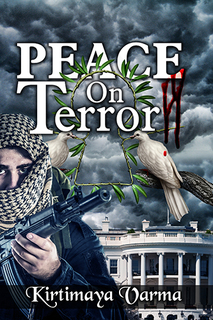
Peace on Terror
Category:
Action/Thriller
Publisher: eTreasures Publishing, LLC
ISBN-10: 1942391161
Type: Fiction
Pages: 408
Copyright: August 8, 2015
ISBN-13: 9781942391166
Price: $4.50 (eBook)
Sadiq's conversion from an Islamist to a true Muslim and nationalist American is the novel’s story, set mainly in the U.S., Afghanistan, Pakistan, and India.
Synopsis of the novel PEACE ON TERROR
SADIQ ALI, a Pakistani American, and MULLAH RASHID, a Saudi cleric who has taken asylum in dar al-harb U.S. after being expelled from dar al-Islam Saudi Arabia for anti-American activities, plan to assassinate the American President BILL POWERS to turn the War on Terror in favor of Muslims. Before going on the mission, Sadiq meets his mentor, Dr GHULAM AHMED, a Pakistani American and his childhood neighbor in Lahore, who guided him in his doctorate program at the Colorado State University. Ahmed is well-read in Islam and devoted to creating American space in the American Muslim’s Islamic identity.
TOM EAGLEBURGER, the Secretary of State, and HENRY BURNS, the Secretary of Homeland Security, are on the opposite sides of the covert split in the U.S. cabinet on the issue of continuation of the War on Terror. They are discussing policy issues, such as the U.S. opposition to Pakistan- and Saudi Arabia-inspired terrorism but support to Pakistan- and Saudi Arabia-inspired anti-terrorism. Burns favors the President’s policy of continuing the War till Islamists are defeated; Eagleburger opposes it. To clarify the increasingly confusing American policy on Terror, the President addresses the nation and the world on the TV. He reiterates Islam is a religion of peace and exhorts everyone to imbibe Islamic ideals and denounce Islamic jihad. Muslims see Islam in danger. As planned, they assemble in front of American embassies in their respective countries to protest violently. But their religious leaders caution them that the best time to see Islam in danger is when the TV crew arrives. Their wait is soon rewarded. The demonstrations turn violent in the glare of TV cameras.
Journalists analyze the President’s speech. Their discussions lead them into contradictions in the American foreign policy. In an appropriate context, the White House will see al-Qaeda and Taliban doing right even as they bomb and kill, like it saw Khmer Rouge, though Pol Pot’s killing fields were graves to two-and-a-half million people.
Powers comes on a state visit to India. Sadiq slips across the border from Pakistan into India to assassinate him. He fails. His failure ignites higher passions in him and Mullah Rashid to do Allah’s work. They rope in mullahs and jihadis to nuke America. A Russian jihadi steals HEU from Sevmorput. Chinese-trained Pakistani nuclear scientists begin making suitcase nuclear bombs at a secret place near the Af-Pak border for the ultimate jihadi assault.
Sadiq reads the synopsis of a book Ahmed is writing on jihad, dar al-Islam, and ummah. Ahmed describes how since the Prophet’s death, Muslims have allied in jihads more with non-Muslims than with Muslims to kill Muslims rather than non-Muslims, while ironically struggling to establish dar al-Islam and ummah. The current history is similar, with more Muslims than non-Muslims killed by Muslims in jihads against Crusaders and Zionists.
While the U.S. presidential election approaches, Powers’ popularity index is dropping because of the opposition to the War in the U.S. Opinion polls show his party heading for a rout. To win the elections, should he lose the war and bring back American forces?
Jihadis build twelve suitcase nuclear bombs. Before leaving for jihad, Sadiq invites Mullah Rashid and Ahmed to his home in New York for his last meeting with them. Ahmed does not know about Sadiq’s jihad. He draws upon Islamic history to show how unnatural is the war of Muslims with Christians and Jews, and upon Islamic scriptures to explain what an inviting place is the Quran to grow a relationship between nations and tribes. Ahmed goes on to show that democracy, secularism, and globalization are Islamic concepts accepted by ancient Muslims. Muslims must return to their Islamic roots and become democratic and secular in a global society. Sadiq’s thoughts go back to experiences of togetherness Ahmed has enabled him share with Christians and Jews, enjoying commonality. But when he remembers his brother-jihadis in Pakistan waiting for him, he wants to return to the jihad. The next day he leaves for Pakistan. The jihadis will carry suitcase nuclear bombs to Mexico City from where they will smuggle the weapons into the U.S. with the support from MS-13.
One night in the Mexico City, YUSUF, an MS-13 operative and jihadi, murders a Mexican public servant for refusing to be bribed any more by the drug cartel till the bribe amount is raised. Yusuf’s victim is a suspicious person under FBI watch. FBI men following him see the murder, and know they have stumbled upon leads. They pursue Yusuf.
A few days later Yusuf receives twelve jihadis, including Sadiq, from Karachi, at the the Mexico City international airport. Islamists working at Karachi and Mexico airports enable safe passage of the luggage. Yusuf drives the jihadis to a bedsit hired in a building near the U.S.-Mexico border. For four days Yusuf and Sadiq survey the border with binoculars from the building terrace. FBI agents following Yusuf see him with Sadiq on the terrace, where they place bugging devices, suspecting drug trafficking. On the fourth day, while surveying, Sadiq reveals to Yusuf the jihadi plan. They decide jihadis will smuggle the suitcase bombs one by one through a secret MS-13 tunnel from Tijuana to San Diego. Sadiq is the first to leave. An MS-13 jihadi receives him at Tijuana and takes him to an MS-13 safe house where his colleagues will join him. Through taped conversation between Yusuf and Sadiq, FBI comes to know of the plan to nuke America. It raids Yusuf’s bedsit. Yusuf and the eleven jihadis with him are arrested. FBI begins looking for Sadiq but is unable to trace him.
While security organizations try to apprehend Sadiq and prepare themselves for any contingency, the President meets his secretaries in the Presidential Emergency Operations Center. They look for a political solution to end the War. They realize fighting terror as a war is not the best strategy, and discuss moving into a new phase in the confrontation wherein terror is seen as a crime and internal Muslim problem, and not a Christian or Jew versus Muslim problem. Instead of the U.S. being in the lead in the confrontation, and Muslim countries being U.S. allies, moderate Muslim nations should take the lead, and other countries should become their allies, keeping a low profile. When Islam confronts Islam, a solution will emerge more easily than when Christianity and Judaism are seen facing Islam.
Sadiq comes to know through the media about the FBI raid on Yusuf’s bedsit. Left alone with the bomb, his success is crucial. He leaves for Washington in an MS-13 bus. When the night comes—which is his last on the earth—he nostalgically remembers his connectivity with America. Quranic injunctions that Ahmed often quotes come to his mind one by one: There is no compulsion in religion; We have made you a nation of moderation…so establish justice and moderation; And among his signs is the creation of the heaven and the earth, and the differences in your languages and colors; and many such verses confirming diversity and moderation as the law of Allah’s creation. Sadiq sees his connectivity growing with America and begins claiming his share of America—the country where the Quranic ideal of nations and tribes coming to know one another reaches its pinnacle. He sees opening up before him frontiers of a renewed Islam.
The FBI receives an anonymous call informing it about the location and the number of a bus with a suitcase nuclear bomb hidden under a seat. The caller is Sadiq Ali.
Excerpt
First three chapters from Kirtimaya Varma’s novel PEACE ON TERROR
CHAPTER ONE
Sadiq Ali walked up the marble steps to the prayer hall of the Badshahi Mosque in Lahore. The winds, blowing across the waters of the river Ravi, scattered his hair at all angles on the top of his yellowish-brown face. Tall and stout, he looked towering older than his eight years.
It was a day like many other days; yet different. He often came with his father, Dhul Fiqar, to the seventeenth-century mosque, which epitomized the Moghul grandeur his school teacher described nostalgically. The redstone tiles of the courtyard that was the largest in the world, the stone carvings on the exterior of the edifice, and the four minarets higher than the Taj Mahal’s standing like sentinels to three white domes were expressions in bold reliefs of a small part of the Moghul magnificence he learnt in his history class.
Unlike during his earlier visits to the mosque, none of these expressions came to his mind. The river glistened in the midday sun and the air was clear, but his eyes were hazy. For the first time his father had not accompanied him. Rather Dhul Fiqar could not. Because the prayer meeting was especially for boys in the eight-ten age group. Young boys were targeted in mosques throughout the world to lead them grow up into suicide bombers by filling them with a rage against the supposed enemies of Islam.
He entered the prayer hall. Beneath the engraved arches on huge piers, some two thousand boys had assembled. They were standing silently in neat rows, waiting for the imam, while more boys poured in. Sadiq read the Kalimah inscribed under the main vault in the prayer chamber and joined a row.
Soon the imam arrived and conducted the dhuhr, prayers when the sun crosses the zenith. After leading the prayers, the imam spoke about various Islamic issues giving Sadiq a sense of déjà vu: Islam was the only true religion; Christians, Jews, Hindus, Buddhists, and other religious communities were the enemies of Islam; Islam was in danger from its enemies; and so on. These words were idioms too familiar to be interesting.
But Sadiq’s large black eyes shone as the imam said: “It’s either they or us. Either they win, or we win. Either they kill us, or we kill them. Now is the time for you to decide. Your fate. Their fate. The bomb is their fate if you want them to burn in the fire of hell. The suicide bomber is your fate if you want to enjoy the bliss of paradise.”
Sadiq was all ears, with no identity beyond. In rhetoric and rhapsody, the imam went on to explain how the so-called War on Terror led Muslims to an uncompromising situation of either/or, life or death, salvation or perdition. A compromise was more than weakness; it was treason against Islam.
The imam continued, “Do not compromise your life with your death. Do not compromise your enemy’s death with his life. Your life is precious. Because you lead a life conforming to Allah’s will. Why not give up the transient life on the earth for the eternal life in paradise? Your enemy’s death is inevitable. Because he doesn’t lead a life according to Allah’s will. Why not take his life on the earth so that he may perpetually suffer in hell? Hordes and hordes of Muslim boys beat at our doors, clamoring to be sent on suicide missions. How difficult it is to select only a few! It’s not we who choose. Who are we but Allah’s servants? It’s Allah who chooses the lucky ones for early entry into the paradise.”
The imam spoke for an hour-and-a-half before the meeting dispersed. Sadiq stepped out of the Alamgiri Gate, with the message of the imam churning in his mind. He stared at the road in front leading to the Lahore Fort.
“Blow myself up? A good idea? A bad idea? Not so bad after all. Should I consult my father? My mother?” He was restless more than ever before.
The child in him reached out to his father that night for guidance. Dhul Fiqar, the Pakistan correspondent of The New York Times, also covering the Palestinians, often cautioned his son to cleanse his mind whenever he heard a holy man and wash his body whenever he touched a holy man. Dhul Fiqar was a Muslim by birth, but more by choice. He chose to belong to the religion of his birth because fourteen hundred years ago when humanity was violently divided on the basis of slaves and masters, castes and creeds, colors of the skin, and possibly the shapes of the nose, the Prophet of Islam, peace be upon him, unequivocally preached the equality of mankind. How unholy his teachings had become in the hands of the holy men of Islam! Dhul Fiqar would tell Sadiq. Dhul Fiqar occasionally attended mosques for the solace they provided in spite of the sermons.
Sadiq summarized to his father the glorification of a suicide bomber in the imam’s sermons.
Dhul Fiqar said after some quiet moments, “Muslims are more human than not.” His small eyes behind the round lenses of his spectacles did not display the concern in his voice. They flowed with love and kindness. A smile broke on his clean-shaven face as he put his hand gently on Sadiq’s shoulder and drew him close. “You’re wrong if you say it’s either they or us. Say it’s they and us. The world isn’t black or white. There are black and white and other colors too. Like gray. Other situations too, like a win-win situation for all. Other idioms too, like live and let live. Never exchange the merciful Allah of Islam with the vengeful Allah of Islamic holy men who seek suicide bombers to destroy Islam’s perceived enemies. You’ll not attend prayer meetings in mosques except with me.”
Words from his father could annul the words of imams. Good boys listen to their parents. Wasn’t he a good boy? How often his mother said he was so!
“Blow myself up? A bad idea!” Sadiq said in his mind. But not with finality. “Why do some television channels portray suicide bombers as brave and noble? So do many Muslims, young and old alike.” He was confused. “Perhaps there’s good suicide and bad suicide. Legitimate killing and illegitimate killing. Holy jihad and unholy jihad.” He began vicariously experiencing good suicide, legitimate killing, and holy jihad. The thrill and enjoyment evolved at times into a desire to experience these in reality.
He never thought whether the war people talked about would end or go on forever. The sounds, smells, and sights of war did not make him hold his breath. Because he had yet to learn that children in some distant lands grew up without such a feel of war and that this difference of feeling was unjust and inequitable. The war did not make him happy or unhappy. But he realized grown-up people were not happy with it. Good manners prevented him from eavesdropping into the conversation of elders; however, many times he overheard them talking about war and war and war waged incessantly against Islam by the U.S., U.K., Israel, India, and other ungodly countries, making Muslims more miserable.
“It’s either they or us,” the thought overwhelmed him at times but could not last long in his family relationship.
When he was twelve, he began feeling passionately for Palestinian refugees he saw on the Pakistani television channels during prime time. He did not need reasons to love the Palestinian cause; he needed his religion, like most Muslims. But he had reasons too. He did not need reasons to hate Israel and its supporters; he needed the Palestinian cause, like most Muslims. But he had reasons too.
His passions ran wild when during the summer vacation, with his school closed from early June to late July, his father got an assignment to do a story on the life of Palestinian refugees after living with them for some days in a refugee camp. He persuaded his father to take him.
Dhul Fiqar met in Ramallah his Palestinian contact, Shehryaar, a tall man with stooping shoulders and long hair. Shehryaar had worked with Dhul Fiqar for many years, providing inputs for stories on Palestinian issues. He was to host Dhul Fiqar and Sadiq. The three boarded an ancient bus, and after a fifteen-minute ride got down on the outskirts of the town, and walked a short distance to Qualandya, one of Ramallah’s three refugee camps. They trudged along narrow alleys, skirting open sewage ditches here and there. Hundreds of one- and two-room houses stood somehow, crammed into and leaning over one another.
“When will you live in normal houses, Uncle?” Sadiq asked Shehryaar innocently.
“That’s something we’ve been thinking for six decades and more, my son. All we know is that someday we’ll return to our homes in our villages from where Jews have turned us away. We’ll return home from exile. Return home from exile.”
Shehryaar repeated return home from exile so obsessively as if he had been nursing these words for ages. Sadiq could feel within himself the obsession that was not yet his.
He looked around for streets and sidewalks, trees and gardens and flowers, patios and plazas, but found none. All along he saw scores of small children, many of them semi-naked, and some stark naked.
“Look at these children,” Shehryaar continued, aiming more at Dhul Fiqar than at Sadiq, “One Palestinian generation lived and died in the refugee camps and the next took over the household. This generation is also passing away. The third generation is now at the helm, and in some cases the fourth. Someday these children will head their families. Allah knows whether they’ll run their houses in this hell-hole or in their villages, after they return home from exile.”
“I’ve brought some toys for your children. I wish I had brought more for these children too,” Sadiq lamented.
Shehryaar laughed. They reached his house. His makeshift home had a single room with a concrete floor and little natural light. Blankets were stacked against a wall. His wife, wearing a thob in the red, black, white, and green colors of the banned Palestinian flag and full of embroidery eminently featuring the slogan We shall return, was cleaning kitchen utensils in one corner. She did not look at her guests.
“I think we’ll inconvenience you staying in your home,” Dhul Fiqar told Shehryaar.
“Not at all,” Shehryaar replied reading Dhul Fiqar’s mind. “Though we’ve only one room, there’re merely eight of us living here. My wife and I, and our six children. Three boys and three girls. Many single-room homes have twice this number of people.”
“Where’re the children?” Sadiq asked.
“Five of them are in the school run by UNRWA. One boy—the eldest—has been missing.”
“Missing?” Dhul Fiqar asked.
“Yes. For two months now,” Shehryaar smiled like a proud father.
“May Allah safely bring him back home,” Dhul Fiqar did not pursue the matter further.
But Sadiq did so in his mind. If he were to go missing, would his father smile proudly? There was something incomplete in the situation.
Shehryaar’s children returned from the school. Shehryaar’s second son, Zaman, was three years older than Sadiq. The two boys found instant rapport. When the evening came, Zaman took out Sadiq for play in the alley, as wide as the span of a child‘s arms. It was the only place for children to play.
“Zaman, I’ve brought toys for you,” Sadiq said, as they strolled along.
“Which toys?” There was no excitation in Zaman’s words.
“Battery-operated cars and planes.”
“These are for girls. I won’t play with them.”
“Which toys do you play with?”
“Guns and knives. Like most boys.” There was pride on Zaman’s cherubic face as he pulled forward his broad chest and drew out a knife from his pocket.
A brief silence.
“Someday we must return home from exile,” Zaman continued. “We’ll never be able to return to Beit Daras unless we grow with guns and knives.”
“Beit Daras?”
“That’s our ancestral village in Israel. My great grandfather had seen it demolished and erased by Israeli forces, except from his memory that he took to grave.”
“Don’t parents prevent children from playing with guns and knives?” Sadiq asked.
“If they do so, some boys opt for a life secret from their parents. Inshallah, my parents are supportive.”
“How do you get the weapons?”
“From the militia. They provide us free.”
“Your parents may not teach you to operate the weapons?”
“If they don’t, no problem. We prefer learning less from our parents and more from the militia and the clergy.”
Two days later a fifteen-year boy from Shehryaar’s neighborhood went missing. From the cries of pain of his family members and words of consolation from his neighbors, Sadiq came to know that losing children was not a matter of much concern to the Palestinian refugees. Indeed, it could be a matter of pride, badge of honor, and symbol of sacrifice. The militia was always on the prowl to get fresh recruits, at times persuading well-built boys to secretly leave their homes, and brainwashing and training them to kill themselves while killing others. Such boys were living martyrs—as the clergy and the militia warm-heartedly called them. The living martyrs had two choices: the holy choice of a possible death at the hands of the enemy while fighting the enemy, or the unholy choice of a certain death at the hands of a friend if they refused to fight the enemy. Many of these living martyrs later showed up on Palestinian calendars as the “martyr of the month,” glorified in paradise, triumphant beneath a flock of green birds who had carried their souls to Allah.
During the ten days Sadiq stayed in the camp while his father worked on the story, he empathized with Zaman in the experience of exile and dream of return. A year later Shehryaar was in Lahore to do a story with Dhul Fiqar. Zaman came with his father to return Sadiq’s visit. During his five-day sojourn to Lahore, Zaman discovered there were children who lived in their homes, and they never had to wait to return to their homes. He found them at times laughing with joy. Some day he too would laugh like them. Sadiq took him round the city. What remained in his mind was the picture of children growing up without waiting to return to their homes.
“When do we meet next?” Sadiq asked Zaman seeing him off at the Lahore railway station.
“Very shortly,” Zaman replied.
“Where? In Lahore or in the Qualandya refugee camp?”
“In Beit Daras. After I return home.”
“Really!”
“That’s my promise.”
“It may be too long before you return home?”
“No. It won’t be.”
Zaman came back to his home in the refugee camp, but he knew how far he was from homecoming. He remembered his experiences in Lahore. Remembering them, he felt a bit less orphaned, alien, and misplaced. But Sadiq had started feeling orphaned, alien, and misplaced. He did not know the right place for him to be.
Six months later Dhul Fiqar informed Sadiq that Shehryaar had told him Zaman had gone missing. Sadiq knew what this meant. He chose to blur the meaning. Zaman could be in the Israeli prison. He would be back, when Palestinians and Israelis exchange prisoners.
One day Dhul Fiqar received a gift packet from Shehryaar. Dhul Fiqar opened it to find Palestinian calendars. Zaman appeared on the calendars as “martyr of the month.” Shehryaar said in a letter he was proud of his son who would now live forever in the paradise, as the reward for killing in the occupied lands twenty enemies of Islam by suicide bombing. Dhul Fiqar did not feel any pride. He was sad. A life could have been saved. Twenty more lives could have been saved.
Sadiq looked at his friend’s picture. The portrait of a martyr. But no more a living martyr. He smiled wistfully.
“You promised me we would meet again in Beit Daras. After you return home!” he told Zaman in the portrait. “You didn’t keep your promise?”
The smile vanished.
CHAPTER TWO
Where was he in a war that was becoming more and more his? Sadiq thought in his lonely moments.
When he was fifteen, he was grown up enough to know that a time would come when the war would end. How would it be at the end of the war? If he survived, he would start attending his school again. But he hadn’t left the school? His parents would never let him do so. He was their only child. Besides, they never believed “It’s either they or us.” They believed “It’s they and us.”
With the enemies of Islam charging from all sides, circumstances might change their beliefs and they would want him to go to the war. By the end of the war, a lot of people would die. Because the war had spread to many countries, including Pakistan. Cities, towns, and villages would be destroyed. Buildings and homes would perish. Roads would become craters. Landmines would make places uninhabitable.
“Where’s my mother? My father?” he might ask not finding them at his house baring iron, bricks, and mortar after being blasted by a bomb. He would hear the hush of silence beyond the drooping faces of people around. He would run to Uncle Ghulam Ahmed, his neighbor since his childhood. Uncle Ahmed would look at him mournfully, unable to speak.
“No! Never! The paradise is far, far away. From my parents. From me,” he said beneath his breath.
“It’s close by. Very close by. The paradise. It lies beyond my thumb. Beyond the trigger. On the other side of the detonator,” the words slipped past him, as he imagined himself holding a gun and ready to shoot at the enemies of Islam. He tried to turn a deaf ear to the call of the paradise, but failed. The paradise beckoned him again and again beyond the call of his parents. What a sense of success was there in his failure! A sense of victory. Yet, a sense of defeat. Of deprivation. Of fulfillment.
He realized that the lure of jihad was not simply the lure of revenge but of renewal. Cultural renewal. Spiritual renewal. Islamic renewal. The lure of jihad led to a meaningful life that was death in Allah’s path to the world beyond, or hope, purification, and liberation in Allah’s paths to this mortal world.
“How complete is my identity based on Islam with the Palestinians!” Sadiq told his father one day while they sat together on an upholstered divan in their living room.
“Sympathizing with them is okay,” Dhul Fiqar said softly, and then slightly raised his voice. “Who’s going to define your identity? You’re in the danger of being identified only by your religion rather than by yourself. How many young Muslims are choosing this cowardly way!”
“Cowardly!” Sadiq looked at his father in disbelief.
“Yes,” he said. “Cowardly because when you’re identified only by your religion there’re hardly any struggles to go through than when you accept the challenge of building up a composite identity for yourself, complete with individual as well as global orientations, and your religion is merely one of its many strands.”
“Look at the plight of the Palestinian refugees. Israel, U.S., U.K., and many countries are collectively responsible for it. Shouldn’t we also think of a collective action? Islam is the best cementing force for such an action.”
“You can’t entirely blame other countries for the plight of Palestinians. How did they become refugees? When Israel was founded in 1948, Arab countries invaded Israel to destroy it. The Israeli Palestinians sided with the Arabs and chose to leave Israel willingly to live in camps in Arab countries and join the war against Israel. Seeing their infidelity, Israel carried out what came to be called ethnic cleansing, adding to the voluntary influx of Palestinians from Israel.”
“As Palestinians are Arabs, isn’t it natural for them to side with the Arabs in the Arab-Israel war?”
“Nationalism doesn’t operate that way in current history.”
“For Palestinians in Israel, Arab nationalism overrides Israeli nationalism.”
“Every nation in the world will be in turmoil through a perpetual civil war if some of its citizens were to believe in any nationalism above that pertaining to their country. If there were anything called Arab nationalism, the Arabs would have constituted a single nation and not almost two dozens there today, often at war with one another.”
“Isn’t it a fact that the Jews have formed their Jewish state usurping a part of the Islamic land of Palestine?”
“Muslims usurped all the lands of the Byzantine Empire—Christian lands—and all the lands of the Persian Empire—Zoroastrian lands—and founded Muslim countries in these lands. Can Christians and Zoroastrians ask Muslims to vacate their lands? If they were to ask, would Muslims vacate? No. How many such examples are there in the world? Many.”
Dhul Fiqar paused and continued, “Historical forces have played their part resulting in historical facts. Fighting historical forces is like fighting nature. Israel was founded by historical forces. Palestinians must face up to this reality, as Christians and Zoroastrians have done, and end their misery. Thankfully, some Muslim states and Palestinians are living up to this truth and changing their perspectives.”
A few seconds of silence. The reasoning in Dhul Fiqar’s argument momentarily appealed to Sadiq’s intellect but fell short of satisfying Sadiq’s emotions for the return of Palestinian refugees to their homes in Palestine rather than in Israel.
Sadiq’s mother, who wore a burqa much to the annoyance of her husband, was working in the kitchen. She overheard the conversation and joined them. “You’re doing very well in school, my son. I hope you’ll continue to do well and go to the U.S. for higher education. Your father and I hope someday you’ll do your masters and doctorate in science from a leading American university. Don’t disappoint us.” In spite of her commitment to Islam, she wanted her child to remain away from radical Islamism. He could serve Islam better through his intellect than through the gun.
The hope of his parents was as much his. “How can I disappoint both of you?” Sadiq said.
“Promise?” his mother asked.
“Yes,” he said from his heart, but doubted whether his father would live long enough to see that hope materializing. Dhul Fiqar was fighting lung cancer for two years, and refused to give up though medical reports were unfavorable.
From an energetic rambunctious boy, Sadiq became quiet and self-contained. He spent most of his television time watching programs dealing with the lives of Palestinian refugees.
If Palestine was turning from a hopeless state to a more hopeless one, Pakistan too began holding out diminishing hope for him. Things were never good in Pakistan since its creation. They became worse with rising number of Pakistanis taking to the streets and to weapons, accusing Pakistani rulers of being anti-Islamic in its perfunctory support to the White House and more anti-Islamic in its more perfunctory support to the Palestinians. Pakistanis talked of the good old days—a long time ago, as it seemed to them, though Pakistan was born as late as in 1947—when men and women could live with just a little fear. During those days, there was the fear of Muslim-Hindu communal riots. As years passed, there was the greater fear of militias. Sunni militia to protect the Sunnis. Shia militia to protect the Shias. Ahmediya militia to protect the Ahmediyas, and so on. Various terrorist groups Pakistan spawned each had its own militia. Soldiers came out on the streets to suppress the militias. People lived in greater fear of the soldiers. Checkpoints sprouted all over Pakistan. The militias aimed at selected targets, but for soldiers everybody who was not a soldier was presumed guilty and available for torture. At times, for killing. If checkpoints were the best arena for torture, no place was less than sacred for killing. One could get killed even in one’s own home by the arms of law.
“How could one outlaw law in Pakistan?” Sadiq once asked his father.
Dhul Fiqar thought for a while. “It’s becoming increasingly difficult to see the difference between law and outlaw.”
Sadiq was in junior college when Dhul Fiqar died of cancer. For some evenings after his father’s death, Sadiq went to the Badshahi Mosque and walked alone up and down looking at the sinking sun from the vast courtyard. But he was never alone. His father’s soul was by his side, reminding him of their visits together to the mosque and the hope they shared of his attaining high academic qualifications from America. Sadiq had not let down his father when he lived; he would not let him down in his death.
Uncle Ahmed migrating to the U.S. a year ago to teach at the Colorado State University was another stimulus to keep him on the path of America, and yet another was the growing chaos and killings in Pakistan.
As days passed, he began realizing his shortcomings as a Muslim. Wasn’t he away from the war against Islam? Without telling his mother, he began attending prayer meetings in mosques. In the process of healing himself, he tore himself further apart.
He wanted to discover a new self—his identity, his wholeness, his unity. The discovery continued when he went for higher education to the U.S., taking with him his mother, whose health was failing because of old age.
Perhaps love could heal him. The jihadi child in him in the days gone by was too young to know the adult love based on sex; but the jihadi youth in him was looking for it. One day he came out of a Colorado Muslim Society mosque in Denver and passed by a secluded spot. A girl in burqa strategically moved past him unveiling her face fleetingly, convinced that her beauty was meant for any soul, whether looking for war or peace. He took the hint; she took to flight. Love at first sight and flight at first sight. A practical first step in mortal love guaranteeing the next. They were to meet again at that place expectedly, and in many places in the coming months more expectedly. Yes, he was in love with Rabiya, who had recently come from Pakistan to work and settle down in America.
“How much do you know about men?” Sadiq asked her teasingly one day, because she refused to give up her burqa in spite of his requests, though he knew in a few months she would Americanize herself sufficiently to bare her face, and even more, so much so that it might be difficult to withhold her from baring all.
“A little—as much as religion permits.”
“How much do you know about loving men?”
“A lot—so much that only America can permit.”
“How much do you know about having sex with men?”
“A lot more—for which permission or no permission doesn’t matter.” She too teased him.
They dated till Sadiq completed his academic education, earning a doctorate in nuclear physics under the guidance of Dr Ahmed. Then they got married. He built his sweet home in Riverdale overlooking the Hudson in northernmost New York. He was blessed with two children, a son and a daughter.
He found in himself the wholesome being of a father, husband, and son; yet, he could not find his wholeness. In trying to discover himself more and more, he discovered his enemies more and more: Christians, Jews, Hindus, and others.
Did he need a religious teacher, a theological guide, a spiritual mentor? he wondered. At this juncture he heard of Mullah Rashid at the Islamic Cultural Center of New York. Mullah Rashid was an aged Saudi cleric well-known in Islamist circles. During his younger days, in between five prayers to the most compassionate and merciful Allah, he had killed in bomb blasts hundreds of innocent civilians in jihads. How could a holy man wreak such carnage? The question at times rose in his mind, but did not sustain. Allah knew that he killed in the name of Allah, and not in his own. By the virtue of his holy deeds and spiritual knowledge, he became an imam in Riyadh.
But when he openly opposed the presence of American troops near Islam’s holy places, his sin washed away his virtue, and the Saudi rulers began hounding him out of the Kingdom. American mullahs from ICC New York advised him that the American concept of individual freedom was becoming so liberal that sooner than later bomb blasts in America would be looked upon as a non-violent affair born out of peaceful intentions unless proved otherwise. Like many mullahs in his situation, he sought and got refuge in the U.S. Here he could pursue his Islamist activism with less hindrance compared to in Saudi Arabia. Yet, he could not give up the idea of the U.S. being dar al-harb, and condemned the country for its beliefs in democracy, secularism, liberalism, and such ideals the state pursued empowering him do in America in the name of Islam what he could not do in Saudi Arabia. He hoped inshallah America would become dar al-Islam like Saudi Arabia.
Sadiq often met the Mullah at the ICC New York. He felt vulnerable yet stronger in the presence of the Mullah, whose beard was twelve inches of gray turbulence obscuring his face and firmly rooted like his beliefs. His forehead was pinched and lined, and his eyes, sharp and clear. Beyond his lacy skullcap and white tunic, and the small stoop on his shoulders, making his robe longer than his body, Sadiq discerned the Mullah’s bonds with all the mullahs in the last fourteen centuries after the Prophet. The strength in Mullah Rashid’s convictions seemed to subdue the wrinkles on his face and his toothless anger.
“My world is centered on Afghanistan today, occupied by the Soviets,” he told Sadiq one day. Sadiq looked into his eyes set deep below his overhanging brows. They took their shine from inside his Islamic being than from the outside world. There were no tremors of age in his voice, as he went on, “The entire creation of Allah revolves round Afghanistan. The sun, the moon, and the stars are moving round Afghanistan. No Muslim is worth the strength of his religion if he cannot show his power to the God-denying communists occupying the Islamic land of Afghanistan. Afghanistan is the place to be for every Muslim worth Islam. If somebody is not worth Islam, he must be killed, because Allah sees no reason for his living.” The Mullah was never deterred by reality or unreality, nor undeterred by unreality or reality.
His stern pronunciations were like poetry to Islam. There was no end to the poetry through their meetings in the mosque the next few days. Had Sadiq found his religious teacher, theological guide, and spiritual mentor? Yes, he answered with finality one Friday after the fajr, the pre-dawn prayer. The frail old man became his character, mind, and wisdom. The Mullah too had found a favorite disciple.
Sadiq began seeing the Soviet occupation of Afghanistan as an opportunity, though Uncle Ahmed advised him there were greater opportunities for him in the U.S. The years of his childhood and adolescence, and early twenties, when he was torn in the dilemma to be or not to be a jihadi, seemed far away. He was born to be a jihadi. He would live a jihadi. He would die a jihadi. Whether he lived or died, his family had enough resources to make a decent living.
“I’m going to Pakistan on an important mission,” he announced to his family one day when sitting together and watching the television.
“Which mission? It’s hardly six months you’ve returned from Pakistan after a four-day stay,” Rabiya was curious. “I’ve been seeing you keeping to yourself for the last three-four weeks. What’s the matter?”
“Oh, nothing! I’m working on some inter-university project on terrorism by state and non-state entities,” Sadiq lied. He lied in the name of Allah to do Allah’s work; so Allah would forgive him. The philosophical tenets of Mullah Rashid had taken deeper roots in him than scientific thinking. “I’ve to set up the infrastructure for some universities to coordinate with one another. I’ll need to stay in Pakistan much longer this time, though I can’t say for how many months.”
“For months!” his mother protested. “You know my health is failing.”
“I wish I could take you with me, Ma,” Sadiq smiled in his mind, knowing his mother could not make the journey. “Rabiya will look after you. The children will play with you.”
No amount of persuasion could hold him back.
“Every time you visit Pakistan, you go to Peshawar in spite of my fears of this city,” his mother continued her protests. “You’ll not go to Peshawar this time.”
Sadiq smiled without saying yes or no.
He reached Peshawar, the climax for terror in the North-West Frontier Province of the puzzle that Pakistan had become! The country amazed him with its skill of running with the hare as a victim of terror and hunting with the hounds as the sponsor of terror, leaving all gasping between dissatisfaction and more dissatisfaction. Peshawar was a forward command post for CIA, who trained the mooj—the CIA’s fond appellation for mujahidins—and transformed Peshawar into a warfare training ground, and also a weapons producer. The city began manufacturing copies of Chinese version of AK-47 assault rifles, British Lee Enfield rifles, and Russian pistols in huge quantities. These were supplied to the moojs, who fought the Soviets. America could not have been happier, even as to contain the Soviet Union, it sent Afghanistan and Pakistan to the paths of their own destruction—paths eagerly taken by both.
The CIA made Peshawar the choice land of jihad. To meet, train, fight, and forge connections, jihadis came to Peshawar from Lebanon, Saudi Arabia, Syria, Sudan, Indonesia, and many countries, including Yemen, a single nation happily divided into two on the ground of tribal rivalry and unhappily united into one on the basis of common religion, but always split painfully, whether united or divided. Sadiq discovered with them reasons for jihads and more jihads and even more jihads. If discovery failed them, invention did not.
Years ago when his parents were protecting him from radical Islam and inspiring him to go for higher studies to the U.S., he had thought being a pop star was more entertaining than being a technologist. At times this thought emerged during the extreme hardships of jihadi life spent without adequate food and water in the mountains and forests of Pakistan-Afghanistan border in hostile climate. But the CIA and Islamic scholars in CIA payroll persuaded him being a jihadi was yet better for entertainment. If he died fighting for Allah, he would get seventy-two virgins to serve his senses in the paradise. Besides, Islamists often exalted martyrs to the level of a pop star. He could have the best of both the worlds by being a jihadi.
South West of Peshawar, in the Waziristan mountains, Sadiq’s legendary hero the six-foot-five Sheikh, Emir, and Prince, Osama bin Laden, who walked with a cane in his left hand, had set up a hideaway. Sadiq met his warriors visiting Peshawar to buy or barter a wide range of weapons from .50 caliber machine guns to RPGs to 20mm artillery pieces.
The jihadis made Peshawar a clearing-house of global jihad. Carrying weapons on Peshawar’s streets and back alleys, they made it impossible for people to sleep—on a peaceful night. How disturbing was peace with its jarring silence grating into the ears! Thanks to these fighters in their fatigues, such disturbance was rare. Did they all have visas? at times some local people wondered aloud. The knowledgeable knew that the answer did not matter. The laws of Islamabad were for those who wanted to break them, and not for those who did not want any laws to break or follow.
The fighting spirit of the jihadis did not slacken after the Soviet defeat and withdrawal. Indeed, it became stronger. As there were no enemies to confront, the jihadis turned their guns on one another. The staccato sound of gunfire became the distinctive Voice of Peshawar heralding jihad to the world. Jihad against whom? Whomsoever, gunfire could be heard intermittently everywhere in Peshawar. The city continued to be driven by lungpower, firepower, and Islamic power, which found violent expressions, and at times reasons. Peshawar became uglier than what it had been before the Soviet defeat, with perpetuity of war looming amid pranks of peace, while lawlessness fed to fundamentalism, and fundamentalism, to lawlessness.
When Sadiq left Peshawar for New York to return home, he was as proud of the jihadi victory against the Soviets as of the ties with jihadis across nationalities he had made here. He was convinced of the ultimate triumph of Allah’s forces over any enemy. He regretted seeing what Peshawar had become; yet, he knew Peshawar was his destiny.
Destiny faced him differently when he reached home. His mother had died two months ago.
CHAPTER THREE
Sadiq dreamed there were no Christians, Jews, Hindus, Sikhs, Buddhists, God-denying communists, U.S., Israel, or India. In the world there were only Muslims and one nation—the Islamic ummah. Jihad after jihad had destroyed dar al-harb, and established dar al-Islam in all of Allah’s lands.
How many times had he seen this dream-vision when awake! But it remained unrealized. Now he was seeing its fulfillment while snoozing.
Yet he started feeling more frustrated than while awake. With the world becoming Islamic, he could not get any outlet for the Muslim anger surging in his body, mind, and soul for fourteen hundred years, though he was hardly forty.
He came out of his nap. Oh! To be on the earth! He did not want to be anywhere except in the paradise. All he asked Allah was the chance of taking as many enemies of Islam as possible while leaving the earth.
“Allah!” he intoned, first raising and then dropping his voice and feeling vibrations throughout his being. What an effort it was to extricate from the soul a holy word in Peshawar! Earlier, he was in Peshawar in the jihad against the Soviets; now he was in Peshawar in the jihad against the Americans. In the intervening decade and a half, the world had turned a full circle. But he saw no roundness in the world; indeed, the world had become more skewed than before.
“Allah!” he called again. Firmly out of his nap, he found himself seated on a white plastic chair with a high back. He was alone. Another plastic chair with a broken arm and a table of varnished maple were the only furniture around. Cigarettes allowed to burn beyond the table’s beveled edge had left depressions and ash-colored scars. He consulted his wristwatch, a gold Breitling with several dials. It was past midnight. The best time for secret conclaves, according to Mullah Rashid. Sadiq was waiting for the Mullah.
He heard low taps on the wooden door.
“Yes? Who?” he asked.
He recognized the answering voice and rushed toward the door. With a metallic sound, he unbolted the latch, opened a chink, then wider.
“Salam-alaikum,” Sadiq said with a half-smile to Mullah Rashid and his driver Majeed, and pushed the door ajar.
“Alaikum salam,” they replied together. The Mullah smuggled himself into the room. Majeed was holding a rifle he gave to Sadiq without stepping in. He said he would wait in his vehicle, turned around, and hurried down the staircase. Sadiq shut the door behind him and glanced at the weapon. It was a VR1 semi-automatic sniper rifle.
“Death to U.S. Death to Israel. Liberate Palestine. If we can defeat one superpower, why not the other? March, march, march toward Jerusalem,” the Mullah uttered, the words tumbling out as if by rote. His eyelids closed briefly, showing tiny purple veins.
His mouth locked in a grimace, and eyes latched on Sadiq, he went on, “In compliance with Allah’s orders, we must carry our jihad more to al-Adou al-Baeed from al-Adaou al-Qareeb. To the far enemy—the United States of America—from the near enemy—Muslim pro-American rulers.” When talking to jihadis, mullahs operating globally translated Arabic theological terms into English, more for emphasis than for clarity. They spoke with greater authority when conveying Allah’s orders than their own. Didn’t they have a hotline to Allah?
“May Allah’s curse fall on Columbus for discovering America,” he continued, explaining his philosophical beliefs.”Muslims would have been saved a lot of misery if America hadn’t been discovered.”
“Wouldn’t Muslims have suffered more misery if there were no America for the Muslim rage to expend on?” Sadiq asked, drawing from his dream a while ago.
The Mullah looked thoughtful. “Perhaps. That’s the reason Allah has made America. America is a necessity so that Muslims can destroy it. Islam may lose its appeal if Muslims give up their goal of obliterating America.”
Such was Mullah Rashid’s aversion toward the Americans that when the U.S. intervened in Bosnia and Kosovo to protect Muslims from Christians, he criticized its actions as anti-Islamic and pro-Christian. Such was his fear of U.S. pervasiveness that when he saw trucks bearing Red Cross or UN logos providing succor to Muslims in Bosnia and Kosovo, he lamented the U.S. presence in these two countries.
Sadiq motioned Mullah Rashid to a chair. The Mullah staggered toward it and parked himself as if lightening his own burden. In his right hand he held the Quran. Throwing furtive glances here and there, he coughed against his left fist. Caution was more important than breath. Sadiq pulled a chair near the Mullah’s and sat down.
The tumbledown room on the top floor of a three-story building was one of Sadiq’s safe houses—bedsits lost among clusters of dwellings in the tangle of side streets and dirt roads on city fringes. He could disappear for days or at times for weeks in such places he occupied alone. He chose them at random. They were rented under false names, so that they could never be tracked back to him. His fake passports supported his many identities. He was a rising star of the al-Qaeda, with a growing influence in the Taliban. How much of the world would be chasing him some day was less of a fear and more of a nourishment feeding his jihadi self giving meaning to his life and life to his meaning.
The Mullah looked up as if pleading to Allah. Cobwebs, ready to collapse, yet strong and capturing without letting go, crisscrossed the ceiling. They teemed with spiders bringing the room to life pulsating within him. The smell of dead fish pervaded the air.
“Allah,” he sighed. He closed his eyes again as if in a trance. His eyelids shuddered with the pulse of the capillaries within them. Oh, his invisible extension into realms purer than the three dimensions of his everyday world when uttering the word Allah! What a sensation of pouring in and pouring out! A sensation of silence in speech. Of speech in silence. He opened his eyes and struggled to position his small frame comfortably into the chair. Through a broken windowpane he saw smoke and fire curdling the city by night. The sound of gunfire and explosions disconcerted him only a little. He knew to share in the spoils of hatred.
“That night will change the world,” the Mullah said measuring as if each syllable. “You’ll witness history; more than that create it. The world is watching the war. You’ll decide whether it’s victory for us jihadis, and defeat for the U.S. and its allies. Or vice versa.”
Sadiq held the rifle like to once-in-a-lifetime opportunity. He would create history with it. He looked up prayerfully. Momentarily, the chain of his thoughts snapped. His American education based on critical analysis would have ruined him by coming in the way of his Islamic beliefs had he not met the Mullah. Once he had found his spiritual mentor, nobody could have changed his religious beliefs. Perhaps not even Allah.
“Inshallah, I’ll succeed,” he reiterated in a husky voice and leaned toward the Mullah.
The Mullah stood up. Sadiq followed. The Mullah rested his hands on Sadiq’s shoulders. There was something in that touch flowing from the Mullah’s soul to his, Sadiq thought. Was it the nectar of Islam?
Sadiq was leaving for the border city of Lahore on his way to India to strike at America. The Mullah’s facial sturdiness gave way to a paternal longing. Sadiq might never return! He raised his arms and tried to reach his palms to Sadiq’s hair hanging down to the shoulders in black whorls. He could not get to his disciple’s head six feet and more above the ground. He held Sadiq’s arms. In their girth and power, he sensed a promise. He saw a word written invisibly on Sadiq’s face made larger than life by beard flowing conspiratorially in a hirsute wilderness down his chin and cheeks across his chest to his navel. That word was invincibility.
Sadiq scrutinized the rifle, holding it in both the hands and turning it up and down and sideways. With its laser-sight attachment, night vision goggles, and telescope he could hit his target at night by firing long range ammunition such as .338 Lapua Magnum or .408 Chey-tac. How much of America would be in his life if he were to live after his mission? How much of America would be in his death if he were to die in his mission? A lot. There was so much of America in him. Earning a Ph.D. in the U.S. wasn’t the peak of his student life, whose culmination he saw not in academic institutes but in the battlefields of Pakistan and Afghanistan where the CIA made him what he wanted to be—a jihadi fighting in the defense of Islam. Oh, those days and nights of CIA training in terror warfare against the Russians in Afghanistan! The nostalgia about it all of which America was a part. He began feeling the wistfulness that night. Could he think of harming America?
Sadiq narrowed his eyes with a forward movement of the head and peered at Mullah Rashid and then at the rifle. From where did uncertainty come during those moments when actions were about to reach the climax? A lump rose in his throat that he swallowed down.
Wasn’t America the country where his late parents’ aspirations and his own for wealth and prosperity brought him? His wife, son, and daughter flashed smiles before his mind’s eyes. “No...don’t go...,” he almost heard them in the silence between him and the Mullah. The jihadi in him superseded the father in him. The husband in him. That was a glorious moment he validated to himself his truth as a Muslim over and above his other truths.
The Mullah walked with short steps up and down the room, at times swaying from side to side shaking his head, and muttered, “Look at the audacity of these Americans? They teach us morality. How dare they? They go to the church just once a week. If at all they go. That too on Sundays and not on Fridays. We go to the mosque five times every day.”
Sadiq entreated something from Mullah Rashid in silent words. The Mullah was an Islamic force that when perceived through Sadiq’s Islamic mind could solidify molten steel or melt solid steel. They sat down and discussed their plan at length.
When the sky brightened fractionally in the east proclaiming the coming dawn, Sadiq was ready to go. He wore a voluminous salwar and a loose kameez stretching from his shoulders to below his knees, and hid a dagger in the right pocket of his kameez, and the rifle in a heavy-duty protective box. The Mullah blessed him as he stepped out of the room. The box dangled in his left hand.
“Allahu Akbar,” Sadiq said before turning to leave. The fire of hell burned in his eyes that dreamed of the heaven promised in the Scriptures.
“Allahu Akbar,” the Mullah replied edging toward the door. “I know you crave for shihada, martyrdom. As a person close to Allah, I promise you Allah is waiting to reward you in the paradise.”
Sadiq walked down the stairs on the way to the paradise. He was assailed by a dank underground smell, but when he stepped out of the building, a wisp of air greeted him. The air was not as fresh as in the normal times; it reeked of smoke and chemicals. Yet there was something in it to enable him start anew. Majeed was waiting for him in a red Dunbar armored truck stolen from the military. Such vehicles had a better chance of reaching the destination.
“Where shall I take you?” he asked after Sadiq had settled down on the rear seat.
“Peshawar railway station.”
“To the middle of the city? In this kind of situation?”
Sadiq read Majeed’s fears. “Inshallah, we’ll reach the station. I know the warlords here.”
“There could be somebody you don’t know.”
“I’ve enough dollars to take care of all circumstances.”
“Fake dollars or genuine?” Majeed asked with a mischievous smile that showed his knowledge of the state of affairs in Peshawar.
“Both. We can use whichever works.” Sadiq too smiled.
“If anything happens to us?”
“Allah will wait to welcome us in the heaven. After all, we’re in the service of Islam,” Sadiq said in a booming voice he always used when drawing strength from Islam.
The logic was irrefutable for both.
The Dunbar chugged and coughed, and then seemed to die. It came alive again with a series of low sounds before getting into motion, kicking clouds of dust into the air with a thick stench of cordite, and then began moving forward, bumping and jolting and trundling on the shoddy track that passed for road.
Occasional bursts of gunshot. Rumbles of explosives. Screeches of metals. Shouts of war. Flashes of lightning. Various sounds and sights, definable as well as indefinable. Sadiq looked at the piles of rubble. Would these soon outnumber livable houses? Buildings burned at a distance, spewing columns of smoke. Some showed their entrails after blowing apart.
There was a hint of pink and orange in the eastern skies. Gradually, the city limped into the day. Chai-khanas cropped up by the roadside. Such a tea-house was made with a fire, a brew of tea, and a group of men around the fire. Sheds that passed for eateries began sprouting, with men struggling to kindle the coal in circular mud furnaces. People started coming out on the street. They had to do something for a living, even if it meant endangering their lives. Sadiq’s accustomed eyes could differentiate between the turbans of Pashtuns, Waziris, Ghilzai, Afridis, and Pakistanis, contrasting with the chitral caps from the tribes in the north and the fur-trimmed winter hats of Uzbeks and Tajiks. He gazed at a person with an RPG launcher plonked on his shoulder.
At a street corner the Dunbar turned right. A shack with open sides and a thatched roof supported on wooden pillars gave out an aroma of meat grilled over tongues of fire from red coals. The odor overrode the diesel smell from the vehicles and tickled Sadiq’s appetite. He wished he could stop and relish in the food delight, but knew the risks. In most cities one would generally keep one’s weapons hidden so as not to attract attention. But in Peshawar one would attract attention if one were to hide one’s weapon, and invite bullets if one were to display it. It was best not to be seen, especially when on an important mission.
The Dunbar soon passed by fields of white poppies with whorls of bluish pollens in the center. Sadiq looked at the undulating white beauty spreading far and wide into the villages. What a show of peace even in Peshawar! Poppies were a negatively sentimental affair for him. Fighting drug addiction was a cause dear to him next only to jihad. He worked for global associations fighting drug addiction.
When he saw the two minarets of the Mohabbat Khan Mosque, he felt relieved reaching the city center. The floral and geometric designs of the prayer-hall sheltered beneath three low-fluted domes floated before his eyes in a wide range of colors. The Dunbar headed toward the Church Road—a name that smacked of blasphemy—and then crossed the Reti Gate, the business center of Peshawar, and continued on to Ashraf Road before turning left to the ancient Grand Trunk Road, initiated by the Maurya Empire in the third century before Christ, and now linking Bangladesh, across north India, to Peshawar and beyond to Kabul.
The Dunbar swerved to Saddar Road. Sadiq thanked Allah when a board on his left declared Peshawar Chhavani in Urdu, with Peshawar Cantonment written in small letters in English under the Urdu words. He got down from the armored truck, bade Majeed goodbye by waving his hand, and walked toward the railway station, bracing up for the five-hour journey from Peshawar to Lahore.
|