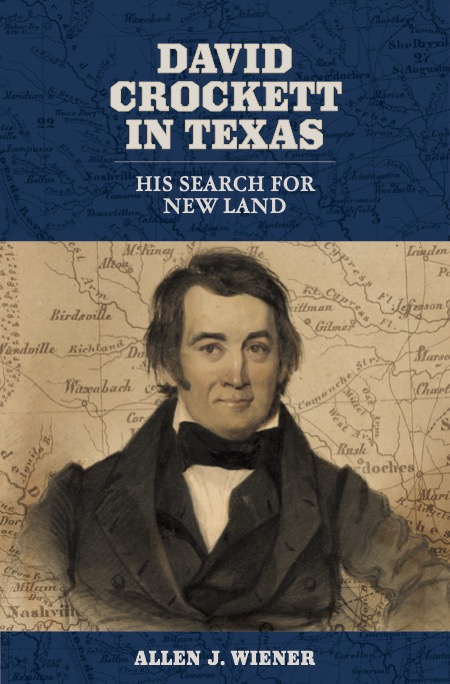
A fresh look at the well-known figure from the perspective of his quest for land in Texas and the new start it promised for his family.
"A stunning tour de force of research and analysis that illuminates the last three months of ‘Davy's’ life. Wiener's book will stand in the top rank . . . . He also adds important new speculation and analysis on those last thirteen days in the Alamo."—William C. Davis, author of Lone Star Rising: The Revolutionary Birth of the Texas Republic
David Crockett in Texas: His Search for New Land, by Allen J. Wiener, takes a fresh look at the well-known figure from the perspective of his quest for land in Texas and the new start it promised for his family. This retelling of what the author terms “the last adventure in the life of a nineteenth-century Tennessee frontiersman who became a national celebrity” presents a picture of Crockett that contrasts with the popular image of the brash adventurer who sought glory on the battlefield as well as that of the bitter, failed politician who came to Texas as a last resort. Wiener presents a nuanced examination of Crockett’s motivations that places them in the context of the full arc of his career and aspirations, starting long before he ventured to the south side of the Red River.
Notably, this book devotes a full chapter to the fate of Crockett’s family after his death, contributing perhaps the most complete account to date of the astute legal actions taken by Elizabeth Crockett to secure title to the land obtained by her late husband’s enlistment in the Texian cause. Uniquely to studies of Crockett, Wiener presents Elizabeth Crockett as a shrewd businesswoman who ably managed her husband’s various enterprises at home while he was off campaigning or serving in Washington, DC.
David Crockett in Texas offers fascinating new evaluations of what we thought we already knew about one of the most studied and debated figures in Texas and American history.
Excerpt
It was not long after the Alamo guns were silenced and its defenders’ bodies burned that accounts of the battle appeared in the press and elsewhere, most of them of dubious factual or historic value. Some of the earliest ac- counts mentioned Crockett and speculated about the manner and location of his death in the Alamo. Nearly a century-and-a-half after the Alamo battle, historians took up a prolonged and heated debate over the idea that Crockett somehow survived the battle only to be executed immediately thereafter on Santa Anna’s personal order, which was carried out despite objections from some Mexican officers who allegedly witnessed the event.
The debate over Crockett’s death centered largely on the authenticity of With Santa Anna in Texas: A Personal Narrative of the Revolution, the memoir of Lt. Col. José Enrique de la Peña, a Mexican officer who fought at the Alamo. The memoir claims that Crockett was captured at the end of the battle and then executed. Although published in Mexico in 1955, it did not appear in English until 1975. In 1978, Dan Kilgore was the first to evaluate this and other Mexican accounts that repeated the execution scenario in his monograph, How Did Davy Die? A subsequent debate took place in a series of articles by James E. Crisp, Thomas Ricks Lindley, and William Groneman, which are included in the bibliography. Although the documents were ultimately found to be authentic by David B. Gracy II, that alone does not mean they are reliable accounts, and the various reports of Crockett’s death deserve a fresh look.1
It is significant that no Mexican post-battle reports mention Crockett’s death or anything more than his being among those killed. Santa An- na’s official report, written within hours of the battle, merely noted that Bowie and Travis—“who styled themselves Colonels”—and “Crocket” were among those slain. Colonel Almonte, an English-speaking special adviser to Santa Anna, did not participate in the attack but entered the fort afterward. In his diary entry that day he did not mention executions, nor did he record many details about the battle, although he did say he was robbed by his own men. Capt. José Juan Sánchez Navarro y Estrada noted in his journal that “some cruelties horrified me among others the death of an old man who they called Cocran,” which some authors have speculated indicates Crockett, “and a boy of about fourteen.” The journal of the San Luis Potosí Battalion names Bowie, Travis, and Crockett as “the ringleaders” and curiously says that Crockett “succeeded in entering [the fort] three nights ago.” That information could have come from post-battle interviews with Susanna Dickinson, who, in 1874, nearly forty years after the battle, said Crockett was “one of 3 men who came into the Fort during the siege & before the assault.” In an 1876 interview she said that “3 of our spys entered 3 days before the assault.” She might have told her Mexican captors the same thing shortly after the battle. None of these accounts shed any light on how Crockett died.
Professional Reviews
William C. Davis
David Crockett's constituents in Tennessee may not have gone ‘to Hell,’ as he told them, but he did go to Texas, a journey that took him from folk hero to American icon. Allen J. Wiener's new book David Crockett in Texas is a stunning tour de force of research and analysis that illuminates the last three months of ‘Davy's’ life. For some reason, we have many fine works on segments of his career, but still no definitive single biography. Wiener's book will stand in the top rank of these. Indeed, it is worth reading for the highly informative footnotes alone. He also adds important new speculation and analysis on those last thirteen days in the Alamo. Americans will never let go of their ‘Davy,’ and Wiener's outstanding work will make that grip even tighter.”— William C. Davis, author of Lone Star Rising: The Revolutionary Birth of the Texas Republic.
Paul D. Lack
“As the title suggests, the central assertion here is that Crockett must be understood as a frontier archtype with a seemingly endless appetite for speculating, primarily but not exclusively in land. Do not be fooled by the title—this study thoroughly describes Crockett’s origins in Tennessee where he repeatedly sought every means available to advance himself. Thus, his earliest military service in Indian wars and his up and down political career all emerged from his restless ambition that by 1835 left him with few resources other than his own wit and exalted reputation. Indeed, Crockett invented ‘Davey’ replete with frontier tall tales and his gift for gab that gained him on again off again successes in seeking the favor of voters. At times he regretted the buffoon image but had to use it in repeated campaigns for political office. His pattern of failures extended from financial losses to the role of husband and father, a dimension he valued so little as frequently to leave behind his wife and children to fend for themselves. By the time of his journey to Texas Crockett had lost almost everything and in fact often did utter the famous words to his detractors and opponents: ‘you can go to hell and I will go to Texas.’ His motive had not changed in that he went off again in search of elusive material success, enrolling for military service one last time primarily because it offered a bounty of free land. Finding land offices shut down due to concerns about selfish speculators and wartime vicissitudes, he journeyed on to San Antonio expecting easy victory that would lead to peace and restoration of the land business. For those who must know its take on the perennial ‘how did Davey die’ issue, Wiener marshals evidence that Crockett fell early in the Alamo fury and even provides a likely location for the corpse on the field of battle. His conclusion is based primarily on accounts told by civilian survivors that together comprise the earliest known evidence.
Wiener thus clearly avoids the trappings of the Crockett mythology, which he describes in great detail, and presents a realistic profile of his subject. The work is based on a foundation of research in primary and secondary sources that can only be described as exhaustive. The author searched out every imaginable detail not only of Crockett’s life and activities but also of matters of historical context. For those who feast on documentation he provides extensive notations and detailed explanations. Crockett partisans can also find solace in the author’s view of his subject as a consistent advocate for the poor in terms of governmental land policy. Altogether this interpretation is quite objective and balanced—Crockett is portrayed as less than heroic but likeable and living up to his homely dictum: ‘be sure you’re right, then go ahead.’ The author does not shy away from informed conjecture, but his treatment is founded on stark realism. Given its balanced tone and exhaustive research, this book actually has a chance to become the last word on an enigmatic subject.”—Paul D. Lack, author of Searching for the Republic of the Rio Grande: Northern Mexico and Texas, 1838–1840.
Robert Burns' first daughter was Elizabeth. Her story and the five descendants Scottish lives are recorded here with the Bard's message today as ever in need. Al Quida listen: Then let us pray that come it may, As come it will for a' that. That Sense
Margaret Kohel Evans invites her mother's grandchildren to a delightful visit with their grandmother, sharing charming memories of her across eighteen life themes.