Kindle Edition
Amazon
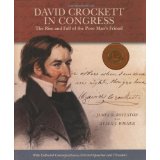
David Crockett in Congress
Category:
Biography
Publisher: Bright Sky Press
ISBN-10: 1933979518
Pages: 340
Copyright: 2009
ISBN-13: 9781933979519
Price: $7.69 (eBook)
The real "Davy" Crockett, seen through his political career, letters and other primary sources.
We’ve all heard of Davy Crockett, the King of the Wild Frontier, but serious historians have long known that the man behind the myth was more substantive and more complex. Current Crockett scholarship has been largely based on James Atkins Shackford’s 1956 biography, David Crockett, the Man and the Legend, and Shackford’s interpretation of the historical Crockett as an admirable but inept and somewhat naive politician has become as pervasive in the historical sector as the mythological “Davy” has to the general public.
Now, two life-long Crockett aficionados present missing correspondence and previously unexamined primary documentation that sets the record straight. Countering the characterization of Crockett as little more than a coonskincapped, buckskin-clad frontier hero, this remarkable biography chronicles his life in politics, revealing him instead as an inveterate entrepreneur, advocate for the poor, and career politician with a talent for hardball campaigning.
Following Crockett’s political rise from justice of the peace and magistrate to two-term representative in the Tennessee State Legislature and three-term member of the U.S. House of Representatives, David Crockett in Congress fully documents the elections of 1829, 1831, 1833, and 1835, details the progress of both the Tennessee Land Bill (1829-1830) and the Indian Removal Bill (1830), and traces the evolution of the mythological “Davy.” A truly exceptional volume, this exploration offers an alternative context for one of American history’s most important, yet misunderstood, figures.
With heretofore unpublished documents, portraits, and all the political writings of Crockett as well as a complete and fully annotated collection of Crockett correspondence, David Crockett in Congress is an insightful and provocative addition to the library of any reader with a passion for American history.
Excerpt
Crockett also had said that “He knew many of their tribe; and nothing should ever induce him to
vote to drive them west of the Mississippi. He did not know what sort of a country it was in which they
were to be settled. He would willingly appropriate money in order to send proper persons to examine
the country. And when this had been done, and a fair and free treaty had been made with the tribes, if
they were desirous of removing, he would vote an appropriation of any sum necessary; but till this had
been done, he would not vote one cent. . . . No man could be more willing to see them remove than he
was, if it could be done in a manner agreeable to themselves; but not otherwise.” The final decision, he
believed, should rest with the Indians, not the government.
Crockett knew that he could not keep his vote or such a speech secret from his constituents, and he was keenly aware that his position on the issue was unpopular with many of them. Newspapers back home criticized his vote, and he defended it openly in his letters and circulars, which were widely read by his constituents. He also boasted proudly of his vote in his autobiography, published in 1834, and insisted that it was a matter of conscience and his obligation under the trust that voters had placed in him. “I had been elected by a majority of three thousand five hundred and eighty-five votes,” he wrote, “and I believed they were honest men, and wouldn’t want me to vote for any unjust notion. . . . I voted against this Indian bill, and my conscience yet tells me that I gave a good honest vote, and one that I believe will not make me ashamed in the day of judgment.”
|