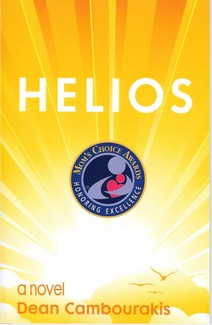
Helios is an award winning novel about a brilliant inventor of new technology, a fallen CEO seeking redemption, and an idealistic youth who comes of age in corporate America.
Set in a fictional conglomerate best known for consumer electronics, Helios tells the story of Chris Andros who accepts a position at the company's headquarters right out of college. He tries his best to fit in but soon learns that slick and gimmicky sales techniques are not for him. His career takes a turn for the better when he is introduced to Peter Hosum, the head of the company's research and development, and quality control divisions. Andros greatly admires Hosum's inventive genius and is thrilled to be taken under his wing. The dramatic conflict occurs when CEO Henry Dandle overrides the quality control system to increase production at the expense of product integrity and safety. A dangerously defective product is let loose upon an unsuspecting public, and disaster ensues. Dandle faces his moment of truth. In a flash of insight, he sees the path he must follow to make amends, redeem himself, and save the company.
As someone who works in a factory setting, I am all too familiar with what happens when quantity comes before quality and Helios drives this point home.
Especially when we're young, as is the story's main character, Chris, it's so easy to fall into the seduction of money and power without knowing what the consequences will be. The characters in the story are genuine and complex while showing us how consumerism in our modern world is often a downfall, not a boon. Well written and heartfelt.
Reviewed by Laura H. (Reader)
Reviewed on February 5, 2018
Unexpected story.
While I admit the bold yellow cover attracted me, the content kept me reading. I found this book to be one of the best I have read on social dilemmas. As a person reads this story it is easy to place oneself in Chris's shoes and contemplate how you would react or what actions you would take.
The first few pages were slow with details of the conglomerate Therion but as the story enfolds, I understood the reason for this detail. The CEO's rant, for lack of better word, was exceptional and relevant for any person and gives the reader something to seriously think about.
The manner of this author's writing is exceptional. From the standpoint of the business world, a professional way for this young man to handle the difficulties he was finding in his job, also the way the bosses observed quickly he needed a different position and how that was handled, was remarkable. Obviously a work of fiction.
To read the story of Chris Andros and his first job out of college --was accurate but disturbing. To have his final boss tell him " you questioned xxx and xxx and saw their half-truths and took a stand against them "about his previous two bosses in the parent company was unsettling but not surprising.
While discussing the parent company Therion with a co-worker and to hear the CEO "favored production quotas over safety, and quantity over quality" was par for the course and left this reader wondering about conglomerates today. This CEO had deluded himself into thinking wrong was right.
The author's use of a fictional company and circumstances to write this story around was a capital idea and in such a way the reader correlates what they are reading with companies today. This book would be useful in a high-school or college ethics class or a sociology class.
The CEO's observation about quality control, advertising, legal department, news stations, and the educational system while speaking about his company and the changes that had to happen were enlightening to say the least.
Thanks to the author for the time and effort for putting thoughts to words and then sharing them.
To have the reader evaluate the ethical boundaries in their own lives is what I took away from reading this amazing publication.
Part Three in the Mu Series - Sarah Thompson reluctantly abandons her desperate search for her soul mate on Maui and returns to her Montana hometown. Her brother has had a terrible accident...
3 WAY MIRROR is about a lost identity as experienced by a twenty-eight-year old who thinks he's Charles Randall, until strange events suggest otherwise.





Especially when we're young, as is the story's main character, Chris, it's so easy to fall into the seduction of money and power without knowing what the consequences will be. The characters in the story are genuine and complex while showing us how consumerism in our modern world is often a downfall, not a boon. Well written and heartfelt.
While I admit the bold yellow cover attracted me, the content kept me reading. I found this book to be one of the best I have read on social dilemmas. As a person reads this story it is easy to place oneself in Chris's shoes and contemplate how you would react or what actions you would take.
The first few pages were slow with details of the conglomerate Therion but as the story enfolds, I understood the reason for this detail. The CEO's rant, for lack of better word, was exceptional and relevant for any person and gives the reader something to seriously think about.
The manner of this author's writing is exceptional. From the standpoint of the business world, a professional way for this young man to handle the difficulties he was finding in his job, also the way the bosses observed quickly he needed a different position and how that was handled, was remarkable. Obviously a work of fiction.
To read the story of Chris Andros and his first job out of college --was accurate but disturbing. To have his final boss tell him " you questioned xxx and xxx and saw their half-truths and took a stand against them "about his previous two bosses in the parent company was unsettling but not surprising.
While discussing the parent company Therion with a co-worker and to hear the CEO "favored production quotas over safety, and quantity over quality" was par for the course and left this reader wondering about conglomerates today. This CEO had deluded himself into thinking wrong was right.
The author's use of a fictional company and circumstances to write this story around was a capital idea and in such a way the reader correlates what they are reading with companies today. This book would be useful in a high-school or college ethics class or a sociology class.
The CEO's observation about quality control, advertising, legal department, news stations, and the educational system while speaking about his company and the changes that had to happen were enlightening to say the least.
Thanks to the author for the time and effort for putting thoughts to words and then sharing them.
To have the reader evaluate the ethical boundaries in their own lives is what I took away from reading this amazing publication.