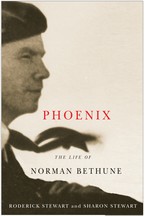
Category: Biography Publisher: McGill-Queens University Press
ISBN-10: 0773538194
Type: Non-Fiction
Pages: 488
Copyright: May 1, 2011
ISBN-13: 9780773538191
A bold in-depth biography of Dr. Norman Bethune, Canadian surgeon and pioneer of medicare,mobile blood transfusion and mobile battlefield surgery units.
Excerpt
In 1935 Norman Bethune wrote to a woman he loved,"I come of a race of men violent, unstable, of passionate convictions and wrong-headedness, intolerant, yet with it all a vision of truth and a drive to carry them on to it even though it leads, as it has done in my family, to their own destruction."
Professional Reviews
Norman Bethune Dark and Light
Norman Bethune, dark and light
Pioneer of battlefield medicine, Bethune shown as humanitarian and narcissist in new biography Phoenix: The Life of Norman Bethune
By Tod Hoffman, Special to The GazetteMay 20, 2011
•Story
•Photos ( 1 )
The Eighth Route Army supplied battlefield surgeon Norman Bethune with winter gear taken from downed Japanese flyers.
Photograph by: McGill-Queen's University Press
Phoenix: The Life of Norman Bethune
By Roderick Stewart and Sharon Stewart
McGill-Queen’s University Press,
479 pages, $39.95
MONTREAL - Dr. Norman Bethune was determined to do something great for humanity. Not until he discovered Communism did he define what that could be. Only at the age of 48, when he went to war-torn China in 1938, sharing the privations and primitive conditions of Mao Zedong’s legendary Eighth Route Army, did he arrive at his destiny.
“This is a cause worth fighting for, this is the answer to every man’s question to himself – ‘What shall I do with my life?’ ” he wrote.
Bethune served with great courage and distinction during the Sino-Japanese War. His insistence on performing surgery as close to the battlefield as possible saved the lives of countless soldiers who would otherwise have succumbed to their wounds or complicating infections during the lengthy and arduous journey to hospital. He also took responsibility for organizing the army’s medical corps, training nurses and doctors, and preparing textbooks outlining surgical procedures.
For all of that, even his devoted biographers, husband and wife Roderick and Sharon Stewart, concede, “Bethune’s fame is largely the result of one historical event – the ultimate victory of the Chinese communists over the Guomindang (Nationalists) in the Chinese civil war. Had that not occurred, his life would be a footnote, not a chapter in the record of his times. And his reputation has continued to be shaped by politics.”
The Ontario native might have been forgotten had he not been invoked as a stirring example of revolutionary zeal by Mao during the disastrous Cultural Revolution in the late 1960s. His effigy appeared on postage stamps, and biographies lauding his self-sacrifice and heroism were widely distributed. Hence, when Canada made overtures to establish relations with the People’s Republic in 1970, Bethune was a useful reference point for asserting common ground.
Thus was a legend born.
Phoenix is a finely balanced biography – likely to stand as the definitive account of Bethune’s life – painting a complex portrait of a man equal parts narcissist and humanitarian. It is the culmination of Roderick Stewart’s career, which includes two earlier books, Bethune (1973) and The Mind of Norman Bethune (1977). He also served as a consultant to Parks Canada on the restoration of Bethune’s birth home in Gravenhurst, which is a national museum.
The Stewarts do not sugar-coat their subject’s shortcomings. Bethune’s early career as a thoracic surgeon, dealing largely with cases of tuberculosis, in Ontario and Montreal was less than distinguished. His abrasive personality, hard drinking and extensive womanizing alienated many of his colleagues and made it difficult for him to secure a hospital appointment. His patients suffered a high mortality rate, though that was largely due to his willingness to operate on those whom others may have declined as being beyond help. His style of operating is described as “quick, rough, and bold,” which recommended it more for the battlefield than a conventional clinical setting.
A restless spirit, Bethune led an adventurous life. He spent his youth in logging camps in Northern Ontario, working his way through medical school at the University of Toronto before volunteering as a medic with the Canadian Forces in the First World War. Upon his return from Europe, he received further training at McGill and had positions at the Royal Victoria Hospital, the Ste. Anne de Bellevue Veterans Hospital, and Sacré Coeur in Cartierville. With the outbreak of the Spanish Civil War, he volunteered for the anti-fascist cause, establishing a transfusion service that brought much-needed blood to wounded fighters at the front. However, his lack of personal discipline troubled his comrades and he was returned to Canada.
With the opportunity to go to China, he resolved to redeem himself. There is desperation in his confession, “I’m too old, but there’s nothing I can do now. I have no money. I have no job. I have nothing. So I’m going to China.”
Nonetheless, his devotion to his patients was beyond reproach. His insistence on eating no more or better than a common Chinese soldier would leave him emaciated and weakened. Operating in filthy conditions, with no gloves available, he suffered frequent cuts. During an operation in late October 1939, he sliced one of his fingers, which became infected. The infection spread quickly, killing him within two weeks.
A statue, a gift from China, honours him in Place Norman Bethune at the corner of Guy and de Maisonneuve. It casts him in an audacious pose. Like this book, it pays tribute to a man whose ideology was rooted in his humanitarianism. For a healer who put the well-being of his patients above his own, both are richly deserved.
copyright The Montreal Gazette
Phoenix: The Life of Norman Bethune
Review: Biography
Phoenix: The Life of Norman Bethune, reviewed by Michael Bliss
Reviewed by Michael Bliss
From Saturday's Globe and Mail
Published Friday, Jul. 01, 2011 5:00PM EDT
2 comments
Email
Print
Decrease text size Increase text size
Medicine is a humanitarian profession. Most doctors use their skills to reduce suffering and save lives. Good doctors sacrifice their time and sometimes their health on behalf of their patients. Medical students are, for the most part, highly idealistic. While some practising physicians appear to sell out to materialism, many others work very long hours for less than banker’s wages. There are not many physicians’ lives that do not involve acts of good work and quiet heroism.
More related to this story
•Review: Norman Bethune, by Adrienne Clarkson
Phoenix: The Life of Norman Bethune, by Roderick and Sharon Stewart , McGill-Queen's University Press, 480 pages, $39.95
Norman Bethune (1890-1939) may still be the best-known and most celebrated physician in modern Canadian history. Roderick and Sharon Stewart have spent decades tracking down knowledge of Bethune’s life in Canada, his work in Spain during its civil war, and his service as a guerrilla doctor to communist forces in China. They have read everything by and about Bethune and interviewed everyone who knew him. Their well-written, exhaustive and highly readable Phoenix: The Life of Norman Bethune should become the definitive basis for all serious discussion of Bethune. Because the book is so thorough and so objective, it will spark a more informed debate about the meaning of his career.
The son of a Presbyterian minister who failed repeatedly because of his arrogance and irascibility, Bethune, according to the Stewarts, repeated his father’s misadventures in a medical milieu. Bethune could not get along with anyone for any length of time, alienating colleagues, friends and the various women he compulsively pursued. He was not a good or respected surgeon, for he imperilled patients’ lives with haste and sloppiness. The Stewarts speculate that he had a borderline personality disorder; he was clearly an alcoholic and may have abused morphine. Bethune lied about his communism, defrauded an insurance company to support himself and personally carried out abortions on his wife and one of his mistresses. The Western doctor who knew him best in China considered him “psychopathic” and “a horrible man.”
The Canadian communists who funded Bethune’s medical work in Spain in 1936-37 were appalled by his wild drinking and spending and inability to get along with the Spaniards. They effectively conspired with the Republic to force him out of Spain and back to Canada where they could use him for propaganda purposes. The Spanish, who had been appalled by Bethune’s arrogance, chauvinism and administrative incompetence, were glad to see him go. Claims that he was a great innovator in emergency battlefield medicine have no foundation.
Realizing that he had “blotted my copybook” in Spain and that he had no future in medicine in Canada, Bethune went to China in 1938 to seek redemption as a good communist doctor in the war against Japan. He found it, the Stewarts think, by rising, phoenix-like, to several months’ of high levels of sacrifice and service tending to wounded soldiers of Mao Zedong’s Eighth Route Army before dying of the effects of septicemia.
Not an innovator in China either, Bethune had continued to abuse and alienate his fellow workers. The American and Canadian communist organizations that had financed his mission gave him no ongoing support, ignoring his pleas for money and supplies. Even the circumstances of his apparent martyrdom are qualified by knowledge that he was angling to get out of China before his final illness.
“Bethune’s fame”, the Stewarts conclude, “is largely the result of one historical event – the ultimate victory of the Chinese communists over the Guodmindang in the Chinese civil war. Had that not occurred, his life would be a footnote…” His deeds have been immortalized for political purposes, first by the government of China during the Great Proletarian Cultural Revolution of the 1960s, then by the government of Canada in the 1970s as it tried to suck up to China and the Chinese. The campaign to celebrate Bethune largely succeeded.
Norman Bethune’s brief moment of success in a life of failure hardly compares to the achievements of countless physicians, from country practitioners and laboratory researchers through skilled surgeons through the thousands of Christian medical missionaries who first brought Western medicine to China. These are among the everyday heroes of real medicine. Still, it is possible for readers of the Stewarts’ excellent biography to conclude that Norman Bethune achieved a kind of glamorous battlefield humanitarianism and a degree of personal satisfaction. Even the worst doctor usually does some good in this suffering world.
Michael Bliss’s most recent book is The Making of Modern Medicine: Turning Points in the Treatment of Disease.
Like A Phoenix
Feature: Like a phoenix, humanitarian hero rises from the ash -- New biography offers insights into Bethune's life
Xinhua
Updated: 2011-06-14 04:40:00
Comments(0)PrintMail
Large Medium Small
TORONTO, June 13 (Xinhua) -- Perhaps it comes as little surprise that 72 years after his death, Dr. Norman Bethune remains a household name in China, where he spent the last 17 months of his life, while few in his native land of Canada have heard of his name, let alone his life story. After all, despite his many achievements, for most of his life, Bethune had felt like an outsider.
A new biography of Bethune chronicling his remarkable, sometime dramatic, life journey from the first-born child of devout Christian parents in mostly small-town Ontario to a committed Communist who died on the battlefield of Northern China, may re- ignite interest among his countrymen and English speakers around the world in the complex character and story of Bethune.
Exhaustively researched and cogently written with a measured and balanced tone, Phoenix - The Life Story of Norman Bethune, by historian Roderick Stewart and his wife, Sharon Stewart, portrays a man of great intelligence, talent, idealism and courage who at the same time was marked by his violent temper, impulsiveness and irascibility, and a controlling nature, which led to difficult relationships with those closest to him, from his father, his wife, his lovers, to his mentors and colleagues.
In contrast to the near sainthood in which he is revered in China, the Bethune in Phoenix comes across as a genuine human being who despite his many talents and great humanitarianism had been plagued by personal failings that almost derailed his career and life at various points until he found redemption in China.
Having traveled to all the sites in China where Bethune worked and interviewed hundreds of people, Roderick Stewart said he knew how Bethune has been historically viewed in China.
"They've always seen Bethune only from one angle: he was ( perceived) as never doing anything negative," Stewart said at the book's launch in Toronto recently.
In reality, Bethune's life was full of dramatic highs and lows, and he elicited strong feelings in both his admirers and detractors.
Rebelling against his parents' evangelicalism at a young age, he left home when a teenager and put himself through medical school by working in construction, part-time teaching, and military services. After a career as a thoracic surgeon in Montreal, where he was admired for his dexterity at the operating table and at innovating surgical instruments but also criticized for his operating style as well as his abrasive personality that sometimes bordered on cruelness Bethune volunteered his service in 1936 to aid the Spanish Loyalists in their fight against Franco's Fascists. He established a mobile blood transfusion unit on the battlefields of Spain, but his stint in Spain turned out to be short-lived. In less than a year Bethune returned to Canada after a fall-out with the Spaniards.
Despite holding a successful tour that whipped up support among Canadians for the Loyalists after his return, the 47-year-old Bethune was hitting a new low in his life.
His personal life was just as turbulent as his professional one, having drawn many women with his charisma but failed at any long- term relationship, including marrying and divorcing the same woman, Frances Campbell Penney, twice.
"Before coming to China, Bethune had feared that he would never achieve more than second best, never reach the goals he set for himself. Now he was at last receiving respect, reverence and unquestioning support than he so deeply craved," the authors wrote.
"Now physical and cultural isolation had become his monastery walls, his fortress against himself, shielding him from the temptations of sex and alcohol that previously had undermined his high idealism... In the mountain fastnesses of Shanxi and the plains of Hebei, Bethune had entered his kingdom."
Indeed, the authors chose Phoenix as the book's title to symbolize Bethune's life as that of a phoenix, reborn time and again in the fire of destruction, often brought upon by Bethune's own egotism and eccentricity.
Phoenix is the culmination of four decades of fascination with an extraordinary character and dedicated research into his life and death.
In 1969, Roderick Stewart, then a history teacher in Toronto, came upon the documentary film Bethune when searching for materials to teach his secondary school students about the 1930s. He became mesmerized by the doctor who found his destiny in fighting the fascists first in Spain, then in China, where he saved countless lives by greatly improving the efficiency and quality of battlefield surgeries and post-operative care before succumbing to septicemia himself.
In the 42 years since he discovered Bethune's story, Stewart has visited China four times. His research also took him to the United States, Mexico, England and Spain. Stewart interviewed hundreds in these countries whose life paths had crossed with Bethune's, dove into letters and professional articles written by his subject, and published two briefer biographies and a compilation of Bethune's writings and photographs prior to the latest book.
Stewart first went to China in 1972, at the invitation of then Chinese Ambassador to Canada Huang Hua, to interview those who knew Bethune and visit the sites where Bethune worked. In 1975 and 1983, he visited China again, both times teaching English. While back at home, in 1975 Stewart became an advisor to Parks Canada, which in 1976 purchased the house where Bethune was born along with the house next door and turned them into Bethune Memorial House in Gravenhurst, Ontario.
In 2005, at the invitation of the Norman Bethune International Peace Hospital in Shijiazhuang, the Stewarts had a two-week tour of the Jin-Cha-Ji area, the border region between Hebei and Shanxi provinces where Bethune did most of his work in China. During this most recent trip to China, the Stewarts met with Zhang Yesheng, a student of Bethune's in the last six months of his life and the pre-eminent Chinese expert on Bethune, who provided much of the new information in the 479-page biography, including 76 pages of research notes.
Asked about the relevance of Bethune's story to a young generation whose lives are far removed from Bethune's time, Sharon Stewart cited Bethune's support for "socialized medicine"long before Canada established universal healthcare in the 1960s - before returning to the "phoenix" theme.
"Bethune's life was like the life of a phoenix," said Stewart. "He rose high, he crashed to burn; he rose again, he crashed to burn again."
"He tried and tried and tried... and in China he finally got to do what he wanted to do," she noted. "That's what made Bethune a hero."
After recounting his death and burial, Phoenix - The Life Story of Norman Bethune quoted a letter Bethune wrote to Marian Scott, with whom he had a passionate but platonic relationship, some years earlier: "You need an altar to immolate yourself upon - a glad, burning sacrifice to a living God - you ask to be consumed - to rise again like a phoenix from the ashes of your own glad destruction - clean and pure & free - with wings."
"In China he had found that altar and made that sacrifice," the authors concluded.
Robert Burns' first daughter was Elizabeth. Her story and the five descendants Scottish lives are recorded here with the Bard's message today as ever in need. Al Quida listen: Then let us pray that come it may, As come it will for a' that. That Sense
Jack Kelly was a child performer, son of New York model, Nan Kelly, brother of actress, Nancy Kelly, brother-in-law of actor Edmond O'Brien and cinematographer Fred Jackman, Jr. On TV, from 1957 until 1962, he was James Garner's brother on the show,