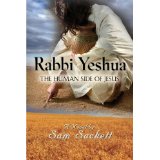
A fictional biography of Jesus of Nazareth based on both canonical and apocryphal gospels and setting him in his historical and cultural contexts.
Palestine was occupied by the Romans, and the Jews didn't like it. Before Jesus was born, there had been a rebellion in a town near Nazareth. The rebels said they didn't need a king or an emperor; their goal was to set up a Kingdom of God. The Romans leveled the town and took everybody they didn't kill into slavery. The possibility of another rebellion was always present.
Jesus -- referred to in the novel by his Aramaic name, Yeshua -- feared that another rebellion would result in genoside: that the Romans would kill thousands, perhaps tens of thousands or hundreds of thousands, of Jews. Jesus went into the desert to seek from God (Aramaic: Elaha) a plan that would prevent such a holocaust. He came back out of the desert to preach that the Kingdom of God was within each person, not something external.
Jesus' popularity grew to the point where it was possible that the Romans would perceive it as a menace to their power. Hence God told Jesus that he must sacrifice himself; once the Romans killed the movememnt's head, they would leave he body of followers alone.
But if each person could communicate with God personally, what use were priests? Thus Jesus was seen as a threat by the Sanhedrin, the Jewish ecclesiastical ruling body; and since the Jews were forbidden by he Romans to hold executions, the Senhedrin turned him over to the Romans to be crucified.
Excerpt
When Yeshua saw the Procurator, he thought to himself, “So this is the man who has killed so many of the Children of Israel and has threatened to kill so many more.” Pilatus was a short, well-built man, his skin almost as dark as a Hebrew’s, his hair beginning to recede. He had been in Judća less than three years but already had achieved a reputation as a very tough administrator, one who did not yield easily but who had a good instinct for how hard to press those under him, pushing them just to the edge of what they would take. Yeshua regarded him with mixed feelings. He suspected that Pilatus was under some pressure for steps he had taken which led the Hebrews to complain to his superiors about him; and for that he felt sorry for the Roman. But on the other hand, he felt that because of that very pressure Pilatus would be uncertain how to deal with him, and as a result Yeshua believed the Procurator would have to handle himself very carefully.
When Yeshua was brought before him, Pilatus was seated in a chair on a dais, the west wind ruffling his thinning hair; the Roman’s simple linen robe was draped around him, and he was bare-headed. Two soldiers in full battle dress stood behind him, each armed with a short sword and a spear. Kayapim stood by him, a little to one side. The High Priest was wearing an embroidered silken tzitzith with deep blue tassels and the Hebrew head-covering. The Procurator read the charge which the legion corporal handed him.
“Are you Messias?” he asked. His Hebrew was heavily accented, and Yeshua had some trouble understanding him.
“You’ve said so.”
Yeshua saw the puzzled frown on Pilatus’s face and realized that the Procurator misunderstood the conventional polite formula of agreement. Did he think Yeshua was denying the charges? Did he think he was avoiding a response? Yeshua was taken aback and did not know what to answer.
“Come, come, man. I haven’t all day. You’re accused of claiming to be Messias and trying to persuade people not to pay their taxes. Are these charges true or not?”
Yeshua asked Elaha within him what he should say, but there was no response.
While he was awaiting Yeshua’s answer, Pilatus drummed his fingers on the arm of his chair. Then he turned to Kayapim. As the President of the Sanhedrin was the supreme religious authority, Pilatus needed to handle Kayapim carefully; if the Sanhedrin called for an uprising, Pilatus would have not only to quell it but also explain to Roma how he had let it happen. “What’s your evidence for these charges?”
“We heard him ourselves.”
Again Yeshua read the Procurator’s reaction from his face. This time there was a scowl. Did that mean disbelief? Apparently it did, for the Procurator continued, using the Greek form of the High Priest’s name: “Now, Kaiaphas, as I understand what you told me, this man has been going about Judća claiming to be your Messias and raising up an army. You’ve had him arrested so that you can demonstrate to me how loyal you and the other Sanhedrin are to the Emperor. And all you have to place before me is your word. Where are this man’s weapons? Where’s his army?”
Kayapim flushed.
Yeshua froze inside. This was not going at all the way he had expected. At this rate, Pilatus might have him released instead of crucified.
“I’ll tell you what I think,” Pilatus continued.. “I think that this is a purely internal squabble between Jews.” Yeshua and Kayapim both flinched at the procurator’s use of the hated word. “I think that this man has developed something of a local following, and you’re afraid that he’ll seduce from you some of the followers who keep you rich and powerful. Isn’t he the one who led the invasion of your Temple a few days ago?”
“We believe that he is.”
“Well, yes, there it is,” Pilatus said, nodding. “You think he’s going to lead the people to rise up against yóu. But he’s not interested in an uprising against the Emperor; he didn’t attack the Prćtorium, he attacked the Temple. I think you’re trying to use me in an attempt to squelch some of your opposition. Unless, of course, you’re trying to make trouble for me by pressuring me into taking an action that might provoke a riot against me by this man’s followers.”
Yeshua could observe Kayapim’s jaw set. His own concern, however, was that the events were not playing out as he had anticipated or hoped. Pilatus evidently saw the situation more clearly than Kayapim had planned and had no intention of making a martyr of him. What had been in the mind of Elaha to set this chain of events into motion? Was he to die not in order to save the lives of the Children of Israel but in order to raise a storm of angry protest that would break the power of the Sanhedrin? Who could guess the purposes of Elaha?
Soldier's Gap is a non-traditional mystery with literary elements. The high school principal is brutally murdered, but Deputy Sheriff Dave Jenkins's search for meaning and love is a much more significant theme.
"Murder isn't usually this fun
Determined to confront the hazy memories of his troubled youth, Oliver Matthews, a retired detective and confirmed bachelor, returns to the picturesque town of Henley-on-Thames for the first time in years.
Soldier's Gap is a non-traditional mystery with literary elements. The high school principal is brutally murdered, but Deputy Sheriff Dave Jenkins's search for meaning and love is a much more significant theme.
"Murder isn't usually this fun