Category: Spirituality Publisher: Stone Bridge Press
ISBN-10: 1933330074
Type: Non-Fiction
Pages: 512
Copyright: July 1, 2007
ISBN-13: 9781933330075
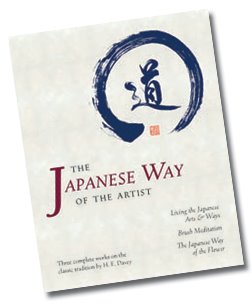
The three works anthologized here are essential to understanding the spiritual, meditative, and physical basis of all classical Japanese creative and martial arts. Living the Japanese Arts & Ways covers key concepts—like wabi and “stillness in motion”—while the other two books show the reader how to use brush calligraphy (shodo) and flower arranging (ikebana) to achieve mind-body unification.
"Mr. Davey's writing is fluid and engaging. He does not get overly technical and is easy to understand. The book kept my attention and made me wish for more balance in my life."--Reader Views on Brush Meditation
"There is something for everyone . . . Floral designers in western countries will find it is a very well-grounded, well-organized, helpful guide to the art of ikebana. Those studying Japanese culture and art will see it as a valuable source of information on how aesthetics have become an important part of human psychology. "--BellaOnline on The Japanese Way of the Flower
"As artful as a flower arrangement, this succinct, powerful book instructs as well as inspires. From historical overview to stylistic differentiation, and from meditative exercises to basic principles to step-by-step design, this is a wonderful work that will enrich anyone's personal Way of self-cultivation." --Stephen M. Fabian, Ph.D., author of Clearing Away Clouds: Nine Lessons for Life from the Martial Arts on The Japanese Way of the Flower
"The best presentation of the basic ideas underlying Japanese approaches to the arts I have found is H. E. Davey's Living the Japanese Arts & Ways."--Renga Roads review of Living the Japanese Arts & Ways
"Connecting with the deepest possibilities in Japanese arts is a tall order. Davey is one Westerner able to deliver."--ForeWord magazine on Living the Japanese Arts & Ways
"The book conveys a depth of understanding in simple language that is as practical as it is profound. "--The Asian Reporter on Living the Japanese Arts & Ways
Including extensive illustrations and an all-new introduction by the author, The Japanese Way of the Artist anthologizes three complete, out-of-print works by the Director of the Sennin Foundation Center for Japanese Cultural Arts. With penetrating insight into the universe of Japanese spiritual, artistic, and martial traditions, H. E. Davey explores everything from karate to calligraphy, ikebana to tea, demonstrating how all traditional Japanese arts share the same spiritual goals: serenity, mind/body harmony, awareness, and a sense of connection to the universe.
Supplemented by resource guides and glossaries of Japanese terms, the three books in THEJAPANESE WAY OF THE ARTIST bring ancient teachings to life:
Living the Japanese Arts & Ways presents 45 essential principles--like wabi, "immovable mind," and "stillness in motion"--that are universal in the Japanese classic tradition. It received a Spirituality & Health magazine Best Spiritual Books Award.
Brush Meditation provides an extensive introduction to Japanese calligraphy, showing how even the most elemental brush stroke reveals your physical and mental state.
The Japanese Way of the Flower examines practical methods for looking at nature and leads the reader through simple meditations as a prelude to learning how to create simple, elegant ikebana compositions.
H. E. Davey is Director of the Sennin Foundation Center for Japanese Cultural Arts in the San Francisco Bay Area. Mr. Davey's articles on Japanese cultural arts, and his Japanese calligraphic art, have appeared in such magazines as Karate Kung-Fu Illustrated, Furyu--The Budo Journal of Classical Japanese Martial Arts and Culture, The Journal of Asian Martial Arts, Body Mind Spirit, and Yoga Journal. He has also contributed to Japanese publications such as Hokubei Mainichi, the Nichibei Times, and Gendo.
Excerpt
If the Ways can be considered philosophies, then they are “philosophies” with a physical expression, or philosophies discovered through their physical expression. Chado (tea ceremony), shodo (calligraphy), kado (flower arrangement), budo (martial arts)and others can be thought of as Ways of art and life whose physical expression is keiko, or “practice.” But what constitutes keiko and why? Let us turn to kata, which are the means through which the Ways are practiced.
Kata means “form,” in the sense of a prearranged form or formal pattern. In shodo, students strive to make exact copies of tehon, which are either books of classic calligraphy or samples of their sensei’s brush writing. In sumi-e, “ink painting,” every novice copies a specific painting and isn’t allowed to progress to the next subject of study until the copy is exact. In the tea ceremony, chado disciples must work through a set series of rituals two centuries old, and in the martial Ways, practitioners endlessly repeat established combat sequences.
Yet even in Japan, there are those who claim that, in the martial arts, for example, fixed, predictable kata do not correspond to real-life combat. Similar comments could be made regarding the kata of many Japanese arts, not just budo. And these critics are correct in that the kata of any Do are artificial to the extent they are predetermined. They are incorrect, however, in supposing that practicing kata is inefficient and cannot lead to spontaneous action.
Continuing with our martial arts example, the key is to put aside combat and think in terms of education. Just as struggling with the “story problems” in arithmetic class and repeating over and over scales and “Mary Had a Little Lamb” during piano lessons gave us the rudiments of real-life problem solving and music making, and did so more effectively than if we had been thrown into real-life situations without this preparation, practicing kata in a martial art teaches fundamental principles that can be extrapolated to real life.
Occasionally there is the criticism that some martial arts kata don’t feature realistic attacks and combat scenarios. The fallacy in this claim is the presumption that it’s possible to predict the nature or form of a future attack. Will it be the bully in the schoolyard using the WWE armlock, or the mugger in the dark alley with the knife? The real deficiency is not in the use of kata in budo but in the practitioner’s understanding of the methodology. Budo teachers aren’t using kata to teach self-defense, and kata are not a collection of “self-defense tricks” to be memorized. Although many children, and adults too, come to the martial arts in search of secret tricks, and, sadly, many self-proclaimed experts will gladly sell these misguided people such tricks for a high price, there are no secret tricks. Having grown up practicing the Japanese martial arts and once undertaken a search for special techniques that would “really work,” I can address this subject with some authority.
Kata are designed to teach principles more than techniques, principles that are universally applicable. These gensoku, fundamental principles, cannot, moreover, be learned intellectually.
They must be learned by doing, which is the role of kata. Repetition of the kata gives us a chance to internalize these principles so that, eventually, we are capable of creating our own variations, or henka, and can thus effectively deal with new situations. In this manner, kan, or “intuitive perception,” is cultivated, allowing us to eventually execute and create new or spontaneous techniques that are situation appropriate. This is crucial because we have no idea how we might be attacked; no matter what technique we drill repeatedly, we’re still faced with adaptation. Ubiquitous principles can be adapted more broadly and universally than specific memorized techniques.
Another aspect of the rationale behind kata-oriented practice that is crucial relates to an esoteric quality. The founders of many art forms, from tea ceremony to odori dance, are at times said to have created their art through divine revelation. This kind of enlightenment and the sanctity with which such a tradition is preserved and passed on are by their very nature beyond verbal description. In the Ways, the means for communicating what is beyond words is again the kata, established forms that place the student in situations that require the development of certain attributes. While I can’t get you to understand what calmness is simply by telling you what it is, I can place you repeatedly in a situation whose resolution requires the realization of calmness. The same can of course be said for other desired traits—coordination, concentration, and perseverance.
Kata are used and passed on from teacher to student because they have proved to be an effective means of discovering firsthand what is beyond verbal or written description.
This excerpt is from the Stone Bridge Press book The Japanese Way of the Artist, which explains the principles behind many Japanese art forms, including budo, calligraphy, flower arrangement, and others. You can read more about this book at http://thejapanesewayoftheartist.blogspot.com.
About the Author: H. E. Davey Sensei is the current President of the Sennin Foundation, Inc. He is also the Director of the San Francisco Bay Area-based Sennin Foundation Center for Japanese Cultural Arts which offers regular instruction in traditional Japanese systems of martial arts, yoga, healing arts, and fine arts.
.
Professional Reviews
Publishers Weekly review of Living the Japanese Arts & Ways
"Demonstrating the Japanese aesthetic of elegance (shibumi), Davey uses words with clarity and simplicity to describe the non-word realm of practicing these arts--calligraphy, martial arts, tea ceremonies, painting--and the spiritual meaning of such practice."
Dave Lowry, author of Sword and Brush, reviews Brush Meditation
"H. E. Davey combines a remarkable technical facility in the Japanese art of the brush with a deep understanding of its spiritual profundities. His book offers a marvelous practical introduction to Japanese calligraphy as well as insights into the essence of the art."
Internet Book Watch review of The Japanese Way of the Flower
"A very welcome addition to students of Japanese culture, interior decorators, florists, and the non-specialist general reader with an interest in floral arrangements, The Japanese Way of the Flower is an impressive, authoritative, and comprehensive introduction."
Are you still angry at God for having lost a loved one due to sickness or unexpected circumstances? This book will give you a better understanding of death, God’s role in it, and what decision is before each of us that would allow us to see them agai