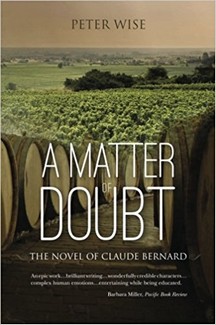
A biographical/historical novel of the life and work of France's greatest medical scientist.
A boy from the Beaujolais, Claude only wanted to write, but by default found himself as a pharmacy apprentice in 19th century Lyon. Inspired by Descartes, he used 'doubt' to probe the verity of pharmacy practice. He was disenchanted with what he found, covertly wrote his play - and got it produced. Now Paris would turn him into a star! A realistic drama critic deflected him towards medical studies, where he again challenged tradition - to his disadvantage. It needed an arranged marriage to get him the necessary finance to do research - and to find scientific truth.
We see the results of his hard work - one important discovery after another - and the unpleasant consequences of the challenges he threw down to his colleagues, his adversaries - and even his wife. His family would eventually almost disown him. Finally he reaches the stars and becomes internationally acknowledged. He even finds a beautiful - and helpful - soulmate, finishing his life with an intriguing enigma - his final challenge.
This is the factually precise life of a great man, a synthesis of his life and work, presented in the form of a biographical novel.
Excerpt
Fanny is furious.
“You’ve just got back from a holiday, Claude; and now you are to be away again?”
“I got back three months ago, actually; and this is different Fanny. You know that I am not well, and both Pierre and Casimir think that I need a complete break. I must follow their recommendation.”
“Can’t you take some medicine like everyone else?”
“You also know that I have tried that; both Casimir and Pierre have prescribed mixtures for me but they don’t seem to help.”
“Then, why don’t you ask my father? He seems to get people better again very quickly. Anyhow, why can’t we go away together – as a family? Other equally busy and successful people seem to manage it.”
Claude was silent and thoughtful, uncertain whether he should confront the situation now – as it would have to be confronted at some time. He takes a deep breath:
“You and I have a problem Fanny. No doubt you consider that it is all my fault, but I believe – and we have discussed this before – that we are simply unsuited to live with one another. You cannot seem to accept those aspects of my life and work which others appreciate, and I am simply not prepared to change them by....”
“….but you expect me to change my attitudes!”
“That is what I am trying to say; I do not expect you to. We discussed a possible separation before; I still believe that is what we should do.”
“And you want me, as a good Catholic to sustain the wrath of God – having supported you and your children over all these years? Just as you are at last allowing me to mix in socially acceptable circles, you wish to embarrass me by throwing me out. And then, what about the children?”
“Firstly, I am sure that you will find other women at Princess Mathilde’s salons who have been separated from their husbands – if those are the ‘socially acceptable circles’ to which you are referring. Fanny, you must also know that the likelihood of failure is greater in an arranged marriage such as ours. As far as the children are concerned, our incompatibility has not been helped by the fact that you have turned them against me. I find that so painful. My relationship with them might actually improve if we live apart.”
Fanny strikes the table at which they were sitting with both clenched fists.
“You are not going to break up a family for which I have suffered so much and worked so hard! Have you conveniently forgotten that it was my father’s money, my dowry that originally supported your grisly research – as well as sustaining your tiresome family in the wilds of France?
Suddenly she stands up, knocking her chair to the floor. “You may go to hell as far as I am concerned!”
Professional Reviews
A Matter of Doubt - the life of Claude Bernard
Title: A Matter of Doubt: The Life of Claude Bernard
Have you ever stared into a Renoir painting, seeing fashionable 19th century French women dressed in ornate gowns, with distinguished gentlemen in tailcoats and tall hats, crossing a damp and shiny cobblestone road with horse-drawn carriages in the background, umbrellas opened, wondering who were these people? It is very possible one of the men may have been Monsieur Claude Bernard.
Peter Wise has used words to the skill level of Pierre-Auguste Renoir‘s use of paint, creating a literary book embellishing a world, a period-piece, with complex human emotions, determination, drive and passion, along with respectful conversational French dialogue in his epic work A Matter of Doubt – the life of Claude Bernard. He has created a hybrid work of fiction based upon fact; a world in which novel relationships are verbosely explained pursuant to generally accepted historical encounters.
A Matter of Doubt articulates, from a third-person narrative view, the life of Claude Bernard and how he was heavily influenced in his logic and reason by René Descartes, the famous French philosopher who questioned “everything.” This led Descartes to become one of the key figures of the creation of what we call today the Scientific Method. Claude Bernard used the practice, not taking anything on face value, and performed blind-experimentation to support his medical research, thus becoming one of humanity’s most accomplished doctors shedding light on many aspects of the human condition of health and well-being. Although controversial even at the time, Claude Bernard used animal experimentation to an extreme, upsetting his wife and daughters, which ultimately led to a divorce; however being convinced the greater good to relieve humanity of disease, justified the use of vivisection.
A Matter of Doubt begins when Claude Bernard moved to Paris to study medicine as a young adult, working as a pharmacist to make ends meet while writing a play and dreaming about becoming a famous playwright. His dichotomy of interests, so eloquently portrayed by Peter Wise, captures the reader and draws one into the world of yesteryear, a time less complicated by the limits of technology, however as modern a group of people as those of us that live today. Peter Wise’s use of language, with his precision, coy remarks of the wonderfully credible characters, and significance of respectful interactions is unlike much of the mundane use of verbiage we read and use today. He truly pulls the reader back in time, like the Time Machine in the H. G. Wells classic, into the mid-1800’s, and drops you among the upper society in Paris, France, amidst famous people like Louis Pasteur.
When reading this book I was pleasantly transported away from modern day life and rewarded with gaining an intimate understanding of the strength of values, fortitude and determination of Claude Bernard, holding a higher appreciation for the medical breakthroughs he now is accredited as founding. The brilliance of Peter Wise’s writing skills are truly amazing, being so presumptuously respectful of the reader’s intelligence while still explaining the fundamentals of the factual evidence portrayed in the scientific medical work. Although a very sophisticated book, I would recommend this for young adults to read as an example of excellence in technique, as well as to the seasoned historical reader; or anyone for that matter, seeking entertainment while being educated. Having a background in French is helpful, as this book seamlessly jumps from French to English with phrases, names and most interestingly uses the thought patterns of the marvelous French culture in describing events. I believe this book is also available translated into French. C'est un très bon livre!
Autumn 1940. Germany invades Britain. Newport is blitzed. Danny O’Shea’s house is bombed, his wife is killed. While taking his young son Adam to neutral Ireland, they witness an attack on a German convoy. The result is brutal.
Fourth Book in the Southern Swallow Series finds the Academician Li K'ai-men in exile on Hai-nan Island. China has a new invasion threat. A showdown between ingenuity and technology explodes as the Sung Dynasty tries to preserve itself.